






Jordan Johnson, Founder and Principal at Bridge Oncology and Legal Data Expert, shared on LinkedIn:
“Is it really about access? Or have we been asking the wrong question all along?
For years, we’ve heard that radiation oncology has an “access-to-care” problem. The latest Red Journal study reinforces that narrative, citing 50 million Americans living in counties without a radiation oncology practice. But I believe the data tell a different story.
This isn’t primarily an access crisis. It’s the predictable outcome of a delivery model whose total cost of care has become economically unsustainable.
In my latest article, I challenge the assumption that counting counties without radiation oncology centers accurately measures access. (based on the new Red Journal Article). Instead, I explore how population density, payer mix, hypofractionation, capital investment, vendor pricing, and rising operational costs have driven the maldistribution of radiation oncology infrastructure.
The result? Community centers close, equipment ages without replacement, and capital migrates to markets where the economics still work.
If we continue treating symptoms through reimbursement changes or new payment models alone, we’ll continue getting the same outcome.
It’s time to stop asking where centers disappeared and start asking why they could no longer survive.
I also discuss why the future lies in redesigning the economics of cancer care around total cost of care, market density, and sustainable payment models – not simply increasing reimbursement.

Radiation Oncology Access?
Additional perspective: Beyond Geography: Why the Maldistribution of Radiation Oncology Infrastructure Is an Economic Problem, Not Simply an Access Problem
A Commentary on the Recent Red Journal Analysis of County-Level Radiation Oncology Practice Sites
Abstract
The recent Red Journal study reporting that approximately 50 million Americans reside in counties without a radiation oncology practice provides an important descriptive assessment of the changing geographic distribution of radiation oncology facilities in the United States. The study highlights a concerning trend in the disappearance of community-based radiation oncology practices and appropriately raises questions regarding access to cancer care. However, the central interpretation – that these findings primarily represent an access-to-care problem – does not fully explain the forces responsible for the observed changes.
Rather, the geographic maldistribution of radiation oncology infrastructure represents the downstream consequence of a delivery model whose total cost has become increasingly unsustainable over the past decade. Rising capital expenditures, increasing regulatory complexity, workforce shortages, expanding administrative requirements, evolving treatment paradigms, and changing payer economics have fundamentally altered the financial viability of community-based radiation oncology.
Consequently, facility closures and consolidation should be viewed primarily as an economic phenomenon rather than evidence of inadequate national treatment capacity. Future policy discussions should shift from simply identifying where radiation oncology facilities are located toward understanding the economic conditions necessary to sustain them.
Introduction
The publication of the recent Red Journal study examining county-level changes in radiation oncology practice sites has generated important discussion regarding the future of radiation oncology access in the United States. The finding that approximately 50 million Americans reside in counties without a radiation oncology clinic understandably raises concern regarding geographic availability of cancer treatment services. The study concludes that these findings represent an emerging access-to-care challenge requiring policy attention. While the descriptive data presented are valuable, the interpretation of those data warrants further examination.
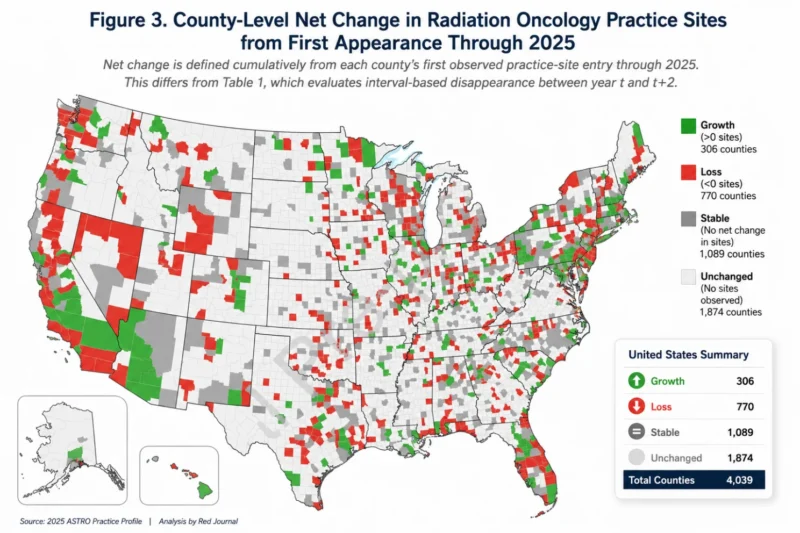
The study accurately documents where radiation oncology practices have disappeared. It does not fully explain why these changes have occurred. This distinction is not merely academic. Policy solutions are entirely dependent upon correctly identifying the underlying cause of the observed phenomenon. If geography is viewed as the primary problem, then policy interventions will naturally focus on increasing the number of treatment locations. If, however, geography is simply the visible manifestation of deeper economic forces, then meaningful solutions must instead address the structural financial challenges that increasingly determine where radiation oncology services can be sustained.
This commentary argues that the disappearance of community-based radiation oncology practices is not fundamentally an access problem. Rather, it reflects the predictable consequences of a delivery model whose total cost has steadily increased while the economics supporting that model have simultaneously deteriorated. The resulting geographic distribution is therefore better understood as a market response to economic sustainability than as evidence of inadequate national capacity.
The Study Measures Geographic Presence Rather Than Meaningful Access
One of the most significant methodological limitations of the Red Journal analysis is its reliance on county boundaries as the principal unit of measurement. Counties are administrative jurisdictions rather than functional healthcare markets, and they vary dramatically in population size, demographic composition, healthcare utilization, and cancer incidence. A rural county with fewer than 3,000 residents is evaluated identically to a rapidly growing suburban county containing several hundred thousand residents despite substantial differences in healthcare demand.
Consequently, the analysis implicitly assumes that the absence of a radiation oncology practice has equivalent implications across all counties, regardless of the population served.
More importantly, the study does not evaluate travel distance, drive-time accessibility, referral networks, or cross-county utilization patterns, all of which are widely recognized measures of healthcare access. The absence of a radiation oncology facility within a county does not necessarily indicate inadequate patient access if residents routinely receive care within reasonable travel times at neighboring facilities. Conversely, counties containing radiation oncology practices may still experience poor access because of treatment capacity limitations, socioeconomic barriers, workforce shortages, or insurance restrictions. Without incorporating these variables, the study measures geographic presence rather than meaningful patient access.
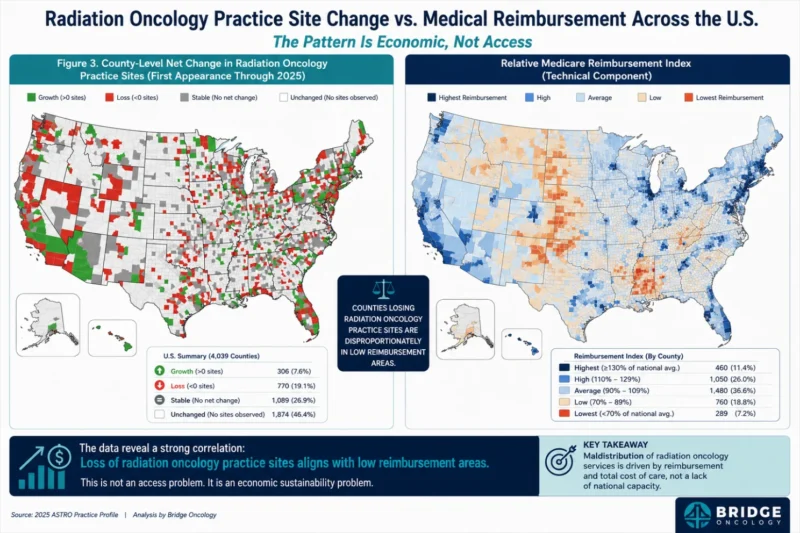
An equally important omission is the failure to account for population density. Healthcare infrastructure has never been distributed uniformly across geographic boundaries; rather, it has historically followed population demand. Evaluating counties without considering the number of people living within those counties risks overstating the significance of geographic gaps while understating the concentration of services in areas where most patients actually reside.
A county-based analysis also risks creating a false equivalency between vastly different geographies. Whether a county has a radiation oncology facility is relative to the size, density, and travel patterns of that county. San Bernardino County, California, contains more than 20,000 square miles but has a population density of only 108.7 people per square mile. By contrast, New York County, New York, has only 22.66 square miles of land area but a population density of 74,781.6 people per square mile. Loving County, Texas, contains 668.82 square miles with a density of only 0.1 people per square mile. These examples demonstrate why counting counties without accounting for land area and population density can distort the access discussion.
A ‘county without a radiation oncology clinic’ may represent a very different access issue in rural West Texas than in the Northeast, where counties are smaller, denser, and often adjacent to multiple treatment markets.
The more relevant question is not whether a county contains a radiation oncology practice, but how many patients live within a reasonable drive time of a functioning treatment facility, how many linear accelerators are available per cancer case, and whether those machines are located in markets where the financial model supports reinvestment. A stronger analysis would compare linear accelerator density against population density, cancer incidence, travel time, payer mix, median income, equipment age, and facility replacement cycles. That comparison would likely show that radiation oncology infrastructure is disproportionately concentrated not only in more densely populated areas, but also in markets with more favorable payer mixes and stronger capital capacity.
The Missing Economic Variables
Perhaps the greatest limitation of the study is the absence of economic variables that largely determine where radiation oncology infrastructure develops and where it disappears. Radiation oncology facilities are not distributed randomly across the United States. They are concentrated where long-term financial sustainability supports continued investment.
Markets with favorable commercial payer mixes, growing populations, strong referral networks, and higher operating margins are considerably more likely to attract capital investment than communities characterized by declining populations, higher Medicare and Medicaid dependence, limited commercial insurance penetration, workforce shortages, and constrained hospital finances. These economic realities directly influence an organization’s ability to recruit physicians, replace aging equipment, purchase new technology, maintain staffing levels, and continue providing services within a community.
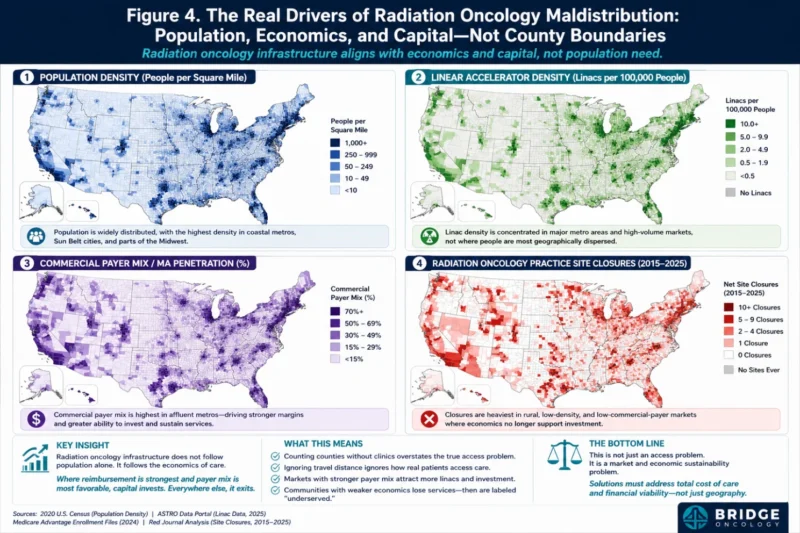
The county-level map presented in the study is therefore not simply a representation of healthcare access. It is also a visualization of capital allocation. It illustrates where healthcare organizations believe long-term investment remains financially sustainable under current reimbursement and operating conditions. Without incorporating variables such as payer mix, median household income, commercial insurance penetration, Medicare Advantage enrollment, hospital financial performance, equipment age, and workforce availability, the study risks attributing what is fundamentally an economic outcome to a geographic access problem.
A more informative analysis would compare the distribution of linear accelerators with population density, age-adjusted cancer incidence, drive-time accessibility, commercial payer mix, socioeconomic status, projected demographic growth, and hospital financial performance. Such an analysis would likely demonstrate that radiation oncology infrastructure increasingly concentrates in densely populated metropolitan markets with favorable commercial payer mixes while communities with older populations, higher Medicaid penetration, lower household incomes, and rural geography experience progressive disinvestment. This distinction fundamentally changes the policy discussion because it shifts the focus from access to market economics.
The Hidden Story Behind the Map
The geographic pattern illustrated by the Red Journal study did not emerge suddenly. It represents the culmination of economic forces that have been developing for well over a decade.
For many years, radiation oncology operated within a volume-based treatment model in which patients routinely received 35 to 45 fractions of radiation therapy. This environment supported substantial investment in linear accelerators, treatment planning systems, imaging technology, facilities, software platforms, and specialized personnel. The business model appeared sustainable because treatment volumes and reimbursement levels generated sufficient operating margins to support continual reinvestment in technology and infrastructure.
Clinical science subsequently evolved. Hypofractionation became the standard of care for numerous disease sites because it provides equivalent – and in many cases superior – clinical outcomes while reducing treatment burden for patients and lowering overall healthcare costs. From a clinical perspective, this represents one of the most significant advances in modern radiation oncology.
Economically, however, the industry failed to evolve alongside the science.
The reduction in treatment fractions was never accompanied by a proportional reduction in the cost of delivering radiation oncology care. Capital equipment continued becoming more expensive. Annual service contracts increased. Software licensing expanded. Regulatory compliance became more complex. Cybersecurity emerged as a major operational expense. Staffing shortages increased labor costs. Prior authorization requirements evolved into permanent administrative infrastructure requiring dedicated personnel and technology. Vendors continued pricing products within an economic model built around historical treatment volumes rather than the realities of modern radiation oncology practice.
As reimbursement gradually declined while fixed operating costs remained elevated, many community-based radiation oncology programs entered prolonged periods of financial stagnation. Rather than generating sufficient margin to support routine capital replacement, numerous organizations simply generated enough revenue to maintain ongoing operations. Linear accelerators remained in service well beyond their intended replacement cycles. Capital investments were deferred. Modernization projects were postponed. Ultimately, many organizations adopted a strategy of operating aging equipment until end-of-life without sufficient financial capacity – or intention – to replace it.
The resulting pattern of facility closures and consolidation was entirely predictable. Once aging equipment required replacement, many organizations determined that continued investment could no longer be economically justified. Community practices closed, independent groups consolidated, and services migrated toward larger metropolitan health systems capable of distributing fixed costs across multiple facilities. What now appears as a geographic access problem is, in reality, the downstream consequence of a delivery model whose cost structure never adjusted to the modern practice of radiation oncology.
Total Cost of Care Is the Fundamental Challenge
For more than a decade, discussions surrounding radiation oncology policy have focused primarily on reimbursement. Questions regarding Medicare payment reductions, commercial payer denials, and alternative payment models have dominated policy conversations. While reimbursement undoubtedly influences financial performance, it is not the fundamental determinant of sustainability. Rather, reimbursement functions as an indicator of whether the underlying delivery model remains economically viable.
The more important question is why the cost of delivering radiation oncology has increased so dramatically.
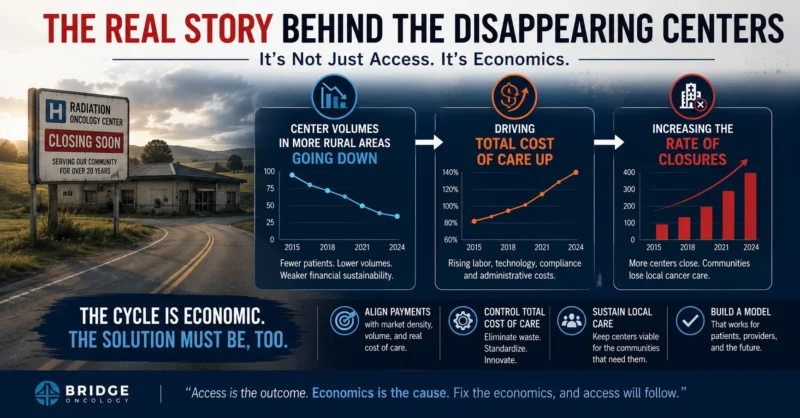
Operational assessments conducted across community hospitals, academic medical centers, and independent practices consistently demonstrate that hidden operational costs increasingly determine long-term financial viability. Fragmented software systems, duplicate documentation, manual revenue cycle processes, redundant staffing structures, disconnected workflows, administrative complexity, inefficient scheduling, payer management requirements, and expanding compliance obligations collectively increase the cost of delivering every episode of care. These expenses rarely receive the same policy attention as reimbursement rates, yet they frequently determine whether community-based programs remain financially sustainable.
The issue, therefore, is not simply what providers are paid. The issue is why the total cost of delivering radiation oncology has continued to increase while the clinical model has simultaneously become more efficient.
Redesigning the Delivery Model
If the underlying challenge is economic rather than geographic, then the solution extends beyond increasing reimbursement or constructing additional treatment facilities. The long-term sustainability of radiation oncology depends upon fundamentally redesigning the delivery model to reduce the total cost of care while maintaining or improving clinical quality.
Artificial intelligence should reduce administrative burden rather than create additional layers of software complexity. Automation should replace manual documentation and revenue cycle processes. Cloud-based treatment planning should reduce infrastructure costs. Direct Virtual Supervision should improve workforce utilization. Enterprise physics models should maximize limited professional resources. Workflow standardization, integrated digital platforms, and intelligent scheduling should eliminate unnecessary operational variation while improving efficiency across the continuum of care.
The central policy question should therefore become whether new technologies and operational models reduce the total cost of delivering high-quality radiation oncology rather than simply adding new expense to an already strained delivery system.
ROCR is not the solution to this problem. At best, ROCR treats another symptom of the same underlying disease. A reimbursement threshold or episode-based payment model may temporarily stabilize selected practices, but it does not fundamentally lower the total cost of care. If the operating cost of radiation oncology continues to rise, the delivery system will eventually expand to meet or exceed whatever reimbursement threshold is created. Without cost discipline, payment reform simply resets the pressure gauge.
The actual cure would be cost control. True caps on vendor pricing, service contracts, software costs, and administrative burden would directly address the cost side of the equation, but broad caps are unlikely to occur in the current healthcare market. The more practical fix is a payment model that recognizes that radiation oncology is not economically identical across geography, density, payer mix, volume, and capital need.
This is where Barbara McAneny’s model and Bridge Oncology’s work point toward a better solution. Payments should be tied to the real-world economics of care delivery: market density, rurality, treatment volume, equipment age, payer mix, and the minimum infrastructure necessary to safely maintain local radiation oncology access. A low-volume rural program cannot be evaluated under the same economics as a high-volume metropolitan center. Sustainable radiation oncology policy must account for where care is delivered, who is being treated, what volume is realistically available, and what it costs to maintain safe infrastructure in that market.
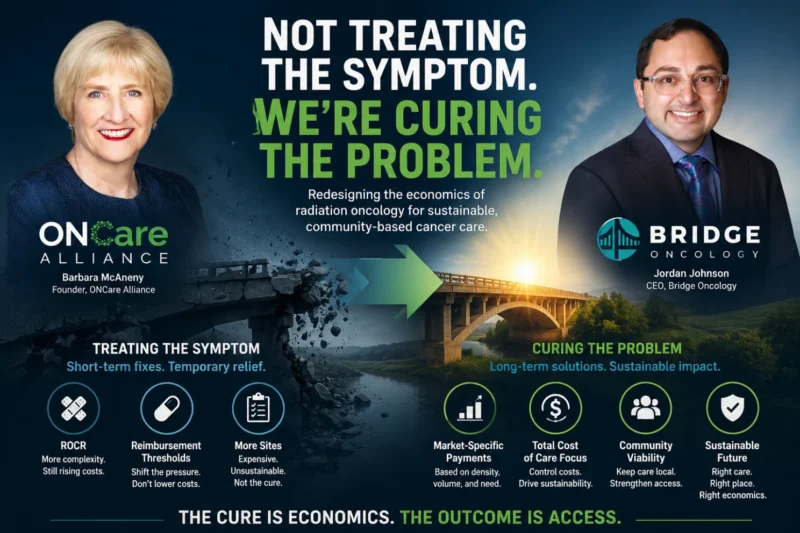
The fix is not more access rhetoric. The fix is redesigning the economics around total cost of care, capital replacement, and market-specific sustainability.
Conclusion
The Red Journal study provides valuable descriptive information regarding changes in the geographic distribution of radiation oncology practice sites throughout the United States. However, interpreting these findings primarily as an access-to-care problem overlooks the broader economic forces that have fundamentally reshaped the specialty over the past decade
The disappearance of community-based radiation oncology programs is not principally the result of insufficient national capacity. Rather, it reflects the cumulative effects of rising operational costs, increasing regulatory complexity, evolving clinical practice, changing payer economics, and a delivery model whose financial assumptions no longer align with contemporary radiation oncology. The geographic patterns observed in the study are therefore better understood as a map of economic sustainability than a map of healthcare access
Future research should move beyond simple geographic inventories of facilities and instead incorporate variables that explain why capital continues to flow into some markets while steadily leaving others. Population density, cancer incidence, travel time, payer mix, equipment age, workforce availability, hospital financial performance, and total cost of care should all become central components of future analyses. Only by understanding these underlying economic drivers can policymakers develop sustainable solutions that preserve community-based radiation oncology without merely treating the visible symptoms of a much larger structural problem.”
Other articles on OncoDaily.