Jayant K. Rane, Clinical Oncologist at University College London Hospitals NHS Foundation Trust, shared a post on LinkedIn:
“Early onset cancers are rising. EOCRC is the clearest signal. Most people (including me) now know someone younger than 50 years of age, who has died due to cancer.
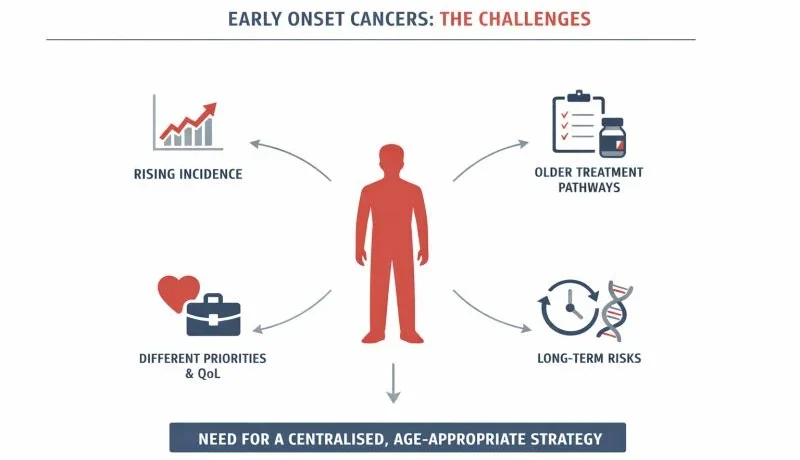
Incidence is climbing:
Across multiple regions, cancers diagnosed under 50 are increasing, with early-onset colorectal cancer (EOCRC) one of the most consistent trends.
We’re extrapolating care from older cohorts
Most pathways and evidence have been built around late-onset disease. Early onset cancer patients are still commonly managed with non age-specific guidelines, despite signals of distinct presentation and unmet needs.
Being fitter doesn’t automatically translate to better outcomes
Early onset cancer often presents at a more advanced stage, and real-world data show persistent excess mortality over time, narrowing any ‘young age advantage’.
Priorities differ at 25–49
Work, fertility, relationships, parenting, body image and financial toxicity can dominate decision-making, yet QoL evidence and measurement are often not tailored to this life-stage.
Survivorship is longer and more complex
If cured, patients may live decades with risks of late recurrence, second primaries, and treatment sequelae, demanding more deliberate long-term strategy.
*What’s needed*: a centralised, age-attuned approach that integrates prevention and early diagnosis, age-stratified trials, fit-for-purpose PROs, and structured survivorship. And more. I would be keen to hear ideas around this.”