Jason A. Mouabbi, Assistant Professor of Breast Medical Oncology at The University of Texas MD Anderson Cancer Center, shared on LinkedIn:
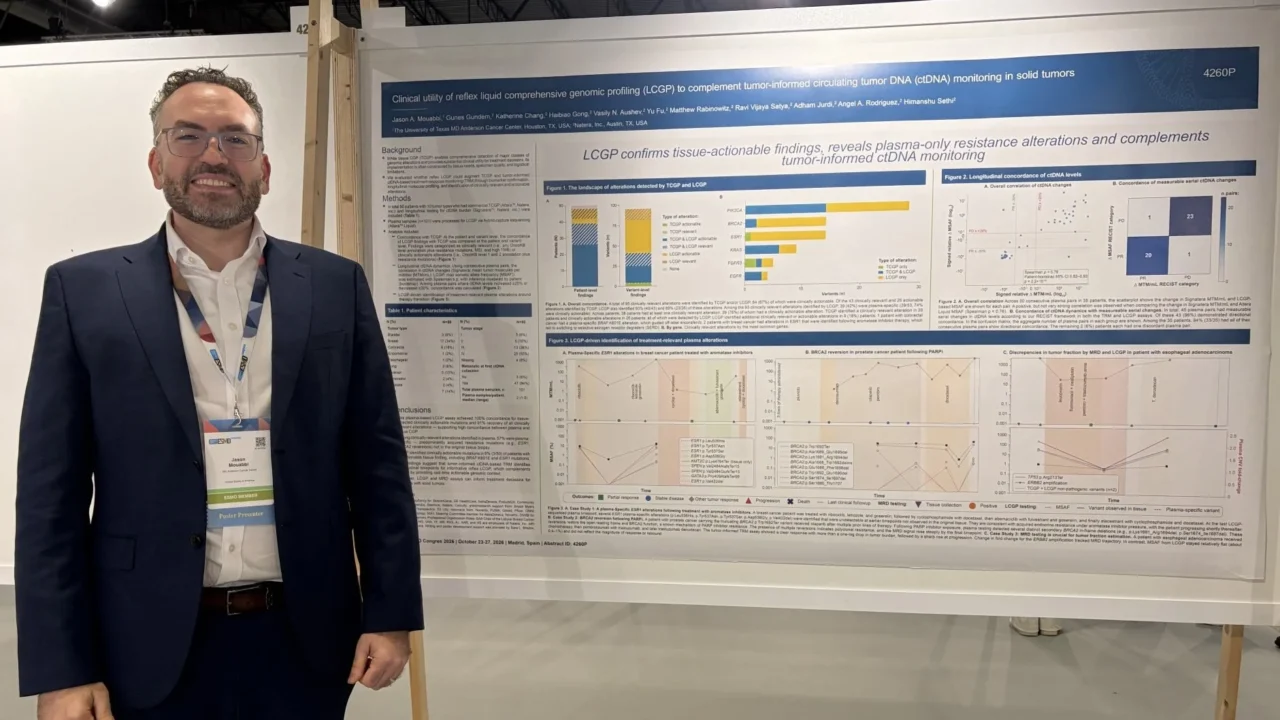
“Excited to share our ESMO26 poster 4260P.
We asked: can reflex liquid NGS add to tissue NGS and tumor-informed ctDNA monitoring?
50 patients, 10 tumor types (34% breast), 101 plasma samples. Tissue NGS (Altera) plus serial ctDNA (Signatera) plus reflex liquid NGS.
Concordance: every patient with a tissue-actionable alteration (26/26) had it found in plasma too.
Plasma added value: new relevant or actionable alterations in ~20% of patients. Mostly acquired resistance:
- ESR1 after AI (switched to a SERD)
- BRCA2 reversions after PARPi
- Plus a plasma-only BRAF K601E that guided encorafenib.
Tracking: across 45 measurable plasma pairs, the two assays moved in the same direction 96% of the time (ρ = 0.76).
But they’re NOT interchangeable. In an esophageal case on T-DXd, tumor-informed ctDNA showed a >1-log drop and a sharp rebound, while liquid NGS allele fraction barely moved.
Takeaway: tumor-informed ctDNA tells you ‘when’ to look, and liquid NGS tells you ‘what’ changed. Together they can guide real-time treatment decisions.
Grateful to my coauthors Natera Oncology / Natera
Come by poster 4260P!”
You can also read: 20 Posts Not to Miss from ESMO Congress 2026: Day 1