
James Fan Wu, Hematology Oncology Fellow at Medical College of Wisconsin, shared on LinkedIn:
“Lung cancer screening still reaches a small share of the people eligible for it. Several abstracts at this week’s American Society of Clinical Oncology (ASCO) Quality Care Symposium look at why.
In PATHFINDER 2, a trial of a multi-cancer blood test, 1,517 participants were eligible for low-dose CT screening. 15% were up to date at enrollment and 20% a year later, in a group motivated enough to volunteer for a trial (Abstract 674).
Other abstracts show where the losses happen, and what helps:
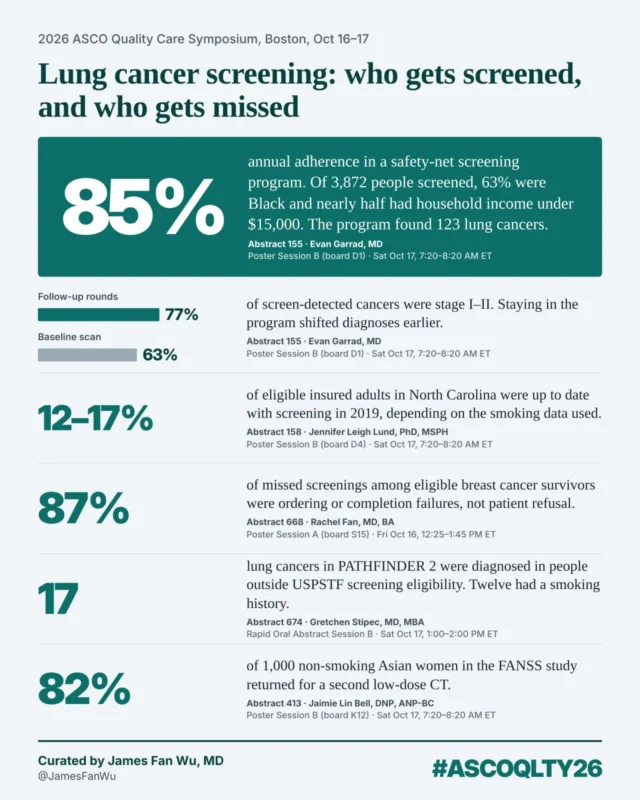
- Among eligible breast cancer survivors, 87% of missed screenings were never ordered or never completed. Few were refusals. (Abstract 668)
- Electronic records missed about a third of people who were eligible by their own report. (Abstract 687)
- A safety-net program serving mostly Black and Hispanic patients, nearly half with household income under $15,000, reports 85% annual adherence. (Abstract 155)
- In North Carolina, the share of eligible adults screened is 12% or 17% depending on which smoking data you use. (Abstract 158)
How I read this a researcher studying lung cancer epidemiology the bottleneck is not patient willingness. It is identification and follow-through. We don’t reliably know who is eligible, so we can’t measure uptake well or act on it. The safety-net result suggests that when a program is built for its population, adherence follows.
Risk-based eligibility (Abstract 22) and screening for people who never smoked (Abstract 413) are the next debates. Both depend on better smoking and risk data than most health systems have today.
What has worked in your program?”
You can also read: ASCO and WHO Sign Agreement to Expand Access to Quality Cancer Care Worldwide.