






Ivy Riano, Medical Oncologist at Dartmouth Hitchcock Medical Center and Clinics and Assistant Professor at Geisel School of Medicine at Dartmouth, shared Chad Markey’s, Incoming Psychiatry Resident Physician at Columbia University Irving Medical Center, post on LinkedIn, adding:
“Excited to see the hard work done by Chad Markey.
In >100 patients undergoing CAR-T/BiTE therapy at Dartmouth Health, pre-existing mental health disorders were associated with significantly Lower odds of CRS – up to an 82% reduction in SCLC patients treated with tarlatamab (OR 0.18).
Anti-tumor efficacy was preserved. These findings highlight a potentially underappreciated psychoneuroimmunology component of IEC toxicity biology and support prospective study of the stress-immune axis in immunotherapy.”
Quoting Chad Markey’s post:
“Happy to share our exciting new abstract, now published in Journal of Clinical Oncology, for the upcoming 2026 American Society of Clinical Oncology (ASCO) Annual Meeting!
What happens to the toxicity profile when those with pre-existing mental health disorders (MHD), treated or not, pursue immune effector cell therapy like CAR-T or BiTE?
We found an interesting pattern, that was consistent and hard to ignore, that those with MHD have substantially Lower odds of cytokine release syndrome (CRS). In fact, in an extra subgroup analysis of small cell lung cancer patients receiving bi-specific Tarlatamab, those with MHD had an 82% reduction in CRS odds (OR 0.18; P=0.038; 95% CI 0.03–0.91). This was also independent of the use of psychopharmacology.
Critically, anti-tumor efficacy was preserved: there was no significant difference in overall treatment outcomes between those with MHD and those without. Our data set was +100 patients spanning a 5-year period at Dartmouth Health Cancer Center.
We speculate that the stress-immune axis and neuro-inflammatory states in psychiatric illness are underappreciated in IEC biology. This prompts me to think and question, mechanistically, what baseline immune tone looks like in this patient population, how it shapes immunotoxicity risk stratification, and strongly suggests psychiatric screening at baseline and longitudinal monitoring through treatment to understand the entire treatment course.
Prospective validation is needed, but I think psychoneuroimmunology deserves a seat at the IEC toxicity table.
Our manuscript is soon to follow.”
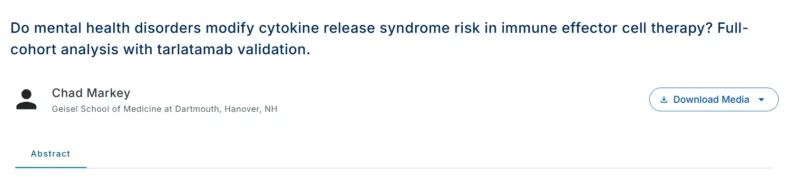
Title: Do mental health disorders modify cytokine release syndrome risk in immune effector cell therapy? Full-cohort analysis with tarlatamab validation
Author: Chad Markey
Other articles featuring Ivy Riano and Chad Markey on OncoDaily.