






Recently, oncologist and researcher Paolo Tarantino, a Research Fellow at the Dana-Farber Cancer Institute and Harvard Medical School, commented on the retraction of one of the most discussed oncology papers of recent years. The study had suggested that administering immunochemotherapy in the early morning improved outcomes for patients with non-small cell lung cancer. However, following concerns about data integrity, the article was retracted, raising important questions about scientific rigor, peer review, and the role of chronotherapy in cancer treatment.
“BREAKING: The most controversial article of the year, claiming that early morning immunotherapy works better than in the afternoon, is now retracted.
After reading the responses provided by the authors to the inconsistencies raised in the web, the Nature Medicine editors no longer have confidence in the integrity of the results. The only prospective evidence that time-of-day matters for immunotherapy is now gone.
To me, this means (at least) two things.
First, it confirms that prudence on this topic was and remains critical. For as inexpensive it may be to give a drug earlier or later in the day, it carries a much more relevant cost: the one of scientific integrity. We owe our patients to make decisions based on solid data. We should not give up this practice too easily, particularly in the presence of several concerning red flags.
Second, this retraction should also prompt a broader reflection on the current state of peer review, in which unpaid reviewers struggle to keep up with a steady rise in submitted papers. Journals need to improve the process by implementing a formal, consistent, in-depth review of each paper by paid professionals. A practice that, in this case, may have avoided a retraction arriving after 22 citations and after inclusion of this study in at least one meta-analysis. And possibly, after some physicians had already changed their practice in IO administration.
For a thoughtful recap of this story, I recommend this well-written new piece in Science Magazine by Laura Agudelo. I’m grateful to Laura for including my perspective in the article.”
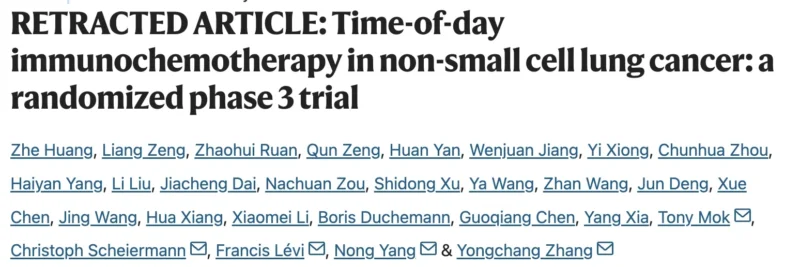
Title: RETRACTED ARTICLE: Time-of-day immunochemotherapy in non-small cell lung cancer: a randomized phase 3 trial
Authors: Zhe Huang, Liang Zeng, Zhaohui Ruan, Qun Zeng, Huan Yan, Wenjuan Jiang, Yi Xiong, Chunhua Zhou, Haiyan Yang, Li Liu, Jiacheng Dai, Nachuan Zou, Shidong Xu, Ya Wang, Zhan Wang, Jun Deng, Xue Chen, Jing Wang, Hua Xiang, Xiaomei Li, Boris Duchemann, Guoqiang Chen, Yang Xia, Tony Mok, Christoph Scheiermann, Francis Lévi, Nong Yang, Yongchang Zhang
Read the article here.
Jon Wigginton, President of Research and Development at Bright Peak Therapeutics, reflected on both the promise and the uncertainty surrounding the findings:
”The LungTIME-C01 Phase 3 study previously reported exciting hypothesis-generating data published in Nature Medicine suggesting that timing of CPI treatment during the day (early vs late) was significant with respect to efficacy outcomes including PFS and OS in patients with lung cancer.
With further evaluation, and a several month investigation, the paper has now been retracted by Nature. Justified it appears, but unfortunate situation. Wonder if there will be a mechanism to evaluate if ‘there is there there’ with respect to these observations in the future.”
Daniel Brickman, Clinical Development Strategy Leader and Founder of Illuminate Biotech Consulting, commented on the retraction and its implications for the field:
“This retracted study was the only randomized time-of-day study supporting the claim that morning administration of cancer immunotherapy leads to better survival. The supporting evidence is now restricted to pre-clinical studies and non-randomized clinical evidence.
Without any randomized evidence supporting the claim that time-of-day administration influences cancer immunotherapy efficacy, potential confounds cannot be ruled out as an explanation for the retrospective results.
There are multiple on-going randomized time-of-day studies now. We look forward to the results of these studies.
This outcome is a good reminder of the importance of critical assessment not just by peer reviewers but by the scientific community as a whole.”
Nieves Martinez Lago, Specialist in the Field (FEA) of Medical Oncology at University Hospital Complex of Santiago de Compostela, wrote:
“And that’s all, folks…
The phase III trial on time-of-day immunochemotherapy in NSCLC, published earlier this year in Nature Medicine, has now been officially retracted.”
Vera Ghali, Medical Doctor Pediatrics, Allergy and Immunology, Member of the Lebanese Order of Physicians and Lebanese Pediatric Society, wrote:
“Retracted article!
A controversial article, ‘Time-of-day immunochemotherapy in Non-Small cell lung cancer:a randomized phase 3 trial‘ published on February 2, 2026, in Nature Medicine was retracted after investigations showed substantial undocumented alterations in design without the authors citing errors, and consequently, proved to be a fraudulent study.”
Alfredo Addeo, Head of the Oncology Department at University Hospitals of Geneva, wrote:
“The randomized phase III trial evaluating time-of-day in NSCLC has been retracted due to major concerns regarding trial registration, protocol inconsistencies, and data integrity. This should not discourage researchers working on chronotherapy. The question remains important, but it deserves answers generated through rigorous, transparent, and reproducible science.”
Other artices about Immunotherapy on OncoDaily.