






Imad Karam, Hematology and Oncology Chief Fellow at SUNY Downstate College of Medicine, shared a post on LinkedIn:
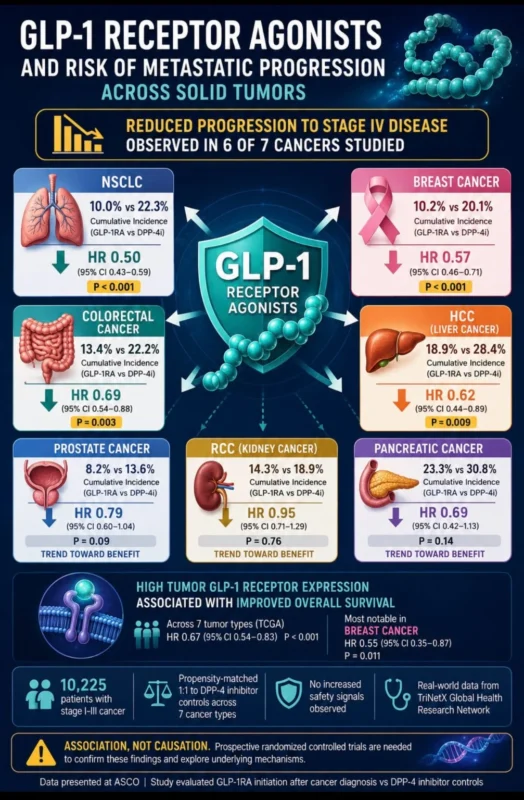
“A fascinating analysis presented at ASCO explored the association between GLP-1 receptor agonists (GLP-1RAs) and progression to metastatic disease across multiple solid tumors.
Using the TriNetX Global Health Research Network, investigators evaluated over 10,000 patients with stage I–III cancers who initiated a GLP-1RA after diagnosis and compared them with propensity-matched DPP-4 inhibitor controls.
Key findings:
- NSCLC:
- Metastatic progression: 10.0% vs 22.3%
- HR 0.50 (50% relative risk reduction)
- Breast Cancer:
- Metastatic progression: 10.2% vs 20.1%
- HR 0.57
- Colorectal Cancer:
- Metastatic progression: 13.4% vs 22.2%
- HR 0.69
- Hepatocellular Carcinoma:
- Metastatic progression: 18.9% vs 28.4%
- HR 0.62
Additional signals suggested benefit in prostate, RCC, and pancreatic cancer, although these did not reach statistical significance.
Interestingly, higher tumor GLP-1 receptor expression was also associated with improved overall survival across the analyzed tumor types.
Important caveat:
This was a retrospective propensity-matched analysis and cannot establish causation. However, the consistency of the signal across multiple cancers raises intriguing questions regarding the potential immunometabolic and antineoplastic effects of GLP-1 receptor signaling.”
Other articles featuring Imad Karam on OncoDaily.