






Hung Trinh, Senior VP of Operations at Seneca Therapeutics, shared a post on LinkedIn about a recent article by Benjamin L. Musher et al. published in Nature Medicine:
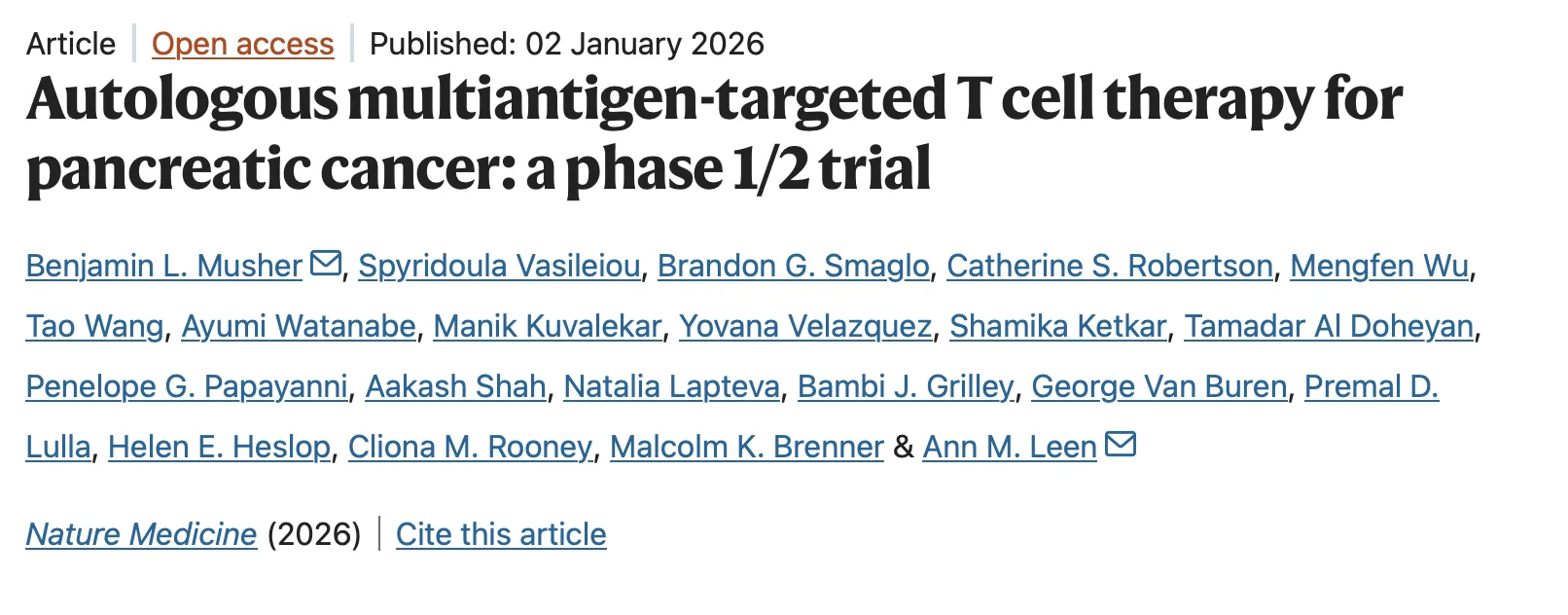
“Autologous multiantigen-targeted T cell therapy for pancreatic cancer: a phase 1/2 trial
T cell therapy has proven challenging for pancreatic ductal adenocarcinoma (PDAC), partly due to heterogeneous expression of tumor-associated antigens (TAAs). To address tumor heterogeneity and mitigate immune evasion, an ex vivo expanded, polyclonal, T helper 1 cell-polarized T cell product targeting five TAAs—PRAME, SSX2, MAGEA4, Survivin and NY-ESO-1—was developed.
These antigens were chosen based on their tumor specificity, oncogenicity, immunogenicity and level of expression. In a phase 1/2 trial, this autologous nonengineered T cell product was administered (1 × 10⁷ cells m−2 per infusion) monthly to patients with advanced PDAC responding (arm A, n = 13) or refractory (arm B, n = 12) to first-line chemotherapy or with resectable disease (arm C, n = 12).
Primary endpoints were safety and feasibility of completing six infusions, whereas exploratory efficacy endpoints included persistence and evaluating the relationship between clinical benefit and the expansion of the infused effector T cells, as well as the induction of de novo immune responses. Of 56 participants procured, 37 were infused, with only 1 treatment-related serious adverse event. Disease control rates in arms A and B were 84.6% (95% confidence interval: 54.6–98.1%) and 25% (95% confidence interval: 5.5–57.2%), respectively.
In arm C, two of nine resected participants remained disease free after 66 months of follow-up. The infused cells persisted up to 12 months posttreatment and elevated levels of tumor-directed T cells were detected during dosing (P = 0.027) and follow-up in responders compared to nonresponders. Clinical outcomes correlated with peripheral expansion of functional TAA-targeted T cell clones and treatment-emergent antigen spreading. Thus, further investigation of this approach, either as a single agent or combined with other complementary modalities, is warranted.”
Title: Autologous multiantigen-targeted T cell therapy for pancreatic cancer: a phase 1/2 trial
Authors: Benjamin L. Musher, Spyridoula Vasileiou, Brandon G. Smaglo, Catherine S. Robertson, Mengfen Wu, Tao Wang, Ayumi Watanabe, Manik Kuvalekar, Yovana Velazquez, Shamika Ketkar, Tamadar Al Doheyan, Penelope G. Papayanni, Aakash Shah, Natalia Lapteva, Bambi J. Grilley, George Van Buren, Premal D. Lulla, Helen E. Heslop, Cliona M. Rooney, Malcolm K. Brenner, Ann M. Leen
Read the Full Article on Nature Medicine
More posts featuring Hung Trinh.