Hannah Levy, Scientific Intelligence Analyst and Global Moderator at MedNews Week, shared a post on LinkedIn:
“In drug development, solving the biology is often only half of the equation.
Many promising therapies fail not because the mechanism is weak, but because delivery, exposure, or tolerability break down in development.
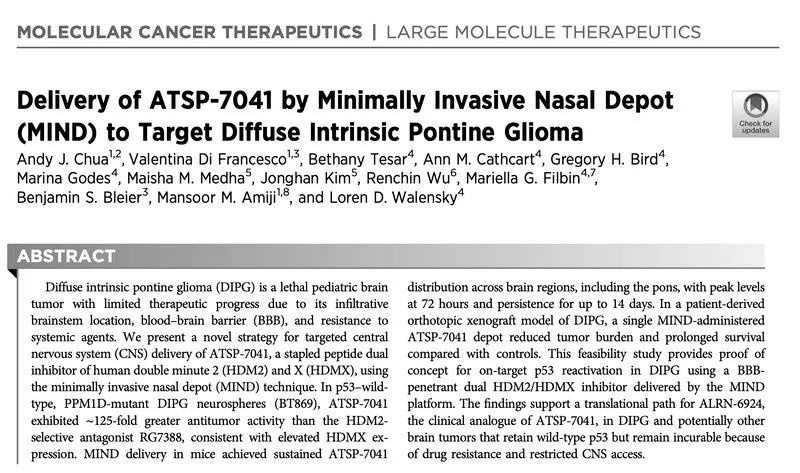
A recent paper applying a p53-reactivating stapled peptide platform to Diffuse Intrinsic Pontine Glioma reinforced that point. Strong biology was paired with a CNS delivery strategy designed to overcome the blood-brain barrier.
That’s what makes translation so challenging: identifying compelling science is only the start. The harder task is converting it into something clinically and commercially viable.
Success requires more than mechanism alone – it takes smart development strategy, patient selection, operational execution, and a realistic path to approval.
That intersection of science, strategy, and execution is where I’m most motivated – and where I’m looking to contribute next.
For anyone interested, here’s the paper that prompted this reflection – an interesting example of pairing strong biology with a CNS delivery strategy in DIPG.”
Title: Delivery of ATSP-7041 by Minimally Invasive Nasal Depot (MIND) to Target Diffuse Intrinsic Pontine Glioma
Authors: Andy J. Chua, Valentina Di Francesco, Bethany Tesar, Ann Cathcart, Gregory Bird, Marina Godes, Maisha Medha, Jonghan Kim, Renchin Wu, Mariella Filbin, Benjamin Bleier, Mansoor Amiji, Loren Walensky
Read the Full Article.