






Gustavo Monnerat, Deputy Editor at The Lancet, shared a post on LinkedIn:
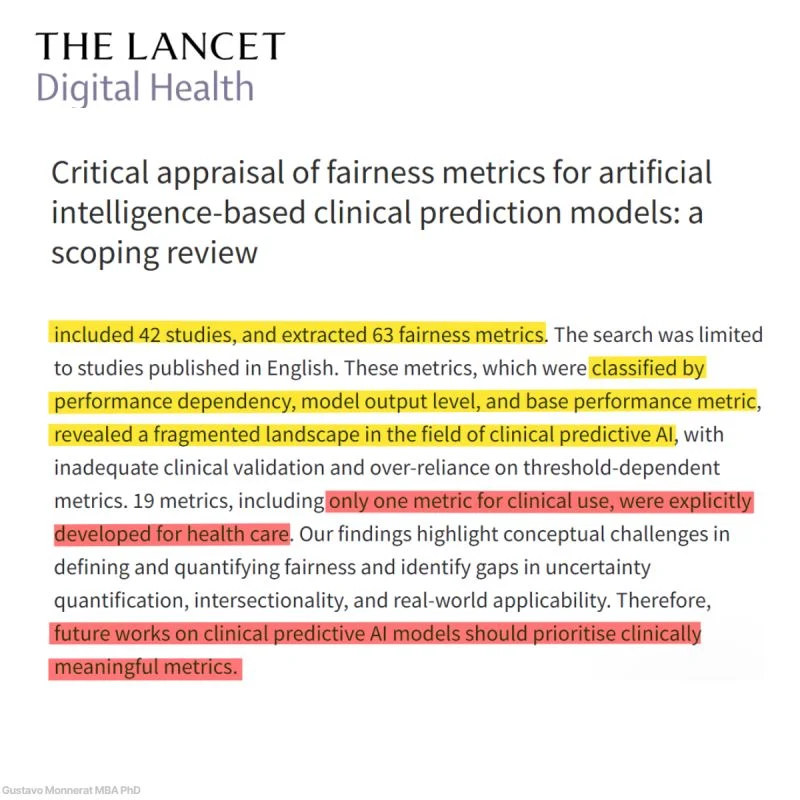
“63 ways to measure clinical AI fairness. Only 1 focused on clinical utility.
Predictive AI is moving into clinics fast, but the field still can’t agree on what a ‘fair’ model even means, and that definition might shape whether these tools narrow health gaps or widen them.
A new Lancet Digital Health scoping review screened 820 records, included 42 studies, and identified 63 distinct fairness metrics for clinical prediction models.
- Only 19 of the 63 metrics were built for healthcare, and just one (subgroup net benefit) measures whether decisions actually help or harm patients.
- 48 of 63 metrics depend on model performance and 33 of 63 hinge on an often-arbitrary decision threshold.
Equalizing metrics across groups does not necessarily improve fairness. The authors push for a different goal: a minimum acceptable performance for every group, tied to patient outcomes. Worth noting this is a qualitative review, English-only articles.
What evidence would you require before calling a clinical AI model ‘fair enough’ for practice?”
Title: Critical appraisal of fairness metrics for artificial intelligence-based clinical prediction models: a scoping review
Authors: João Matos, Ben Van Calster, Leo Anthony Celi, Paula Dhiman, Judy Wawira Gichoya, Richard D. Riley, Chris Russell, Sara Khalid, Gary S. Collins
Read the Full Article.
Other articles featuring Gustavo Monnerat on OncoDaily.