






Giuseppe Banna, Consultant Medical Oncologist at Portsmouth Hospitals University NHS Trust, shared International Urology Cancer Summit post on LinkedIn, adding:
“The CISTO study provides much – needed clarity on the “cost” of bladder preservation versus the “investment” of radical surgery.
The parity in 12 – month physical function is a powerful argument for radical cystectomy in high – risk patients, especially when balanced against the psychological and financial toll of chronic recurrence anxiety.
I look forward to debating these recovery trajectories and their impact on clinical decision – making with my colleagues at IUCS26.”
Quoting International Urology Cancer Summit‘s post:
“IUCS Journal Club Series: The CISTO Study – 12 – Month Results
The management of high – grade NMIBC after BCG failure remains a critical decision point in urologic oncology. We are analyzing the landmark 12 – month results of the CISTO Study (Comparison of Intravesical Therapy and Surgery as Treatment Options), recently published in the Journal of Clinical Oncology
This pragmatic study provides essential data on the tradeoff between Radical Cystectomy (RC) and Bladder – Sparing Therapy (BST) in a real – world setting.
Key Scientific Takeaways:
- Functional Recovery: While RC causes an acute decline in physical function at 3 months, patients reach parity with BST by month 12 (ATE 0.9; p = .22). Initial surgical morbidity does not dictate long – term functional impairment.
- Oncologic Benchmark: RC remains the gold standard for cancer control, demonstrating a 92% recurrence – free survival rate compared to 64% for BST at one year.
- Mental Health & Financial Toxicity: RC was associated with superior emotional health and lower financial burden at 12 months, likely due to reduced anxiety over continuous surveillance and recurrence. BST showed better scores in bowel and sexual health.
- The IUCS Perspective: These data challenge the assumption that organ preservation is the only path to maintaining quality of life. For high – risk patients, the oncologic security of RC offers a unique form of psychological and financial stabilization.
As we look toward IUCS 2026, and to discuss these topics with Jeremy Teoh, Prof Param Mariappan, Syed Hussain, Petros Grivas, Darren Poon, Vadim Koshkin, Giuseppe Banna and Ravindran Kanesvaran the CISTO findings will be pivotal in refining treatment algorithms and patient counseling for NMIBC.
Read the full study here
Congratulations to the authors and the JCO editorial team for this significant contribution to the field.
Special thanks to the leads of the CISTO Collaborative: John Gore, MD and Angie Smith.”
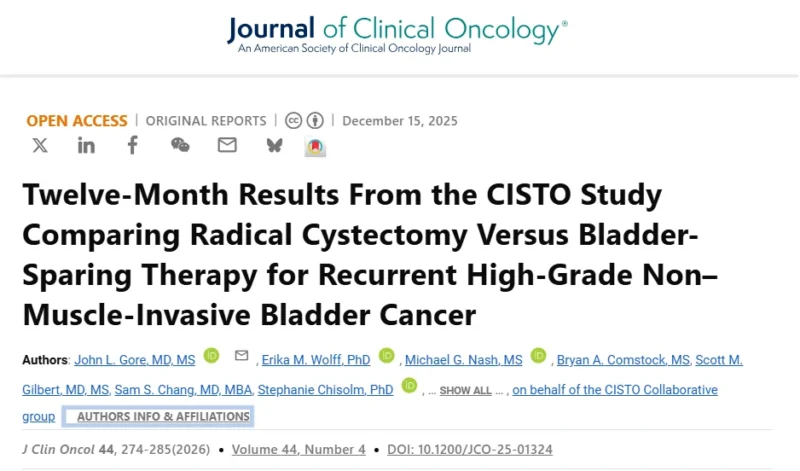
Title: Twelve-Month Results From the CISTO Study Comparing Radical Cystectomy Versus Bladder-Sparing Therapy for Recurrent High-Grade Non–Muscle-Invasive Bladder Cancer
Authors: John L. Gore, Erika M. Wolff, Michael G. Nash, Bryan A. Comstock, Scott M. Gilbert, Sam S. Chang, Stephanie Chisolm, Douglas B. MacLean, Jonathan L. Wright, Max R. Kates, Kamal S. Pohar, Thomas J. Guzzo, Trinity J. Bivalacqua, Kenneth G. Nepple, Jeffrey S. Montgomery, Kristen R. Scarpato, Solomon L. Woldu, Viraj A. Master, David Y.T. Chen, Matthew Mossanen, Siamak Daneshmand, Brock B. O’Neil, Mark D. Tyson, Mary E. Westerman, Ashish M. Kamat, Ahmed M. Mansour, Karim Chamie, Stephen B. Riggs, Janet B. Kukreja, Parth K. Modi, Tullika Garg, Charles C. Peyton, Jeffrey W. Nix, Rian Dickstein, Adam J. Gadzinski, Alex Sankin, Neal D. Shore, Brian R. Lane, Jeffrey C. Bassett, Sanjay Patel, David S. Morris, Liam C. Macleod, Eugene K. Lee, Chad R. Ritch, Kristin M. Follmer, Jenney R. Lee, Sung Min Kim, Larry G. Kessler and Angela B. Smith.
More posts featuring Giuseppe Banna and International Urology Cancer Summit