






Gilberto Lopes, Chief of the Division of Medical Oncology at the Sylvester Comprehensive Cancer Center, shared a post on X:
“Alright. It’s Sunday at ASCO.
Everyone awake and alert?
The trial I most wanted to see – NHS-Galleri at ASCO 2626 (Swanton, LBA100): the first randomized trial of an MCED test in 142,000+ NHS participants.
Honest read: the primary endpoint was missed, but thats not the whole story.
The secondary signals make this neither the breakthrough nor the failure the headlines suggest.
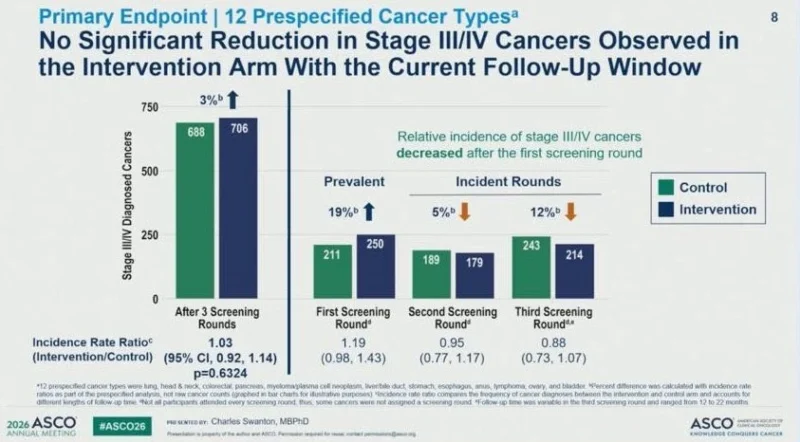
Primary endpoint (combined stage III+IV reduction across 12 cancers): 706 vs 688, IRR 1.03 (95% CI 0.92-1.14), p=0.63. A 3% increase in the intervention arm. By the trial’s own predefined yardstick, this is a negative study.
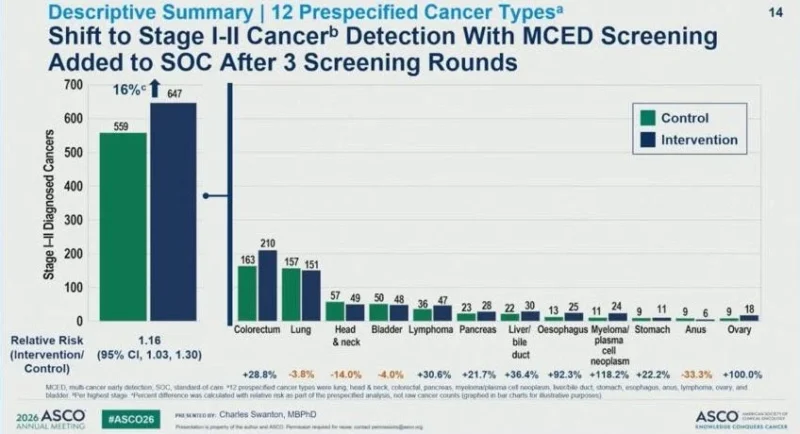
But the composite hides two opposing signals. Stage IV diagnoses fell – and the time trend matters: -9% in round 1, -22% in round 2, -26% in round 3. That’s the signature of a real effect strengthening with experience and time, not noise. Stage I-II detection rose 16%.
The endpoint missed because of an excess of STAGE III diagnoses, especially in the prevalent round. GRAIL argues some of this is stage IV into III shift plus diagnostic-pathway delays. Plausible, but unfalsifiable without the underlying data. A real asterisk, not a marketing-only.
The harder critique: stage shift does not equal mortality benefit. Finding cancers earlier can mean cure, or overdiagnosis of indolent disease, or lead-time bias. Stage-shift data alone can’t tell these apart. Most of us would say: not yet ready for guideline inclusion.
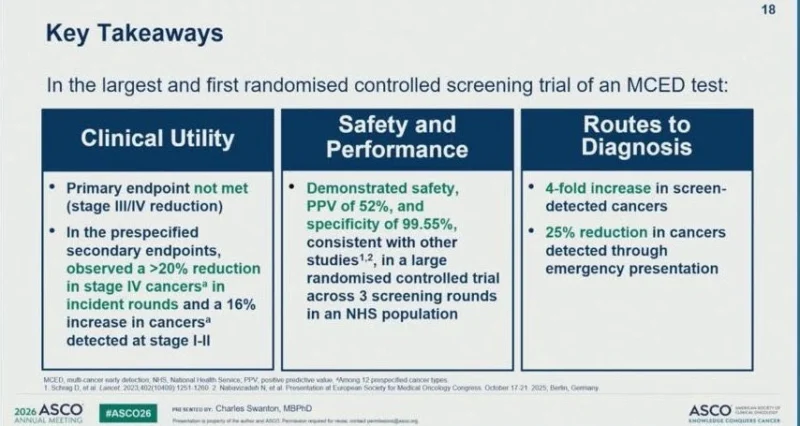
What’s most encouraging on its own terms: a 25% reduction in cancers diagnosed through emergency presentation. That route carries some of the worst outcomes in oncology. If real, this benefit is harder to attribute to overdiagnosis – emergency presentations are rarely indolent.
So – will this translate to a survival benefit?
My read: plausible, not yet proven. The stage IV trend (especially the round-3 26% drop) and the emergency-presentation signal are the strongest arguments for eventual mortality benefit, particularly in the no-screening cancers (pancreas, ovary, esophagus, liver, H&N).
I would focus on those moving forward.
What this trial actually changes: stage shift is not the right primary endpoint for MCED. Future trials need mortality (or at minimum stage IV-specific) endpoints and diagnostic pathways that don’t introduce stage slip. NHS-Galleri’s most lasting contribution may be that lesson, alongside an extended-follow-up readout to come.
I’ll eagerly wait for it!
And this is the LCSM trial I wanted to see the most. TRITON at ASCO 2026 (Skoulidis et al, Abstract 8515): chemotherapy with tremelimumab and durvalumab against chemotherapy with pembrolizumab in 1L STK11/KEAP1/KRAS-mutated nonsquamous NSCLC. The science is right, the execution is honest, and the read is more complicated than a single ORR number lets on.
And it may have changed my mind about adding CTLA4 inhibition.”
Other articles featuring Gilberto Lopes on OncoDaily.