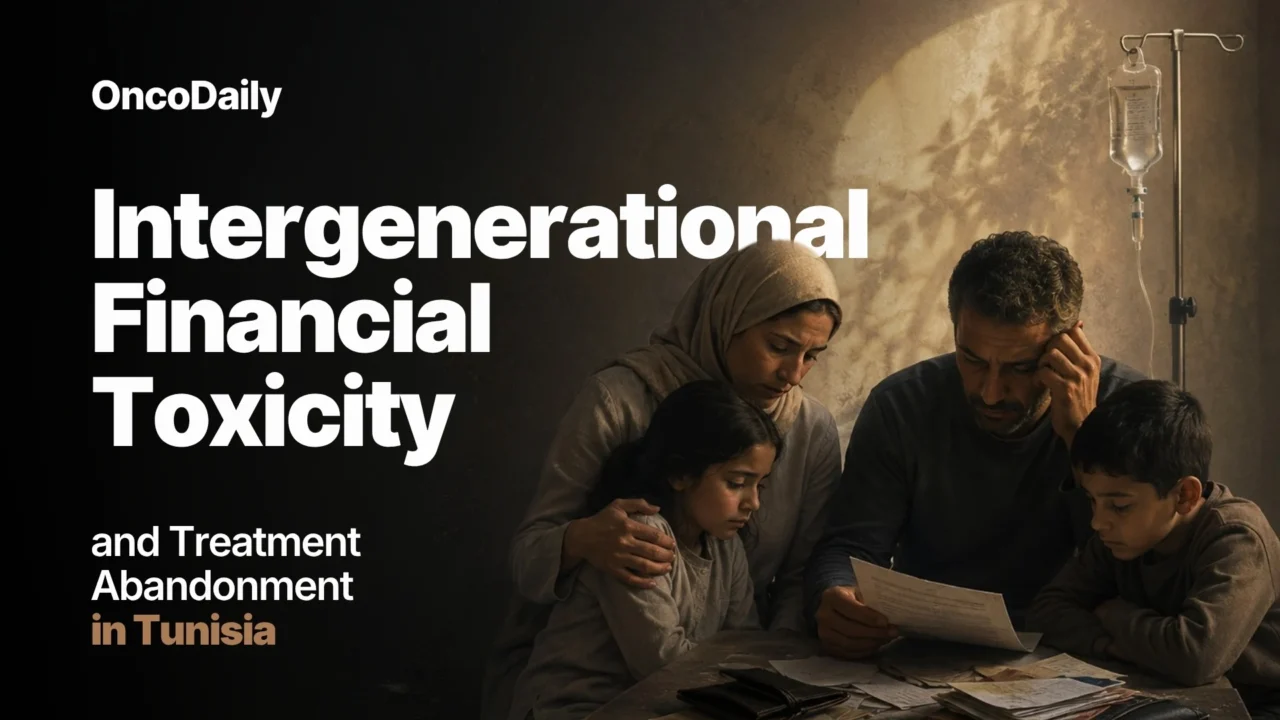
Houda Belfekih, Associate Professor of Medical Oncology, Head of Medical Oncology Department at Mohamed Taher Maamouri University Hospital, shared the study about financial toxicity:
Introduction
Cancer care in low-and-middle income countries often leads to enormous health expenditure, forcing families into a cycle of psychological and financial stress, thus increasing the risk of treatment drop-out. In Tunisia, the socio-economic burden of care extends beyond the patient to impact the intergenerational future of the household. This study aimed to evaluate the financial toxicity among patients receiving intravenous treatment and to identify its associated factors.
Methods
A cross-sectional study was conducted including 70 patients receiving systemic therapy at a public oncology day hospital. Data were collected via a comprehensive survey covering socio-demographics, logistic costs and economic coping mechanisms. Statistical analysis was performed using Jamovi, with p-values < 0.05 considered significant.
Results
median age was 54 years and median treatment duration was 12 months. rural housing accounted for 38.6% of patients. permanent job loss due to cancer was detected in 30% of patients. household monthly income was below the minimum wage in 22.9% of the cohort. The coping mechanisms identified were exhausting life savings in 55.7% of patients, loans from relatives in 64% of the cohort and 7 patients were forced to sell a property. Most notably, 21.4% of the patients reported that at least one of their children had to interrupt their education to provide financial support. High risk for treatment drop-out was identified in 35.7% of the cohort, with 22.9% having already considered treatment abandonment. Significant associations to treatment drop-out risk were low monthly income (p= 0.041), necessity of borrowing money (p= 0.01), treatment duration over 12 months (p=0.024) and most critically the interruption of children’s education (p < 0.001) and patient work stoppage
(p< 0.001).
Conclusion
The significant association between children’s education withdrawal and the risk of treatment drop-out reveals a profound social crisis, triggering an intergenerational cycle of psycho- social distress. These results highlight the need for an early financial toxicity screening to protect both the patient’s clinical outcome and the family’s socioeconomic future.
You can also read:
Financial Toxicity in Cancer Care: A Global Call for Submissions