






Emad Shash, General Manager at National Cancer Institute, Cairo University, shared a post on LinkedIn:
“I am delighted to share that our latest research has been published in the European Journal of Clinical Pharmacology.
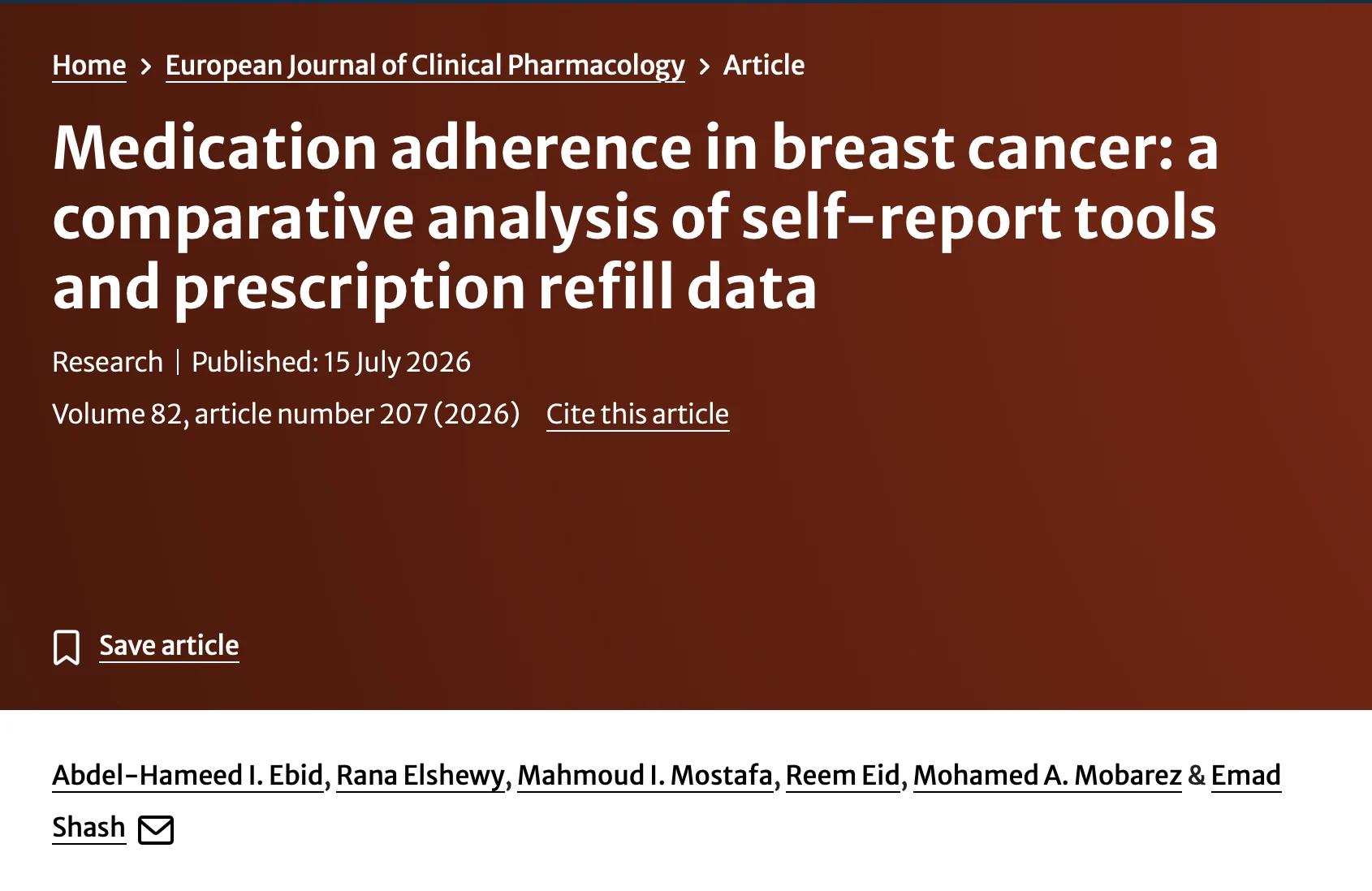
Medication adherence in breast cancer: a comparative analysis of self-report tools and prescription refill data.
Why does this matter?
As oral anticancer therapies become increasingly important in breast cancer treatment, ensuring that patients take their medications as prescribed is essential for achieving the best possible outcomes. However, measuring medication adherence remains one of the greatest challenges in oncology, with different assessment methods often producing very different estimates.
In this study, we evaluated 500 breast cancer patients receiving oral anticancer medications at the Breast Cancer Comprehensive Center, National Cancer Institute, Cairo University. We compared four validated self-report adherence questionnaires with two objective prescription refill measures to better understand how different assessment methods perform when applied to the same patient population.
Our key findings:
- Different adherence assessment methods produce substantially different results.
- Prescription refill measures generally estimate higher adherence than patient self-report tools.
- Combining objective refill data with patient-reported measures substantially improves the identification of patients at risk of nonadherence.
- Among the self-report instruments evaluated, ARMS demonstrated the strongest agreement with prescription refill data.
- Proportion of Days Covered (PDC) appeared to outperform Medication Possession Ratio (MPR) in identifying nonadherent patients.
Our findings support a multimethod approach, combining objective pharmacy refill data with brief patient-reported tools, to provide a more comprehensive understanding of medication-taking behavior.
This publication represents another step in our ongoing mission to generate real-world evidence that improves patient-centered cancer care, particularly in low and middle income countries.
I would like to express my sincere gratitude to all my co-authors for their outstanding collaboration.
A very special thank you goes to Dr. Rana Elshewy and Dr. Reem Eid, whose dedication, scientific rigor, and commitment were instrumental throughout every stage of this work. It has been a privilege working alongside such talented colleagues.
I am also grateful to our patients and to the entire multidisciplinary team at the Breast Cancer Comprehensive Center, National Cancer Institute, Cairo University, whose daily efforts continue to inspire meaningful clinical research.
I hope this work contributes to improving adherence assessment and ultimately enhances outcomes for patients with breast cancer worldwide.”
Title: Medication adherence in breast cancer: a comparative analysis of self-report tools and prescription refill data.
Authors: Abdel-Hameed Ebid, Rana Elshewy, Mahmoud Mostafa, Reem Eid, Mohamed Mobarez, Emad Shash
Read the Full Article on European Journal of Clinical Pharmacology
Other posts featuring Emad Shash on OncoDaily.