





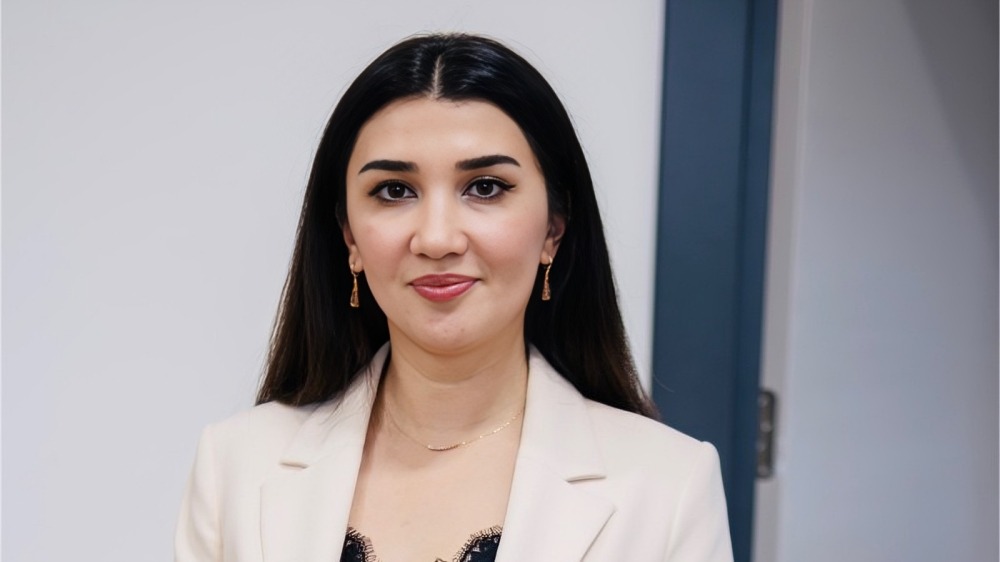
Elvina Almuradova, Associate Professor of Oncology at the European Institute of Oncology, shared a post on LinkedIn:
“Post-neoadjuvant trastuzumab deruxtecan (T-DXd) demonstrated a significant improvement in invasive disease – free survival compared with trastuzumab emtansine (T-DM1):
- 3-year invasive DFS: 92.4% vs 83.7%
- HR 0.47 (p<0.001)
The magnitude of benefit is clinically meaningful and clearly favors T-DXd in this high-risk population.
However, interpretation must carefully balance efficacy with toxicity.
While T-DXd toxicities were mainly gastrointestinal and hematologic, interstitial lung disease (ILD) remains the most important safety signal:
- ILD incidence: 9.6% vs 1.6%
- 2 ILD-related deaths reported
As we consider T-DXd in the curative-intent setting, patient selection, proactive monitoring, early recognition of pulmonary symptoms, and multidisciplinary management become critical.
The efficacy signal is strong – but safety vigilance will determine how confidently we integrate this into routine practice.”
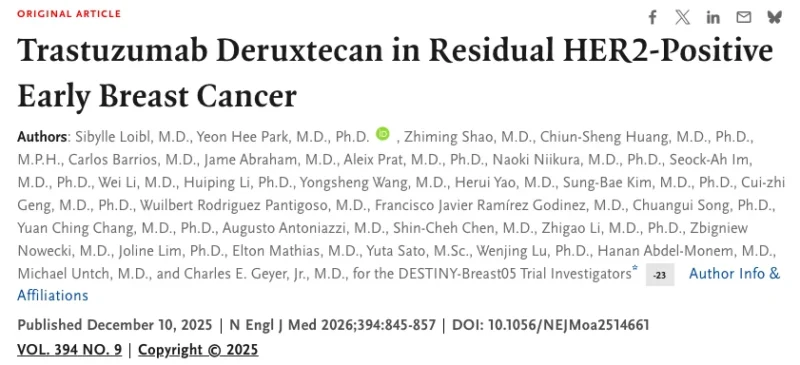
Title: Trastuzumab Deruxtecan in Residual HER2-Positive Early Breast Cancer
Authors: Sibylle Loibl, Yeon Hee Park, Zhiming Shao, Chiun-Sheng Huang, Carlos Barrios, Jame Abraham, Aleix Prat, Naoki Niikura, Seock-Ah Im, Wei Li, Huiping Li, Yongsheng Wang, Herui Yao, Sung-Bae Kim, Cui-zhi Geng, Wuilbert Rodriguez Pantigoso, Francisco Javier Ramírez Godinez, Chuangui Song, Yuan Ching Chang, Augusto Antoniazzi, Shin-Cheh Chen, Zhigao Li, Zbigniew Nowecki, Joline Lim, Elton Mathias, Yuta Sato, Wenjing Lu, Hanan Abdel-Monem, Michael Untch and Charles E. Geyer, Jr.
Other articles featuring Elvina Almuradova on OncoDaily.