





European Alliance for Personalised Medicine (EAPM) shared a post on LinkedIn:
“Cancer Trials Are Everywhere, So Why Can’t Patients Get In?
Oncology is in a golden age of innovation. But for too many patients, that innovation is stuck behind a locked door. A new article, “A Unified Framework for Pre-Screening and Screening Tools in Oncology Clinical Trials,” exposes the hard truth: the science is moving faster than the systems meant to deliver it.
The numbers should embarrass us into action. Only 3–5% of eligible cancer patients enrol in clinical trials.Meanwhile, about one in four oncology trials fails to recruit its planned sample size, and 18% shut down with less than half of their target enrolment. From 2019 to 2023, enrolment timelines in industry-sponsored oncology trials stretched by six months, a 19% relative rise. And this is happening in a world with more than 15,000 interventional oncology trials actively recruiting or preparing to recruit. We don’t have an innovation gap. We have an access and execution gap.
The article’s diagnosis is as pragmatic as it is urgent. Manual screening is too slow, too fragmented, and too dependent on overstretched staff. Fully automated approaches, especially “out-of-the-box” or zero-shot AI can speed up pre-screening, but oncology eligibility is not a simple checklist. It is biomarker thresholds, prior therapy history, comorbidities, lab values that change over time, and clinical nuance that rarely sits neatly in structured fields.
That is why the authors point to the most realistic path forward: hybrid models, AI-enabled pre-screening embedded into workflow, paired with clinician oversight, interoperable data standards, and transparent logic that can be audited, trusted, and improved. Done well, this is not automation replacing clinicians; it is automation restoring clinical bandwidth.
Just as important: trial matching is an equity test. Rural patients, underserved communities, older people, and lower-resource settings remain underrepresented. If digital tools are built on fragmented data and biased pathways, they will scale inequity—fast. If they are built with decentralisation, multilingual consent, interoperability, and diversity-sensitive metrics, they can finally widen access.
This is why the debate is moving from theory to implementation. These issues were actively discussed in Cairo, in a high-level meeting organised by Hesham ElGhazaly, with EAPM contributing to the access-and-trust agenda. The Alliance has also worked closely with Arturo LoAIza-Bonilla MD, a leading voice in this field and one of the article’s authors.
Next week, the conversation continues in Athens, at the conference organised by George Kapetanakis. In the coming months, the Alliance will take these priorities directly to EU institutions, because trial access is no longer a “nice to have.” It is the delivery mechanism for innovation, and Europe cannot afford a system that leaves patients outside.”
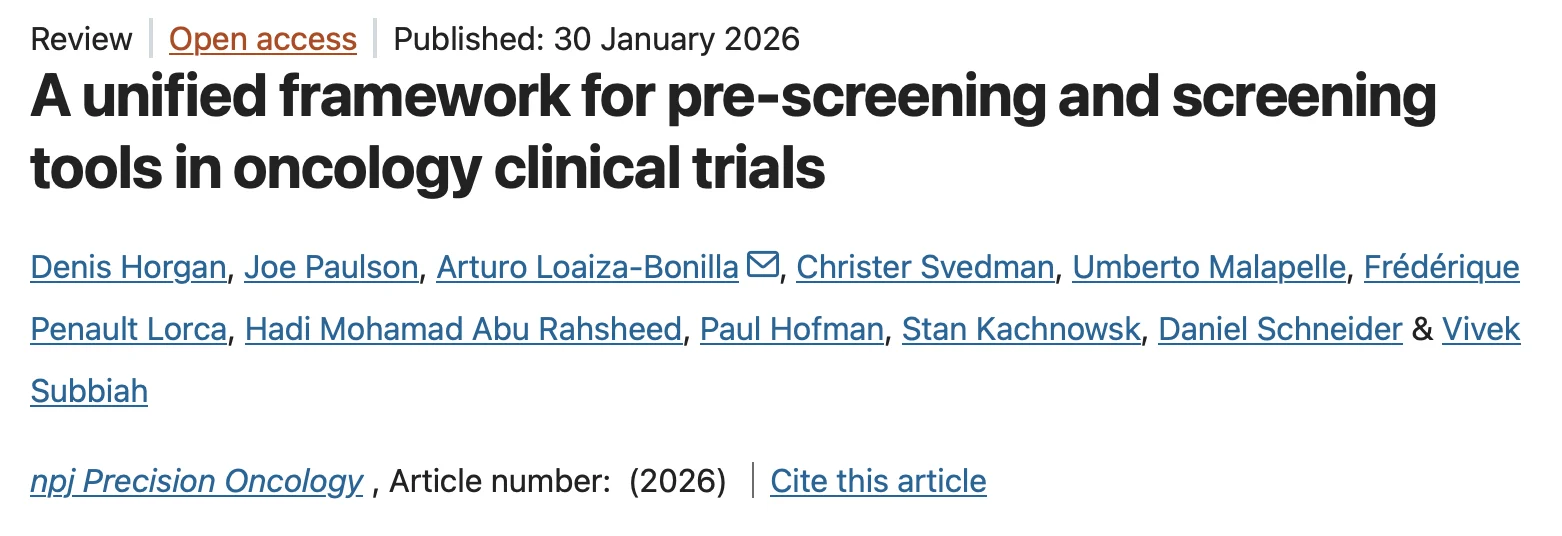
Title: A unified framework for pre-screening and screening tools in oncology clinical trials
Authors: Denis Horgan, Joe Paulson, Arturo Loaiza-Bonilla, Christer Svedman, Umberto Malapelle, Frédérique Penault Lorca, Hadi Mohamad Abu Rahsheed, Paul Hofman, Stan Kachnowsk, Daniel Schneider, Vivek Subbiah
Read the Full Article on npj Precision Oncology
More posts about European Alliance for Personalised Medicine.