





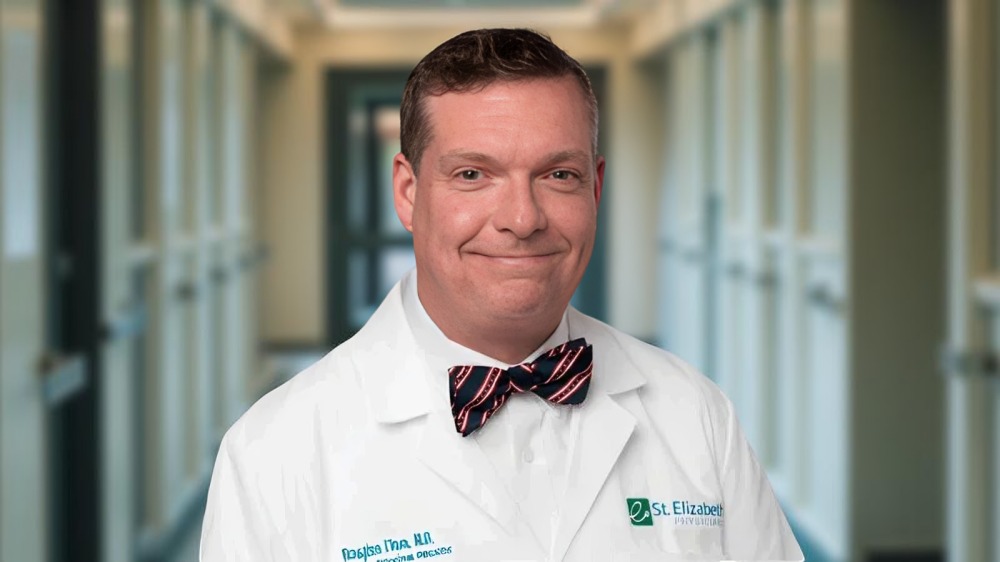
Douglas Flora, Executive Medical Director of Yung Family Cancer Center at St. Elizabeth Healthcare, President-Elect of the Association of Cancer Care Centers, and Editor in Chief of AI in Precision Oncology, shared a post on LinkedIn:
“On noticing, decisiveness, and the exponential arithmetic of a single human act
‘The mathematics of compassion multiplies exponentially.’
I can’t stop thinking about that line. I came across a post by Susan Peterson this week and had to make sure more people read it.
A librarian in Spokane found a teenager sleeping between the stacks. She didn’t call security. She called her husband. An hour later, they’d cleared out their home office. You’re staying with us. No arguments.
Three months. A room. Meals. Rides to school. He graduated valedictorian. Became a social worker. Helped twenty-three kids find housing and finish school. Started a scholarship fund. One act. Exponential return.
We talk a lot in medicine about precision – the right drug, the right dose, the right moment. But there’s a different kind of precision we chronically underinvest in: noticing. Really seeing the person in front of us. Acting on what we see before we talk ourselves out of it.
The librarian didn’t convene a task force. She didn’t wait for a protocol. She made a different calculation entirely. And years later, that calculation is still compounding.
What made me want to share this story is not the extraordinary outcome. It is the ordinary moment that preceded it – a woman closing up a library, a boy she didn’t know, a decision that required no special training, no institutional backing, no committee approval. Just a person who saw something, felt something, and then – and this is the part we do not talk about enough – acted on it.
We have a word for the seeing. We call it empathy, compassion, awareness, and we celebrate it in speeches and train it in medical schools and inscribe it into hospital mission statements, where it lives, pressed flat and airless, between laminated pages in employee break rooms. What we talk about far less is the second half of the equation – the decisive, unhesitating, occasionally costly choice to actually do something with what we’ve seen.
The librarian cleared out her home office. That is not a metaphor. That is a spare room that became a bedroom, a family that reorganized its life around a stranger’s need, compassion not as feeling but as action – specific, material, real. Call it decisive goodness: compassion with its work clothes on, unwilling to remain in the realm of sentiment when there is something concrete to be done.
In oncology, opportunities for decisive goodness appear with an almost relentless frequency. I do not mean that abstractly. The specific, granular texture of cancer care is saturated with moments – small, easy to miss, almost never in the protocol – where the direction of a person’s experience turns entirely on whether someone noticed and acted, or noticed and moved on.
Cancer strips life down to its essential architecture with a speed that most other human experiences do not approach. The social performances fall away. The small talk becomes exhausting and is quietly abandoned. What remains is the actual interior of a person’s life – what they love, what they fear, what they are fighting toward, what they cannot bear to leave. The people walking alongside them in that stripped-down reality encounter that interior every single day. A patient mentions, almost as an aside, while you’re reviewing labs, that her husband has started sleeping in the guest room because he’s afraid of accidentally hurting her. A man who has never missed a day of work in his adult life sits in the exam chair with the expression of someone who has just been told the rules of the world no longer apply to him. A young woman, newly diagnosed, asks a question about side effects-and beneath it is a different question entirely, one she hasn’t yet found words for: am I going to be all right?
These are not interruptions to the clinical encounter. They are the clinical encounter. They are the precise locations where the purely technical practice of medicine either becomes something human or fails to. And what I have come to understand, over years of this work, is that responding to them – not with a pamphlet, not with a referral to resources, but with actual presence and attention and the willingness to be inconvenienced by another person’s reality – is among the most clinically consequential things we do.
There is a concept I want to name here, because I believe it describes something real and important that medicine has not yet found adequate language for.
I think of it as Magnified Goodness – the recognition that acts of compassion do not simply help the person in front of you. They propagate. They replicate. They instruct. They become, in the hands of the person who receives them, a template for what is possible, proof carried forward in the body and memory that this is how human beings can behave toward one another. The young man Mrs. Peterson took in did not merely survive. He was transformed in the image of the care that was shown to him, and he went on to become its instrument – twenty-three kids housed, a scholarship fund seeded, chain reactions initiated that none of us will ever fully trace.
This is not poetry. It is mechanics.
Compassion, genuinely given, does not dissipate into the space between two people. It travels forward through families, communities, institutions, and decades. It finds its way into the behavior of people who were never formally taught, who carry it only as a memory of what it felt like to be truly seen. In cancer care, the downstream effects of that propagation are something I have watched unfold across years – patients who were held with dignity through their hardest experience becoming fierce advocates for others, families who were met with real care carrying something of that forward into how they show up in their own communities, clinicians who were mentored by people who understood that the human dimensions of this work are not soft additions to serious medicine but its very core, going on to mentor others in the same spirit.
This is the force multiplication that never appears in the grant application. The return on investment that operates entirely outside the fiscal year. And it is as real as any trial result, as durable as any data. Which raises the harder question – the one I want to sit with rather than skip past.
Why is decisive goodness so rare?
Not because the people in this field don’t care. Most of those who enter oncology care with a ferocity that would astonish anyone who hasn’t witnessed it. The compassion is there, or it was before the fifteenth patient of the day, and the documentation backlog and the system that was designed, with considerable efficiency, to optimize throughput rather than the human encounter. What gets crowded out is not the feeling but the acting on it – the willingness to be, as Mrs. Peterson was, genuinely inconvenienced. To clear out the office. To stay in the room a few minutes longer than the schedule permits. To ask how are you really doing and then wait for the actual answer rather than the acceptable one.
The healthcare system we have built is extraordinary in its scientific dimensions and quietly hostile in this one. It has created structural friction around decisive goodness, made it dependent on individual will at precisely the moments when individual will is most depleted. The physician who wants to sit with a patient’s fear has to fight the schedule to do it. The nurse who knows that what a family needs is not another informational handout but a human being willing to stay has to find that time in the margins. This is not anyone’s intention. But it is the predictable consequence of a system that measures what it can measure and leaves everything else to chance and conscience.
I believe the tools now emerging in our field – artificial intelligence, predictive analytics, remote monitoring – are most valuable not when they replace the human encounter but when they protect it. When they relieve the cognitive and administrative load that currently colonizes clinical attention, creating space for what the technology cannot do: the unhurried presence, the question asked and genuinely waited upon, the moment of noticing that becomes an act of decisive goodness. The only vision of innovation in cancer care worth fighting for is one that rescues the humane encounter rather than replacing it.
But that is the systemic argument, and however necessary, it is not where this story lives.
This story lives in the ordinary moment. In the closing-up-the-library moment, when no one is watching, and nothing is required, and the easiest thing by far is to move along. That librarian didn’t know she was setting off a chain reaction that would house twenty-three children, fund scholarships, and propagate forward through decades into futures she would never see. She only knew that a child needed a room, and she had one. The full arithmetic of that act was invisible to her in the moment she made it, which is perhaps the most important thing about the mathematics of compassion. You do not need to see the return to make the investment. You do not need to trace the chain to start it. You only need to act, decisively and specifically, in response to the actual human being in front of you, without waiting for the right moment or the proper protocol or the version of circumstances that makes action convenient.
The right moment is almost never convenient. Decisive goodness is, almost by definition, an inconvenient choice.
In cancer care, the invitations to make that choice arrive constantly – in the offhand comment that contains a universe of fear if you slow down enough to hear it, in the caregiver falling apart quietly in the waiting room, in the patient who has stopped asking questions, which can look from the outside exactly like acceptance but is sometimes something else entirely. To notice the difference requires attention. To act on what you notice requires will. But the act itself – the clearing out of the office, the staying in the room, the I see what you’re carrying and I am not going to look away from it – costs far less than we tend to imagine in advance and returns something we cannot calculate after.
The compounding is real. The force multiplication is real. What Magnified Goodness insists upon is simply this: that an act of genuine compassion is never local. It does not begin and end between the two people in the room. It travels, in ways neither of them will fully see, into the world.
I have been in cancer care long enough to have watched the science transform in ways that would have seemed impossible at the beginning of my career – the genomic revolution, targeted therapy, immunotherapy rewriting the expected arcs of diseases we once considered inevitably fatal. I believe in that science completely, and I believe with equal completeness that it will never be enough on its own. That the quality of the human relationship – the presence, the noticing, the decisive goodness of the people around the patient – shapes outcomes in ways we are only beginning to measure, and in ways that may never be fully measurable, and that the immeasurability does not make them less real.
It makes them more important to protect.
Twenty-three kids found housing. A scholarship fund exists. A graduation photo sits on a desk in Spokane, next to a woman who checked out a belief in someone when no one else had, and watched it compound beyond anything she could have planned for.
She saved one kid who’s now saving others. That’s the mathematics of compassion. It multiplies exponentially.
Start the chain reaction. Be decisive in your goodness. The rest will find its own way forward.”

Other articles featuring Douglas Flora.