





Douglas Flora, Executive Medical Director of Yung Family Cancer Center at St. Elizabeth Healthcare, President-Elect of the Association of Cancer Care Centers, and Editor in Chief of AI in Precision Oncology, shared a post on LinkedIn:
” ‘For me, an area of moral clarity is: you’re in front of someone who’s suffering, and you have the tools at your disposal to alleviate that suffering or even eradicate it, and you act.’— Paul Farmer.
I walked to the hospital room yesterday, thinking about all the conversations we had shared over twenty-three years. His bus company and how proud he was of building it from nothing. His three daughters and watching them grow up, get married, and have children of their own. His hopes when we started third-line therapy for his lymphoma, and his quiet gratitude for the ten-year remission we were fortunate enough to achieve.
One of his daughters had reached out to me. After more than two decades, the boundaries between doctor and family had blurred, as they sometimes do. I was hoping the right words would come when I needed them—for her, for her sisters, for their mother.
The disease that was killing him was not the lymphoma we had fought together. Another illness had brought his body to the point of shutting down, and he had made the decision to suspend additional aggressive measures. When I entered the room and we began talking about what the next hours and days would bring, I watched tears stream down his three daughters’ faces. That raw anguish—grief that was still shocked and disbelieving even though we all knew this moment was approaching—will stay with me long after I leave.
After more than twenty years of practice, you might think this gets easier. It does not. It should not. The day I can witness that kind of suffering without feeling it is the day I need to stop doing this work.
The Faces That Stay
Decades later, I still remember losing a young Hodgkin’s patient. Not just her face or her diagnosis, but how she rescued baby birds that fell into her window well and fed them. I remember a burly construction worker twenty years ago, sobbing on his wife’s belly when he said goodbye to her. I will remember those three daughters yesterday.
There is a temptation in medicine to cultivate distance, to develop what we euphemistically call ‘appropriate professional boundaries.’ To see enough tragedy that individual losses blur into general experience. To absorb so much suffering that we become numb to any single instance of it.
But somewhere between incapacitation and numbness is a third space. A place where you still feel the anguish, still carry these moments with you, still let them fuel the work rather than paralyze it. Where those three daughters’ faces were yesterday, the baby birds in the window well, the construction worker’s grief—where all of it becomes not a wound that needs healing but a reminder of exactly why any of this matters.
The pain on their faces is the reason I still work. We need to prevent these moments of anguish, to save more families from this grief, to help deeper than we are helping now.
The Seven-Hour Walk
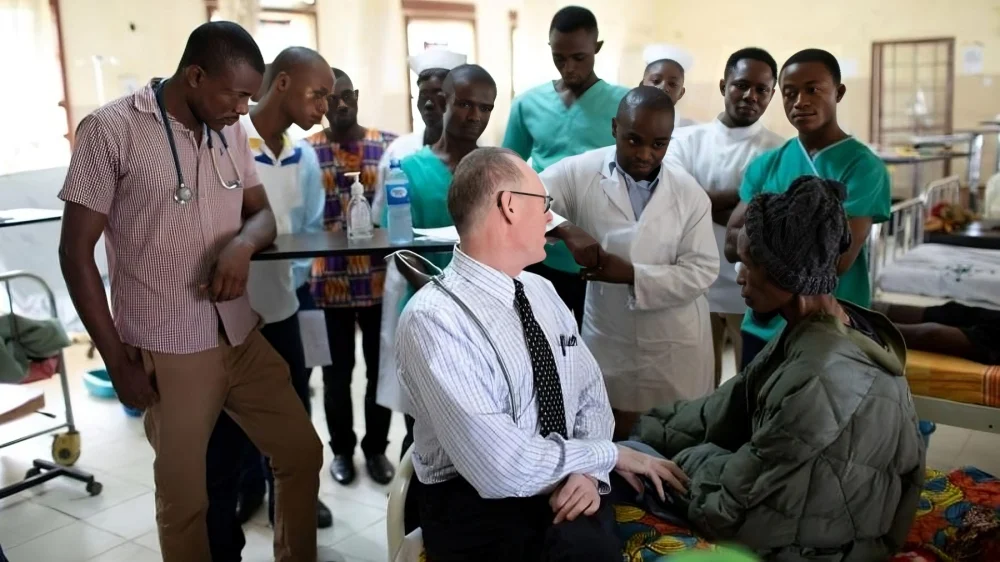
Paul Farmer—the physician in the picture above, who dedicated his life to bringing world-class medical care to Haiti and who died far too young in 2022—once hiked seven hours through mountains to see two families. Someone suggested it was too long to walk for so few patients. Tracy Kidder, in Mountains Beyond Mountains, imagined Farmer’s response: if you say seven hours is too long for two families, you are saying their lives matter less than others. And the idea that some lives matter less was, to Farmer, the root of all that is wrong with the world.
I cannot walk seven hours to reach every family facing cancer. But I can show up in my clinic each week and see their faces. I can carry what I learn there into the rest of my work—the writing, the system-building, the advocacy.
Each week, I remind myself of people like my patient’s three daughters yesterday. The young woman who rescued birds. The construction worker who loved his wife with a tenderness that made his size irrelevant. Every time I see that kind of suffering, I am reminded that we are capable of so much more than we are delivering. The gap between what we know and what we do is not a technical problem. It is a moral one.
What Proximity Teaches
Farmer understood something essential: proximity to suffering clarifies thinking. He once said that seeing patients unclouded his judgment, while those who made policy without direct exposure to the sick were more liable to error. They began to think of people as abstractions, as numbers, as percentages in journal articles.
My clinic day every week keeps the work real. The woman receiving her first chemotherapy is not a survival curve. The man whose scan shows progression is not a clinical trial statistic. The daughters saying goodbye are not a line in a disparities study. They are right there, and their suffering is undeniable. This proximity prevents comfortable abstractions. For every patient I saw yesterday, there are thousands I will never meet facing the same disease with fewer resources, worse odds. Not because the biology is different, but because we have built systems where your zip code matters more than your genetic code in determining who lives and who doesn’t.
Farmer rejected this. When experts told him it was too expensive, too complicated, too impractical to deliver world-class care in Haiti, he built the system that proved them wrong. He refused the premise that some lives deserved different standards.
The Tools We Already Have
We already have interventions that could prevent many of these tragedies. Low-dose CT screening catches lung cancers early when they are still curable. Colonoscopy starting at forty-five, not fifty, finds colon cancers before they become lethal. Better breast imaging augmented by AI detects cancers that conventional mammography misses. Prostate screening, cervical cancer screening, and HPV vaccination for our children. Multi-cancer early-detection blood tests are improving each year, getting ever closer to being ready.
We need psychosocial oncology teams to be standard everywhere. Palliative care integrated early in treatment. Genetic counseling available to everyone with relevant family history. Care navigators who help patients manage the administrative violence—the prior authorizations, the coordination between specialists, the financial toxicity that can devastate families as thoroughly as the disease.
None of this is science fiction. We simply have not decided that all patients are worth the required investment.
The Coalition We Need
What I am describing is not individual heroism. It is the need for a coalition of people who see what I see in the clinic each week and refuse to accept it as inevitable.
Physicians who understand that the gap between what is possible and what is delivered is a policy choice. Researchers focused on the cancers that disproportionately kill the poor, not just the ones with profitable markets. Administrators willing to invest in support infrastructure that does not generate revenue but prevents suffering. Patients and families who demand better systems and hold us accountable when we fail to build them.
Farmer built hospitals in Haiti because you cannot deliver complex care without infrastructure. He trained community health workers because you cannot reach patients without people willing to walk mountain paths. He insisted on the same standards he would expect at Brigham and Women’s Hospital because he refused to tier human worth by geography.
This is not complicated. It is just hard. It requires resources, political will, and the moral imagination to believe that the daughter in rural Kentucky deserves the same chance as the daughter in Boston.
The Urgency We Owe
Cancer will kill more than ten million people this year. In the time it takes to read this essay, roughly fifty people worldwide will have died from the disease. Most in pain. Many having never received adequate treatment, or any treatment at all. Not because we lack knowledge, but because we have failed to deliver what we know to where it is needed most.
These are not statistics. Each one is a person with a family, with daughters who will cry, with years they should have lived. Letting these deaths become routine—letting the sheer number of people suffering make us numb to each individual loss—is a tragedy we cannot allow. Farmer died in 2022, far too young, still teaching in Rwanda. His legacy is not individual heroism but transferred urgency. The insistence that we act when we have the tools to act. The refusal to accept any life mattering less than any other. Some lives matter less is the root of all that is wrong with the world. All lives matter equally is the beginning of making it right.
Those moments—the baby birds, the construction worker’s tears, three daughters’ anguished faces—they stay with us as a compass. They point toward what needs to change. They demand we work harder, push faster, and build better systems. They remind us that behind every statistic is a family, behind every percentage is a person, behind every clinical trial endpoint is a life that matters infinitely. Every family that does not have to endure the pain I witnessed yesterday is worth fighting for. Every cancer caught early enough to cure is a tragedy averted. Every patient who receives comprehensive support instead of navigating alone is progress that matters.
The work—screening, research, system-building, advocacy—is how we honor what we learn at the bedside. How we prevent these moments of anguish. How we save more families from this grief. How we help deeper than we are helping now.How three daughters’ tears yesterday become the reason three other daughters someday will not have to cry.
That is the urgency we owe them.”
More posts featuring Douglas Flora.