



David Wazer, Director at Brown Health Cancer Institute, shared on LinkedIn:
“The Best Hospitalization for a Cancer Patient Is the One That Never Happens.
Oncology has become extraordinarily good at delivering increasingly complex therapies. We have been less consistent at building equally sophisticated systems to keep patients well enough to stay out of the hospital.
This abstract presented by Bridget Nicholson of Daymark Health and collaborators at the 2026 ASCO Quality Care Symposium should get our attention (JCO Oncol Pract 22, 2026 (suppl 10; abstr 78)).
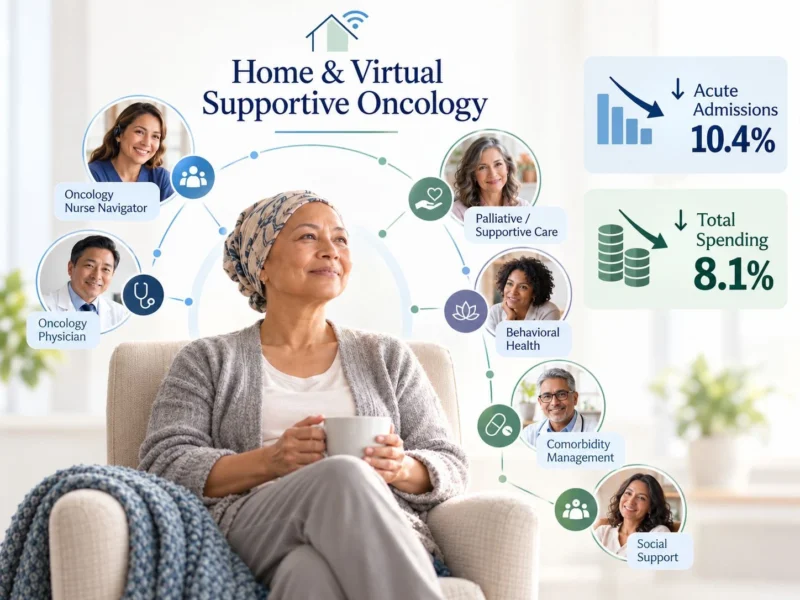
In a real-world cohort of 5,432 patients treated across 20 oncology practices, a technology-enabled home and virtual supportive oncology program was associated with a 10.4% relative reduction in acute inpatient admissions and an 8.1% reduction in total healthcare spending – approximately $789 per member per month.
That is not a marginal operational improvement. It is a signal that proactive supportive oncology can materially change the trajectory of care.
The intervention itself is revealing: navigation, symptom and palliative care, comorbidity management, collaborative behavioral care, and support for social needs delivered through a home and virtual model. In other words, the program addressed many of the predictable reasons patients deteriorate between oncology visits.
The traditional model waits for the phone call, emergency department visit, or hospitalization. The better model anticipates the problem before the patient crosses the hospital threshold.
Perhaps most importantly, these findings move the discussion beyond randomized trials and into routine practice. The benefits were demonstrated across multiple oncology practices and evaluated using an intention-to-treat framework.
The implication for value-based cancer care is difficult to ignore: supportive oncology should not be treated as an optional add-on or cost center. Done well, it may be one of the rare interventions capable of improving patient-centered care while simultaneously reducing utilization and total spending.
The future of oncology will not be defined solely by better drugs and better technology. It will also be defined by whether we can keep our patients healthier, safer, and at home.”
Other articles featuring David Wazer on OncoDaily.