






Claire Wagner, Head of Corporate Strategy and Market Access at Bill & Melinda Gates Medical Research Institute, recently shared a post on LinkedIn:
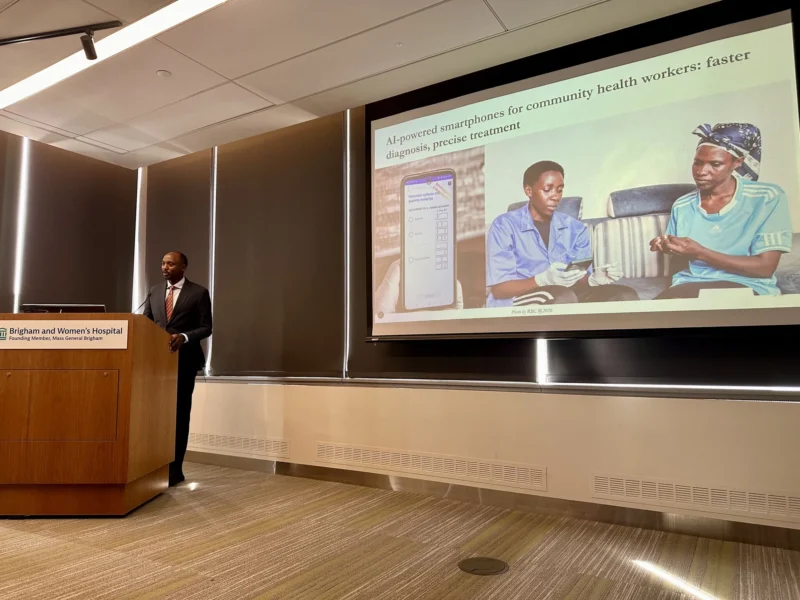
“As promised – more on Minister Nsanzimana’s lecture at BWH this week. And yes, more about the bats.
When Marburg virus hit Rwanda in 2024 – 66 cases, 15 deaths – the case fatality rate was 22.7%. In prior outbreaks, Marburg fatality rates have reached as high as 88%.
The question is how.
It’s a question that often draws a response around whether Rwanda’s systems and lessons are replicable or translatable. Minister Nsanzimana addressed this head on: what might looks from the outside like a black box is, up close: infrastructure, data, and science. He walked through what Rwanda has built – and what it continues to build – across every layer of its health system.
Inside the Ministry of Health is a National Health Intelligence Center – a 24/7 operations room pulling from 50+ data sources. Community health workers in villages. Health posts. District hospitals. Genomic sequencing labs.
Wastewater surveillance at airports. All of it flowing into one platform, in real time. The Minister can see what’s happening at the village level and what’s emerging at a port of entry – on the same screen, at the same time.
To prevent re-emergence of Marburg, Rwanda now deploys GPS tracking devices on bats to map movement and foraging patterns. Digital mapping of every known roosting site in the country (!) PCR and serology sampling of bats, primates, and rodents for Marburg virus RNA.
Fever clinics at mining sites where human-bat contact is highest.
At the community level, 58,000 community health workers – four per village, trusted neighbors, a model dating back to the mid-1990s – now carry AI-powered smartphones for faster diagnosis and treatment of common illnesses. What they report flows into the same system.
Bat surveillance. AI-enabled primary care. Genomic sequencing at borders. These sound like separate innovations. In Rwanda, they’re all inputs into one integrated picture.
I keep coming back to a question from the lecture: what does it actually look like when a health system can see itself in real time – from village to port of entry – and act on what it sees?
Speaking of bats and global health, don’t miss this incredible reporting by Ari Daniel at NPR on a novel approach to preventing viral spillover: vaccinating bats themselves, including using vaccine-carrying mosquitoes.
NPR Article.”
Title: Ecological vaccination: A strategy to prevent zoonotic spillover from bats
Authors: Hongyue Li, Fei Yuan, Yanfeng Yao, Jinglin Wang, Chunzheng Li, Ye Liu, Jinmei Yang, Zhongyang Zhang, Jiandong Liu, Jiankai Liu, Zhenxing Yang, Wanzhu Jin, Dan Wen, Chao Shan, Aihua Zheng
Read The Full Article

Other articles featuring Claire Wagner on OncoDaily.