






Charles Jiang, Medical Oncologist at UT Southwestern Medical Center, shared a post on X:
“ASCO26 starts tomorrow. By Friday your feed will be full of survival curves, and the temptation will be everywhere: cross-trial/study comparison. Before you do so, A few caveats worth keeping in mind.
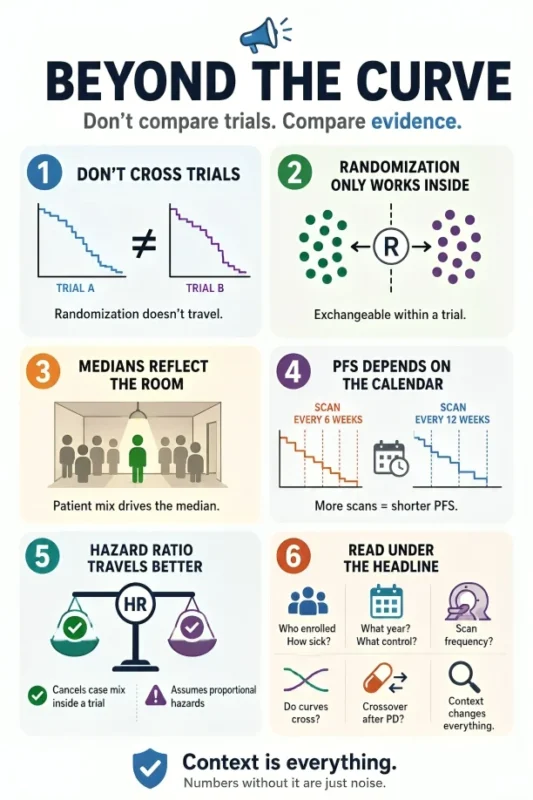
Start with what a randomized trial actually buys you. Randomization makes the two arms exchangeable, so a difference between them can be pinned on the treatment.
That bites hardest on the absolute medians. A median survival is set by the prognosis of whoever happened to enroll. Tighten eligibility toward fitter patients, or sit in a health system that diagnoses earlier, and the median climbs before the drug does anything at all.
PFS hides a stranger trap. Progression is only counted when you scan, so a trial imaging every six weeks records shorter PFS than one scanning every twelve, for the identical disease. Part of any PFS gap is really a gap in calendar.
Across eras the same illusion grows: sharper imaging reclassifies patients into worse stages, and survival rises in every subgroup without a single life extended.
This is why the hazard ratio travels better. Both arms share one population split by chance, so whatever case mix inflated the medians cancels, landing on treatment and control alike. Two caveats survive.
The ratio assumes the curves stay proportional, which immunotherapy routinely breaks when they separate late or plateau into a tail of long survivors.
And every HR is measured against that trial’s own control arm, so a striking ratio over a weak comparator is a different result from a modest ratio over a strong one. HRs resist cross-trial comparison too, just more quietly.
So before the curves start flying, read underneath the headline. Who enrolled and how sick they were. What year it was and what the control arm received. How often patients were scanned. Whether the curves cross.
And for OS, whether control patients crossed over to the same drug after progression, which can shrink a real benefit until it reads as nothing. Run that checklist and the same dataset often tells a very different story than its headline.
Now, see you at asco26.”
Other articles featuring Charles Jiang on oncoDaily.