





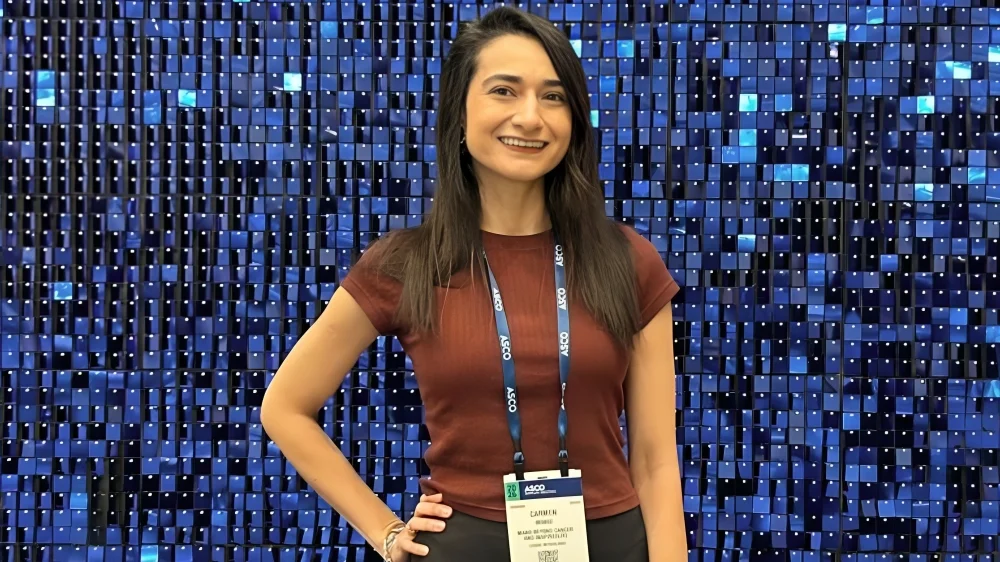
Carmen Monge-Montero, Researcher and Global Cancer Advocate, shared a post on LinkedIn:
“What does it mean to be childless or childfree after cancer?
This year, a priest told me that I needed twins to catch up for the time I had “wasted”. He did not know I was a cancer survivor.
That conversation made me think about something that we don’t do research in AYA survivorship care:
What happens when infertility is not physical after cancer?
After years working in advocacy and research, I have met many survivors who could potentially have children but remain uncertain, afraid, exhausted, financially discriminated, or simply not sure if parenthood is right for them.
Yet most fertility conversations continue to focus only on biology.
Is preserving sperm and eggs the only way to support fertility after cancer?
In this article, I reflect on what I call psychosocial infertility and why I believe we need a more holistic conversation about reproductive decision-making after cancer.
I would love to hear from other survivors, healthcare professionals, researchers, and advocates.
Has cancer changed the way you think about parenthood, regardless of whether you are physically infertile or not?
Curious to hear other perspectives.
Childless or Childfree after AYA cancer?
You have probably seen these terms all over the media lately. More and more young people are openly discussing their decisions about having or not having children and the many reasons behind those choices.
I do not think there are good or bad reasons when it comes to this decision. Choosing whether or not to have children is deeply personal and shaped by many factors. For young people with and beyond cancer, however, the conversation can be different, and so can the reasons behind their choices.
The definitions themselves are not always clear. In general, childfree refers to people who choose not to have children, while childless often describes people who want children but cannot have them because of infertility or other circumstances. Some people use the terms interchangeably, while others feel strongly about the distinction. The term childless can carry negative connotations because it suggests something is missing, whereas childfree implies choice.
Fertility is the ability to produce babies and it is not a new topic in cancer survivorship. We all know that many cancer treatments can affect physical fertility, and many young people lose the option of becoming biological parents after treatment, particularly in Low-Medium Income Countries (LMICs), where fertility preservation may not be available or affordable. However, over the years, I have come to believe that there is another side of fertility that we rarely discuss: what I learned is psychosocial infertility, caused by emotional, social, cultural, financial, and existential barriers that can influence whether a survivor wants, feels able, or feels ready to become a parent.
After +10 years of survivorship and working in advocacy, I have realised that every AYA survivor experiences parenthood differently. I have met people who completely changed their lives and careers to become parents, others who decided they never wanted children, some who remain afraid of making a decision, and others who avoid relationships altogether because they do not want parenthood to become an issue.
There is no single “right” way to feel about having children after cancer, yet many of our conversations about fertility still assume that biological parenthood is the goal for everyone.
It took me a long time to write this article because, as a cancer advocate, I meet many people who cannot have children due to physical infertility. Sometimes that makes you think that if you still might have the choice, perhaps you should take it. Yet, at the same time, there can be many other reasons that make the decision far more complicated.
As the years went by, I never really wanted to have children, and I thought that was normal for my age and lifestyle. Then, I came across a study reporting that 22% of female cancer survivors voluntarily remained childfree, and that cancer treatments, treatment toxicity, and medical comorbidities were not associated with their decision. This made me think that there were more people like me who maybe didn’t have kids after cancer, not because it was physically impossible, but also because of something else beyond that.
The uncomfortable thoughts nobody talks about
Over the years, I have collected stories and reflections about reasons why AYA survivors remain childfree, as well as my own experiences. These are some of the thoughts I have heard repeatedly. They are not universal, but they are common enough that I believe we should be talking about them more openly.
1. Mortal thoughts
I do not want to start dramatically, but many of us think about death more than most people our age.
Fear of recurrence makes us ask questions such as: What would happen if I died while my child was still young? Who would take care of them if I get cancer again?
Of course, many future parents ask themselves these questions. The difference is that cancer survivors have already lived through a situation where death felt very close. That experience can change how we think about becoming a parent.
2. Fear of causing suffering to others and themselves
I remember that the first question my father asked my oncologist was whether my cancer was genetic. He wanted to understand why it happened and whether he or my mom were responsible.
When you have seen your loved ones suffer because of your illness, it is difficult not to think about how your decisions might affect them in the future.
People often say that those who do not want children are selfish. Yet for some cancer survivors, the reasoning is completely the opposite; they worry about causing long-term health effects on the babies due to genetic damage or drug malformation, among other things. Whether these fears are medically justified or not, they are real, and it’s something we need to study more
In addition, many survivors finally find a treatment that makes them feel somewhat normal again after cancer, only to be told they may need to stop it if they want to try to get pregnant. Others are told they need to start fertility medications or hormones to improve their chances of conceiving. On paper, it sounds simple. In reality, for many cancer survivors, taking more medication after cancer carries an emotional weight that is hard to explain.
3. “We are all tired”
A survivor from MANO Beyond Cancer once told me that the phrase that best describes cancer survivors is: “We are all tired.” In many ways, she is right.
Many of us live with chronic fatigue, anxiety, hormonal changes, pain, or other long-term effects of treatment. The thought of pregnancy, parenting, or adding additional physical demands to our lives can feel overwhelming.
Apart from this, fertility is still unpredictable. There is still no sure test to know the impact of some treatment of survivor’s fertility. Many doctors say just start trying, and this could be months to years of trying. How much time, effort or resources would we agree to spend on this?
Sometimes it is not about whether we can do it. It is about whether we have the energy to do it.
4. Finding a partner
During my volunteer experience in Kenya, one of the things that struck me most was hearing that many AYA cancer survivors never marry because of the stigma associated with cancer.
In many LMIC, infertility could even be a social issue since the person beyond cancer is seen as damaged, unhealthy or even cursed. These beliefs can affect relationships, marriage prospects, and how people view our ability to become parents.
In contrast, experiences may differ in high-income countries. A study from the Netherlands suggested that cancer survivors do not necessarily face greater difficulties finding dates than people without a cancer history.[6] However, the study focused mainly on short-term dating profiles. Other research has shown that many young cancer survivors face significant barriers to establishing and maintaining romantic relationships, including fears of being perceived as undesirable, infertile, or a burden.
Even for those who choose to pursue parenthood independently, the path is not always straightforward. In some countries, cancer survivors may face barriers to adoption, making parenthood more difficult to achieve.
5. Financial toxicity
Yes, it is 2026, and we are still talking about financial toxicity.
Someone once told me that having children today is often a question of economic status. For many survivors, decisions about parenthood are not only emotional or medical. They are also financial.
The world is already difficult for many young people. Now imagine living in a country where there is no Right to Be Forgotten law and your cancer diagnosis affects your ability to get a job, buy a house, obtain affordable health insurance, or access life insurance that could protect your family in the future.
But still, we need to keep working for better conditions. In some high-income countries, disability benefits are often insufficient to support a family and may even be reduced or lost when someone gets married or returns to full-time work.
Even if you had the opportunity to preserve your fertility before treatment, that does not mean the path to parenthood becomes easier. Fertility treatments, surrogacy, adoption, medical follow-up, and the overall cost of raising a child can be overwhelming, especially for survivors already dealing with the long-term financial consequences of cancer.
Why is this conversation so difficult?
This is probably the main reason why I’m writing this piece.
This year, I met the priest at a friend’s wedding. He asked me if I was married and if I had kids. Before I could answer, he looked me up and down and said “Definitely not”
When I told him that I had actually been married for 13 years and did not have children, he suddenly stood up, placed his hands on my head, and started praying for God to give me twins so I could “catch up” for all the time I had “wasted.”
Everyone around us laughed. It was horrible. No matter what I could have said, it seemed that, in his eyes, a woman without children was somehow a failure.
When I told my parents what had happened, they asked why I had not mentioned my cancer diagnosis. Their reaction made me realise that they still viewed infertility mainly as a physical issue. I told them that I didn’t want to turn a decision the reasoning of invoking a miracle. It was not fair for me and for the people that physically cannot have biological kids due to cancer treatments. What stayed with me most was not the prayer. It was the phrase “you wasted your time”
I truly believe that deciding whether to have children is difficult for anyone, but it can be even more complicated in LMICs, where cancer stigma and cultural expectations remain strong. That choice can be seen as rejecting your culture, your values, or even your purpose. In contrast, in many high-income countries, choosing not to have children has become more accepted, even if not everyone agrees with it.
Final Thoughts
As I get older, I have become aware of how little space exists to discuss these experiences among AYA beyond cancer who are physically able to have children but may still struggle with uncertainty, fear, stigma, financial barriers, or changing life priorities.
There are very few studies exploring these issues from a humanistic perspective as part of supporting the quality of life for patients. Wondering about other reasons beyond having a cancer diagnosis contributing to this, a lack of desire to become a parent in cancer survivors
I remember attending a conference where the speaker asked the audience the most important concern of AYA cancer survivors. Fertility was the most popular response, but in a way, only the ability to have biological children and not to improve the quality of life overall.
So, is preserving spermatozoids and eggs the only way to support cancer survivors’ fertility? Or do we need a holistic approach?
I would love to hear from other cancer survivors and learn about their experiences and perspectives on this topic. Did cancer change your desire to become a parent, regardless of whether you were physically infertile or not?”
Other articles featuring Carmen Monge-Montero on OncoDaily.