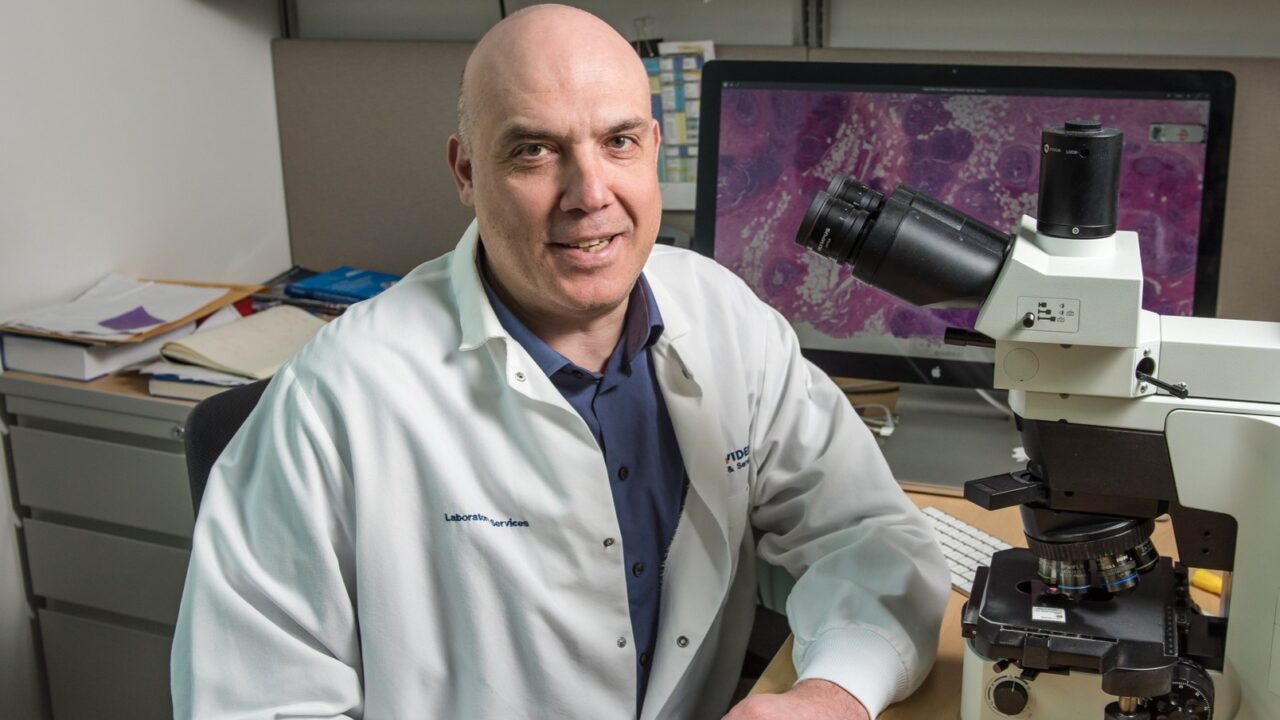
Carlo Bifulco, Chief Medical Officer at Providence Genomics, shared a post on LinkedIn about a recent article he and his colleagues co-authored, adding:
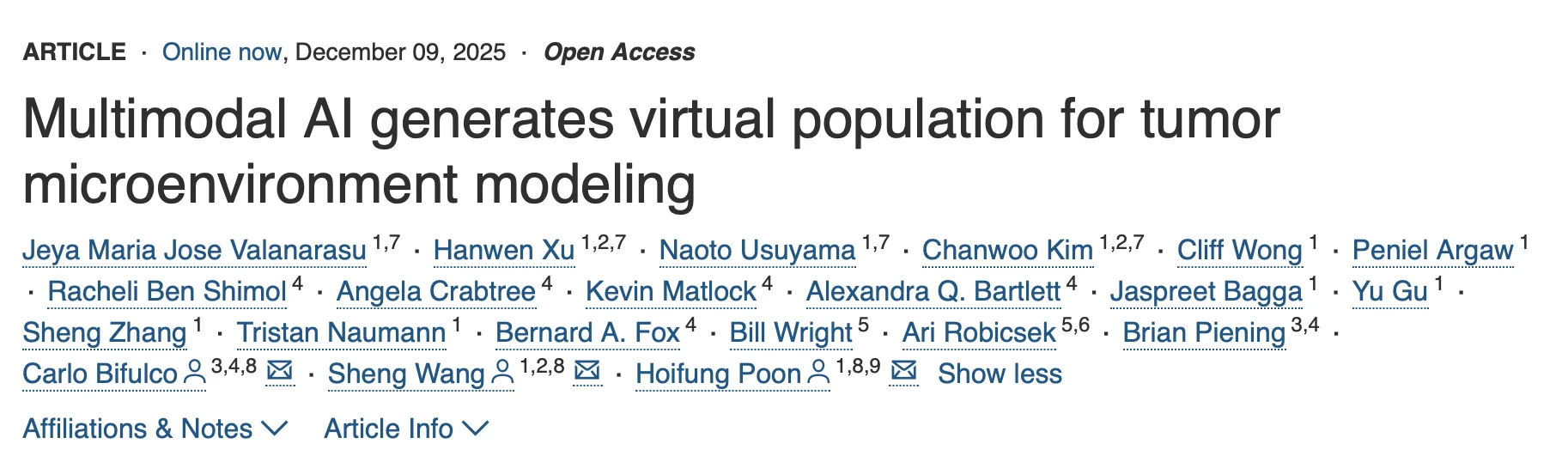
“Our recent paper ‘Multimodal AI generates virtual population for tumor microenvironment modeling’ is now published in Cell.
First, congratulations to Jeya Maria Jose Valanarasu, Hanwen Xu, Naoto Usuyama, Chanwoo Kim, Cliff Wong, Peniel Argaw, Racheli Ben Shimol, Angela Crabtree, Kevin Matlock, Alexandra Q. Bartlett, Jaspreet Bagga, Yu Gu, Sheng Zhang, Tristan Naumann, Bernard A. Fox, Bill Wright, Ari Robicsek, Brian Piening, Carlo Bifulco, Sheng Wang, Hoifung Poon! This work represents years of collaboration between Providence, Microsoft , and the University of Washington.
The Problem
The tumor immune microenvironment (TIME) shapes cancer progression, treatment response, and outcomes. Multiplex immunofluorescence (mIF) and spatial multiomics have recently made fantastic progress, providing deep insights into tissue architecture and cellular composition at unprecedented resolution. Throughput and cost, however, have made population-scale application of these spatial technologies essentially a non-starter, representing a significant limitation of current implementations.
What We Did
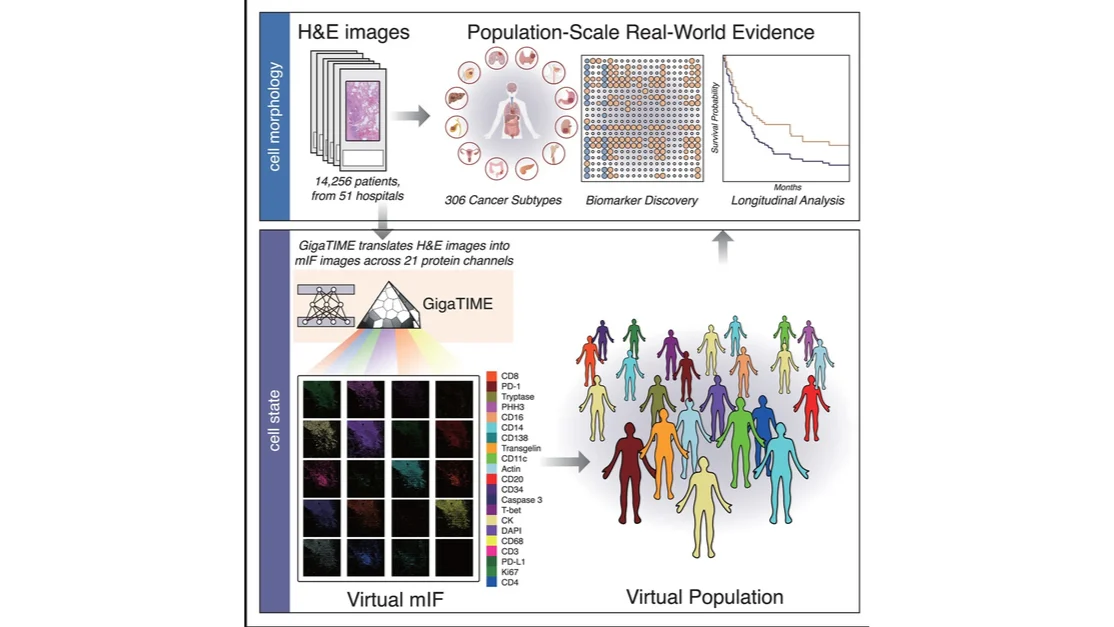
GigaTIME translates widely available H&E diagnostic pathology slides into spatial protein predictions. We trained it on 40 million cells with paired H&E and mIF data across 21 protein channels, then scaled to 14,256 patients across Providence — generating ~300,000 virtual mIF images spanning 24 cancer types. The virtual population revealed over a thousand statistically significant associations between protein expression and clinical outcomes — patterns previously invisible because we simply couldn’t afford to look.
Reflections
- GigaTIME doesn’t replace direct investigation. Virtual predictions based on generative AI do not replace spatial biology, mIF, or other forms of direct tissue investigation. But they open a door: enabling systematic, large-scale application of these platforms to large patient populations.
- This is a proof of concept. Our ability to predict multiomic expression patterns will improve substantially as larger training datasets become available. We’re at the beginning.
- Generative AI is unlocking real-world data. This work builds on recent progress in generative AI and LLMs, which are enabling us to fully leverage the power of real-world data in ways that weren’t previously possible.
- Population-scale spatial biology matters. Scaling spatial biology to populations has the potential to provide novel insights into what drives cancer progression, treatment response, and survival.
- Looking ahead. Synthetic proteomic TIME signatures may unmask mechanisms of immune evasion and help us drive personalized immunotherapies.
Resources
Code: https://github.com/prov-gigatime/GigaTIME
Model: https://huggingface.co/prov-gigatime/GigaTIME”
Title: Multimodal AI generates virtual population for tumor microenvironment modeling
Authors: Jeya Maria Jose Valanarasu, Hanwen Xu, Naoto Usuyama, Chanwoo Kim, Cliff Wong, Peniel Argaw, Racheli Ben Shimol, Angela Crabtree, Kevin Matlock, Alexandra Q. Bartlett, Jaspreet Bagga, Yu Gu, Sheng Zhang, Tristan Naumann, Bernard A. Fox, Bill Wright, Ari Robicsek, Brian Piening, Carlo Bifulco, Sheng Wang, Hoifung Poon
Read the Full Article on Cell
Bernard A. Fox, Co-founder, President, and CEO of UbiVac, shared this post adding:
“Anyone interested in cancer biomarkers and Immunotherapy should take 2 minutes to read this summary from my friend and colleague Carlo Bifulco on GigaTIME and “THE DAWN OF SYNTHETIC SPATIAL BIOLOGY.” This will have an enormous impact on Cancer Immunotherapy Drug Development – including enrolling trials faster. I am sure the FDA is watching.
Now think of it in terms of a paper Prof. Carlo Bifulco forwarded to me today – published last month in Nature..
The paper by Sofia Ibañez Molero, Johanna Veldman, John Haanen,Winan van Houdt, Daniel Peeper and others reported that melanoma metastases – a tumor type that generally contains tumor-reactive T cells (TIL) – showed that T cells in heterotypic clusters were more strongly tumor-reactive. Now think about using GigaTIME to enumerate these clusters in patients with melanoma as well as tumor types that are less immunogenic. Can this further enrich for patients that will respond to checkpoint blockade – and identify patients that need something else? I would suggest that GigaTIME will identify patients that need more than checkpoint blockade with only an H&E. Pharma, pay attention.
In my opinion, the opportunity for patients deemed unlikely to respond to CPI – is to prime B & T cells to cancer antigens the patient’s immune system doesn’t even know that they have – Cancer’s Dark Genome-derived Dark Matter cancer antigens.
- Pancreatic cancer-restricted cryptic antigens are targets for T cell recognition
- Tumor antigens preferentially derive from unmutated genomic sequences in melanoma and non-small cell lung cancer
The debate is on and KOLs are split – See the Bridge2025 meeting in Napoli.
- Cancer’s ‘Dark Matter’ Outshines Neoantigens in Landmark Debate
- Cancer’s ‘Dark Matter’ Outshines Neoantigens in Landmark Debate
Again, In my opinion: The discovery of Dark Antigens that can be safely targeted by the immune system is the cutting edge of the field today. UbiVac and Colleagues have already identified a T cell receptor (TCR) to a sharedDark Matter antigen in a recipient of UbiVac’s DPV001 that is 10+ yr post vaccination and a survivor of NSCLC. That antigen appears to be shared by HNSCC, pancreatic cancer, and possibly more histologies (data at link below).
The impact of AI on hBiomarkers will rapidly change the landscape of what needs to be done in phase I clinical trials.”
More posts featuring Carlo Bifulco.