


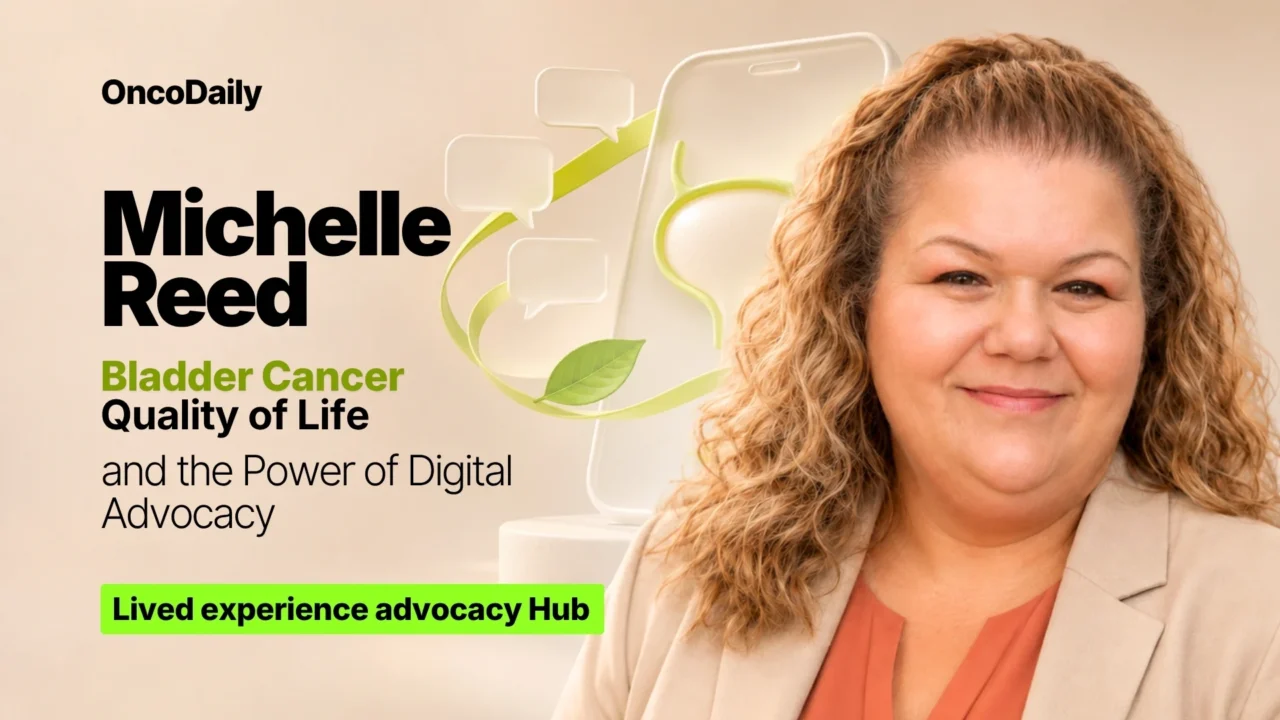
From navigating repeated bladder cancer diagnoses to building online communities and supporting patients across the United States, Michelle Reed shares how lived experience can become a powerful force for advocacy. When Michelle Reed was diagnosed with bladder cancer in 2018, she struggled to find someone whose experience reflected her own. As a younger woman navigating a disease often associated with older men, she felt invisible in many of the patient spaces she encountered.
Her journey has included ten recurrences, ongoing surveillance and treatment, chronic pain, mobility challenges and the financial burden of cancer care. It has also led her to build a community where other patients can find the information, understanding and support she once searched for herself.
Through her platform Bless Your Vibes, social media advocacy, peer mentoring and collaborations with cancer organisations, Michelle is helping people navigate bladder cancer while advocating for more inclusive, accessible and patient-centred care.
In this edition of The Advocacy Lens by the Lived Experience Hub, Michelle reflects on the realities of living with bladder cancer, the importance of quality of life and why people with lived experience must be involved in shaping research and healthcare.
Your journey with bladder cancer has involved multiple challenges, from diagnosis and treatment to navigating life with a disability.
How has this experience shaped who you are today and your decision to become a patient advocate?
My bladder cancer story started before anyone called it cancer.
For about ten months, my symptoms were dismissed as recurring urinary tract infections and small kidney stones. After my hysterectomy, I knew that blood in my urine wasn’t normal, so I kept pushing for answers until I received my diagnosis in 2018. My first urologist recommended surveillance only, which never felt right to me. I also couldn’t receive BCG, a standard treatment for certain types of bladder cancer, because I had previously been treated for tuberculosis as a young adult. I felt I had to fight for every treatment option available to me.
Since then, I’ve experienced ten recurrences, both low- and high-grade, and I’ve kept my bladder. Alongside cancer, I live with chronic pain and debilitating osteoarthritis with nerve damage that severely affects my mobility. After a bad fall, I became nearly homebound and feared I would spend the rest of my life inside my house.
Then a mobility aid changed everything. My Alinker, a yellow walking wheelchair I named Gulliver, helped me get back into the world. In 2024, it even accompanied me on my first trip abroad. All these experiences shaped the advocate I am today. When I was diagnosed, I couldn’t find anyone like me. I was a younger woman who didn’t fit the typical bladder cancer profile, and I was determined to keep my bladder.
Along the way, I learned to speak up for myself, change doctors when I wasn’t being heard and correct inaccuracies in my medical records. Once I realised how many other people were facing similar challenges without knowing how to advocate for themselves, advocacy became my mission.
I wanted to be the person I needed when I was diagnosed.
Where there’s a will, there’s a way, and I want to help other patients find their way through their cancer journey.
During our conversation, you spoke about the importance of quality of life, not just quantity of life.
What does quality of life mean to you, and what do you wish healthcare professionals better understood about the long-term physical and emotional impact of cancer and its treatment?
For me, quality of life means getting to live, not just existing to suffer. It means keeping my bladder, making memories with my family, travelling, going to concerts and being part of the world instead of being stuck at home and relying on others. I’ve always been independent, often out of necessity.
What I wish more healthcare professionals understood is that the impact of cancer doesn’t end when a patient leaves the clinic. Every recurrence brings back the fear. I’ve spent eight years undergoing surveillance and treatments, and the fear of cancer returning never completely goes away. The pain adds up, and so do the medical bills.
I carry years of medical debt, to the point of financial toxicity. I’ve delayed care for my other health conditions simply to manage the costs. I find myself in that difficult position of earning too much to qualify for assistance but not enough to afford my medical expenses. That’s also part of why I fight so hard to keep my bladder.
The possibility of living with a urostomy, managing potential leaks, infections or skin problems, and paying for supplies for the rest of my life is frightening to me. I worry about what would happen if I couldn’t afford those supplies one day, especially as I get older. I also wish more healthcare professionals looked at the whole person.
I’ve had doctors dismiss my pain and tell me to eat better or exercise more without asking what I’ve already done to improve my health.
When you only look at the cancer, you miss the person living with it.
There are gaps in care, and too often patients fall through them when they shouldn’t have to.
You have built a presence on TikTok, using your platform to talk openly about bladder cancer, symptoms, treatment side effects and the emotional realities of living with cancer.
What motivated you to start sharing your experience publicly, and how has your advocacy evolved since then?
I started sharing because I couldn’t find anyone who looked like me in bladder cancer spaces. Most of the stories I encountered were from older men, and as a younger woman, I felt invisible. So I decided to become the person I was searching for.
I started Bless Your Vibes during the COVID-19 pandemic as a creative outlet. Over time, it became a way to connect with and support other younger patients living with bladder cancer. I thought that if someone like me was searching for someone who understood their experience, perhaps they would find me.
And they did!
At one point, I had more than 10,000 followers on TikTok through bless your vibes. I talk openly about things people often whisper about, such as blood in the urine, treatment side effects and the emotional weight of experiencing recurrence after recurrence.
I also share my everyday life because I believe in leading by example. People often tell me that seeing me continue through difficult times encourages them to keep going too. My advocacy has grown significantly.
I now run the Atlanta Bladder Cancer Facebook group and moderate three additional groups. I’ve supported dozens of patients one-on-one and mentor through BCAN’s Survivor 2 Survivor programme and Imerman Angels.
I’ve also developed a searchable directory of more than 700 cancer resources on my website. In addition, I serve as a Tigerlily Foundation Bladder Cancer Ambassador and a National Patient Advocate Foundation Community Impact Ambassador.
I support other cancer advocacy organisations and regularly attend conferences and webinars to stay informed so I can share relevant information with my community. What started as me talking to my phone has become a trusted resource and a meaningful voice within the online bladder cancer community.
You mentioned some meaningful connections you have made through social media, including people who reached out to share how your content had impacted their lives.
Is there a particular interaction or story that reminded you why your advocacy work matters?
A few years ago, a young woman contacted me through TikTok. She was terrified.
She had been diagnosed with non-muscle-invasive bladder cancer and had received intravesical mitomycin treatment. Unfortunately, her cancer returned, and her doctor recommended bladder removal as the next step. I started asking questions because I felt such a major decision deserved further discussion.
She lived in a rural area and was being treated by a general urologist rather than a urologic oncology specialist. I’m not a doctor, so I encouraged her to seek a second opinion from a urologic oncologist at a teaching hospital. The closest hospital was about two hours away, but she made the appointment.
According to what she later shared with me, the specialist felt there were other treatment options to explore before removing her bladder. She began maintenance treatment with gemcitabine, with the aim of preserving her bladder. She was incredibly relieved.
I helped her understand the questions she could ask, the options she could discuss with her medical team and some of the treatments being developed. Ultimately, she made the decision that felt right for her, and I supported her throughout the process. The journey to the hospital is still inconvenient, but she’s doing well with that clinic. Years later, we still keep in touch, and we’ve become good friends.
Moments like that remind me why I continue doing this work. Nobody handed me a map when I was diagnosed.
If I can be that map for even one person, every honest post is worth it.
We also discussed the barriers that women, particularly women of colour and those from underserved communities, may face when seeking information, support and appropriate cancer care.
From your perspective, what needs to change to make bladder cancer care and patient advocacy more inclusive and accessible?
Women with bladder cancer can experience delays in diagnosis because symptoms such as blood in the urine are sometimes attributed to urinary tract infections or menstruation.
That’s what happened to me. My symptoms were repeatedly blamed on UTIs. Because I’d already undergone a total hysterectomy, I knew the bleeding wasn’t menstrual. Otherwise, I might have assumed it was spotting and ignored it.
I worry that this could have delayed my diagnosis even further. For women of colour and women in underserved communities, these challenges can be compounded by additional barriers to accessing care and being taken seriously.
Several things need to change. First, healthcare professionals need to take blood in the urine seriously and investigate it appropriately rather than repeatedly prescribing antibiotics without further evaluation. Second, patient education materials need to reflect the diversity of the people affected by bladder cancer.
Women, women of colour, plus-size people, LGBTQIA+ people and people with disabilities should be represented so that nobody feels excluded from conversations about this disease. Information also needs to be available in plain language and multiple languages.
Support services must reflect people’s everyday realities. Many support groups meet during weekday mornings, making participation difficult for people who work, care for family members or depend on others for transportation. Evening, weekend and virtual options can make support more accessible.
Finally, we need to include advocates from underrepresented communities in decision-making processes and compensate them for their time and expertise.
People trust people who understand their experiences.
Too often, advocates carry out the demanding, unpaid work of supporting others without receiving adequate support themselves.
Looking ahead, what would you like to achieve through your advocacy, and what message would you share with researchers, healthcare professionals and the cancer community about the value of listening to people with lived cancer experience?
Right now, I’m co-organising the first BCAN Walk to End Bladder Cancer in Atlanta, scheduled for May 2027. I believe it will be the first event of its kind in Georgia.
Looking further ahead, I want every newly diagnosed patient to leave their first appointment with a clear map of where to find help. Nobody should have to spend eight years searching for the resources and support they need, as I did. My message to researchers and healthcare professionals is simple. We live with this disease every day, long after the medical appointment ends.
We notice gaps that may not be visible from inside the clinic, and we often know which resources are useful because we’ve needed and used them ourselves. So invite us into the conversation early, when you’re designing a study or developing a programme, not only after everything has already been decided. Pay us for our time and listen to us, even when what we have to say is difficult to hear.
When patients and professionals work together, care gets better for everyone.
You may also be interested in: