Benjamin Walbaum, Medical Oncologist at Pontifical Catholic University of Chile, shared a post on LinkedIn:
“Breast Cancer Weekly Highlights | April 1–6, 2026
My take from last week’s breast cancer publications.
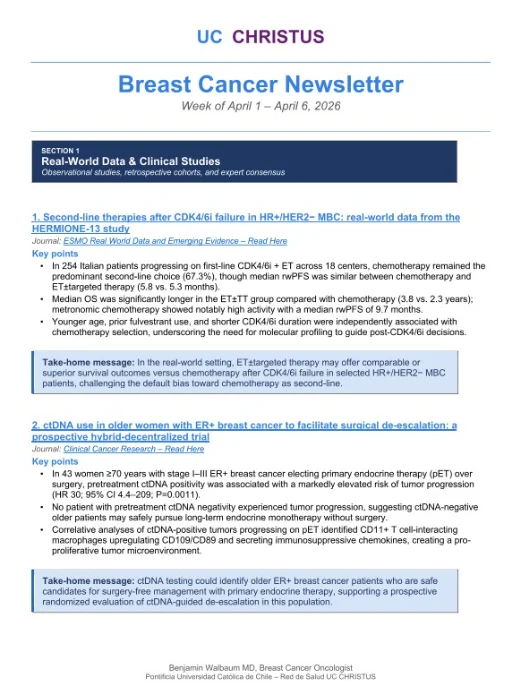
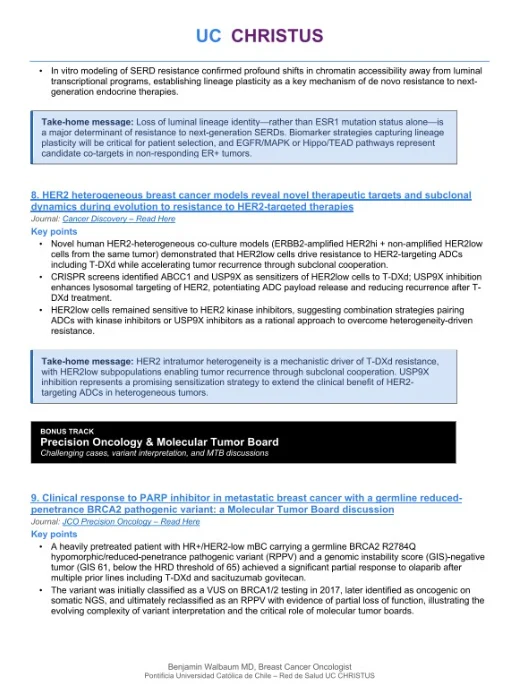
1.Second-line therapies after CDK4/6i failure in HR+/HER2− MBC: real-world data from the HERMIONE-13 study – ESMO Real World Data and Emerging Evidence
- Endocrine therapy ± targeted therapy may remain a valid post-CDK4/6 option in selected patients, with survival outcomes that challenge the routine default to chemotherapy.
2.ctDNA use in older women with ER+ breast cancer to facilitate surgical de-escalation: a prospective hybrid-decentralized trial – Clinical Cancer Research
- Pretreatment ctDNA negativity identified a subgroup of older women who may be candidates for surgery-free management with primary endocrine therapy.
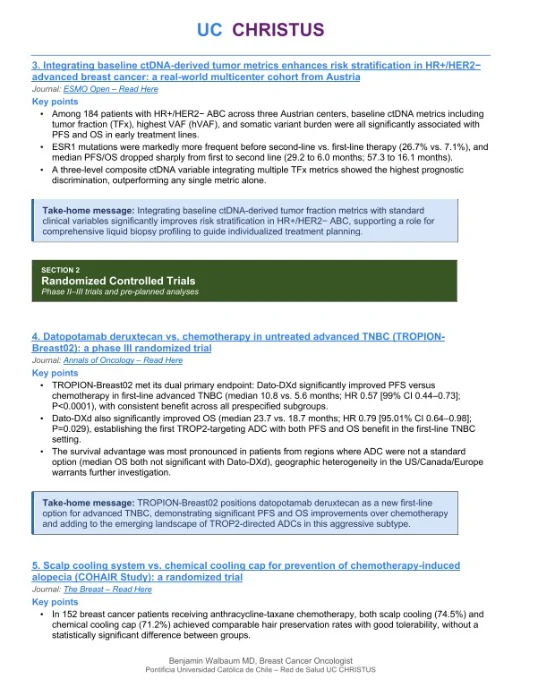
3.Integrating baseline ctDNA-derived tumor metrics enhances risk stratification in HR+/HER2− advanced breast cancer: a real-world multicenter cohort from Austria – ESMO Open
- Baseline ctDNA tumor fraction metrics improved prognostic stratification beyond standard clinical variables, supporting broader use of liquid biopsy in HR+/HER2− advanced disease.
4.Datopotamab deruxtecan vs. chemotherapy in untreated advanced TNBC (TROPION-Breast02): a phase III randomized trial – Annals of Oncology
- Dato-DXd delivered both PFS and OS benefit over chemotherapy, strengthening its role as a potential new first-line standard in advanced TNBC.
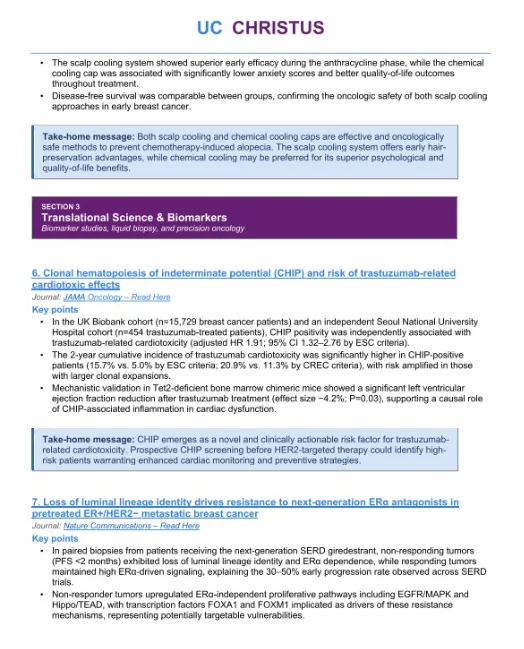
5.Scalp cooling system vs. chemical cooling cap for prevention of chemotherapy-induced alopecia (COHAIR Study): a randomized trial – The Breast
- Both scalp cooling strategies were effective and oncologically safe, with efficacy and patient experience emerging as key differentiators.
6.Clonal hematopoiesis of indeterminate potential (CHIP) and risk of trastuzumab-related cardiotoxic effects – JAMA Oncology
- CHIP may become a clinically relevant biomarker to identify patients at increased risk of trastuzumab-related cardiotoxicity before starting HER2-targeted therapy.
7.Loss of luminal lineage identity drives resistance to next-generation ERα antagonists in pretreated ER+/HER2− metastatic breast cancer – Nature Communications
- Lineage plasticity, more than ESR1 mutation status alone, may be a central mechanism of resistance to next-generation SERDs.
8.HER2 heterogeneous breast cancer models reveal novel therapeutic targets and subclonal dynamics during evolution to resistance to HER2-targeted therapies – Cancer Discovery
- HER2-low subclones appear to drive T-DXd resistance and recurrence in heterogeneous tumors, highlighting HER2 heterogeneity as a biologically relevant therapeutic challenge.
BONUS TRACK
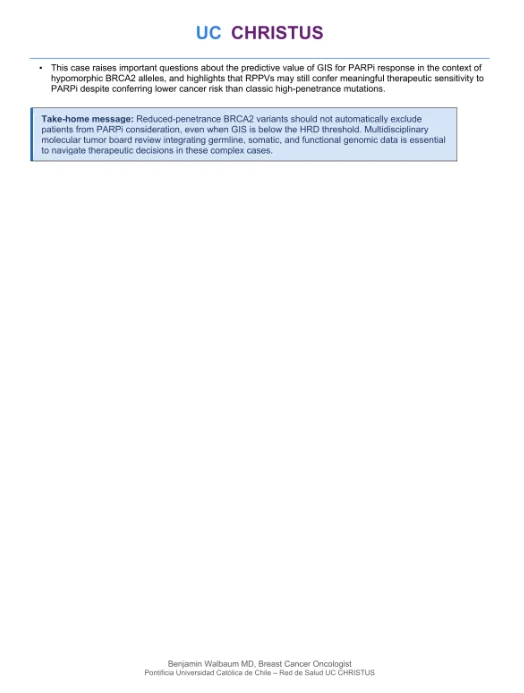
Clinical response to PARP inhibitor in metastatic breast cancer with a germline reduced-penetrance BRCA2 pathogenic variant: a Molecular Tumor Board discussion – JCO Precision Oncology
- This case illustrates that reduced-penetrance BRCA2 variants may still carry therapeutic relevance for PARP inhibition and deserve careful multidisciplinary interpretation.”