






Benjamin Walbaum, Medical Oncologist at Pontifical Catholic University of Chile, shared a post on LinkedIn:
“Breast Cancer – Weekly Key Takeaways.
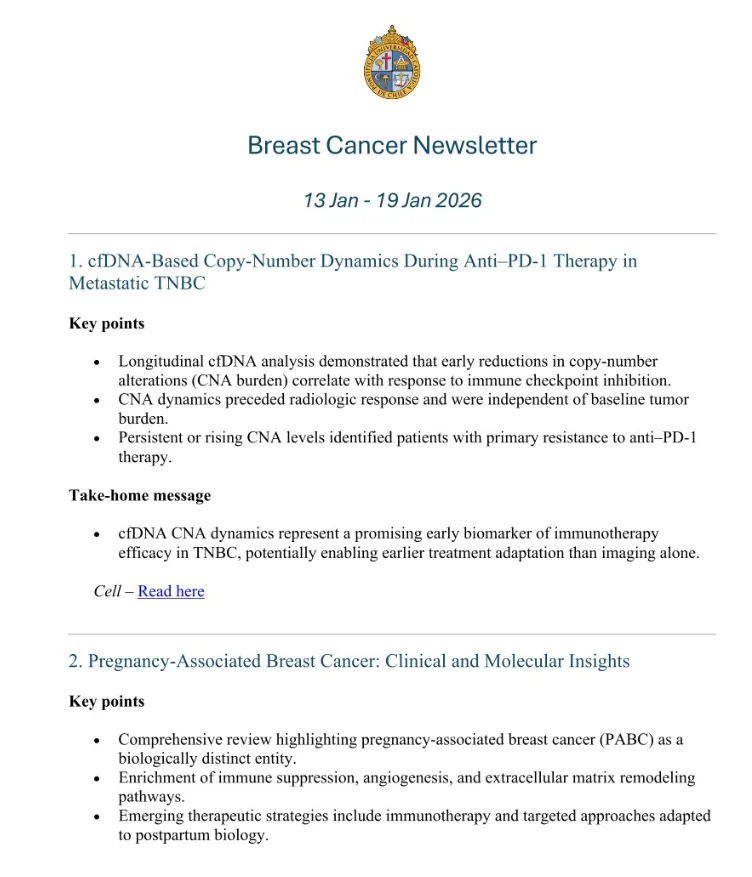
1. cfDNA-Based Copy-Number Dynamics During Anti–PD-1 Therapy in Metastatic TNBC, Cell.
Dynamic changes in cfDNA copy-number alterations capture chromosomal instability in TNBC and predict immunotherapy benefit earlier and more meaningfully than ctDNA tumor burden or imaging.
2. Pregnancy-Associated Breast Cancer: Clinical and Molecular Insights, European Journal of Cancer.
Pregnancy-associated breast cancer represents a biologically distinct entity, enriched for immune suppression and pro-angiogenic programs, requiring tailored therapeutic and research approaches.
3. Postpartum Breast Cancer: Evidence for a Distinct Phenotype, Journal of the National Cancer Institute (JNCI).
Postpartum breast cancer carries an independent adverse prognosis driven by involution-related inflammatory biology, not adequately captured by standard risk stratification.
4. Optimizing Adjuvant Endocrine Therapy in Premenopausal HR+/HER2+ Breast Cancer, The Breast (Editorial).
Residual disease after neoadjuvant anti-HER2 therapy identifies premenopausal patients most likely to benefit from endocrine intensification, while benefit after pCR is limited.
5. Extended Endocrine Therapy After 5 Years of LHRH Agonists in Premenopausal Patients, Journal of Clinical Oncology (JCO).
In young, node-positive HR+ patients who remain premenopausal, extended endocrine therapy significantly reduces late invasive and distant recurrences with acceptable toxicity.
6. Cardiovascular Adverse Events With Denosumab vs Zoledronic Acid in Breast Cancer, Breast Cancer Research and Treatment.
Choice of bone-modifying agent matters: denosumab was associated with fewer cardiovascular events than zoledronic acid, a relevant consideration in long-term survivors.
7. Sentinel Lymph Node Biopsy vs Targeted Axillary Dissection After Neoadjuvant Chemotherapy, Annals of Surgical Oncology.
Axillary de-escalation after neoadjuvant therapy is oncologically safe; whether TAD offers clinically meaningful advantages over optimized SLNB remains uncertain.
8. PD-L2 Landscape and Correlation With Outcome: An Immunomic Analysis, Journal of Clinical Oncology (JCO).
PD-L2 emerges as an underrecognized immune checkpoint in breast cancer, with potential predictive value for response to anti-PD-1 therapy beyond PD-L1 alone.
9. Personalized Management of HER2-Positive Breast Cancer During Pregnancy: A Clinical Case and Review, Frontiers in Oncology.
HER2-positive breast cancer during pregnancy requires individualized, multidisciplinary management, balancing biological risk with strict treatment constraints to protect fetal safety.
10. De-escalation Strategies for Axillary Management at Primary Surgery in Early Breast Cancer, Cancer Treatment Reviews.
Axillary de-escalation is safe in selected patients, but nodal staging still influences access to adjuvant systemic therapies, underscoring the need for biology-driven decisions.”
More posts featuring Benjamin Walbaum.