
Ash Tewari, Surgeon-In-Chief Tisch Cancer Hospital at Tisch Cancer Hospital at Mount Sinai Health System, shared on LinkedIn:
“Prostate cancer deaths are climbing again: about 36,320 in the US in 2026, and the decline in the death rate has slowed to about 0.6% a year since 2012. More men are now diagnosed with distant-stage disease.
My team put the numbers on slides, and I walk through them here, keeping the firm figures apart from the estimates. The 2026 ACS guideline’s own models show 14 to 16 lives saved per 1,000 men screened. Our national scenario, about 14,000 deaths a year avoided by 2040, is an estimate, not a result.
Bottom line is, not every high PSA needs a biopsy, but every man should know his risk.
Prostate cancer deaths are climbing again. What could the new guideline prevent?
My team at Mount Sinai put together a set of slides on why prostate cancer screening matters again. Let me walk you through what the numbers show, where they are firm, and where they are only estimates.
Bottom line first: deaths are rising, more men are found late, and the new American Cancer Society guideline could prevent thousands of deaths a year. Exactly how many is still an estimate.
How many men does prostate cancer affect today?
About 333,830 American men will be diagnosed in 2026, and about 36,320 will die of it. That is roughly 100 men every day.
About 1 in 8 men will be diagnosed in his lifetime. Black men face about twice the death rate of White men.
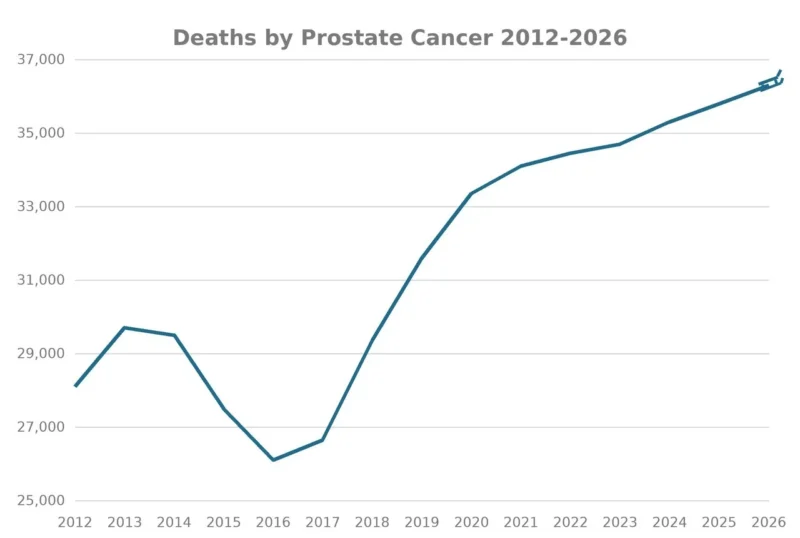
The American Cancer Society’s yearly death estimates, 2012–2026. These are forecasts made each year, not counted deaths. Chart from my team’s slides.
Those yearly estimates rose from 26,120 for 2016 to 36,320 for 2026. They are forecasts, not counts. The CDC counted 34,815 deaths in 2024.
Weren’t prostate cancer deaths falling?
The death rate still is, but only slowly. It fell by 53% from its 1993 peak, from 39.9 to 18.7 per 100,000 men in 2023.
Since 2012 that decline has slowed to about 0.6% a year, meaning progress has nearly stalled. More men are now reaching the ages when prostate cancer is common, so the number of deaths is climbing.
Over the same years, more men were diagnosed after the cancer had already spread.
Why are more men found late?
Less screening is the most likely reason, though not the only one. In 2012, the US Preventive Services Task Force recommended against routine PSA screening, and testing fell.
Since then, diagnoses of cancer that has already spread to distant organs have risen by about 5% a year. Wider use of sensitive MRI may explain part of the rise.
Kratzer and colleagues at the American Cancer Society found this rise in every age group. Over the past decade of data it was 2.6% a year under 55, 6.0% at 55 to 69, and 6.2% at 70 and older.
About 9% of men are now diagnosed at this distant stage. Timing matters: five-year relative survival is 100% when the cancer is still inside the prostate, and about 40% once it has reached distant organs.
The shift shows up in the operating room too. Freitas and colleagues studied 610,762 US men who had their prostate removed. Cancer that had grown beyond the prostate rose from 20% in 2006–2010 to 38% in 2016–2020.
In the same database, cancer in the lymph nodes rose from 2.4% to 6.7%. Part of this reflects who goes to surgery, because fewer low-risk men had an operation over those years.
Is this only an American problem?
No. The Lancet Commission on prostate cancer projects deaths worldwide rising from 375,000 in 2020 to close to 700,000 a year by 2040. Populations are aging, and men live longer.
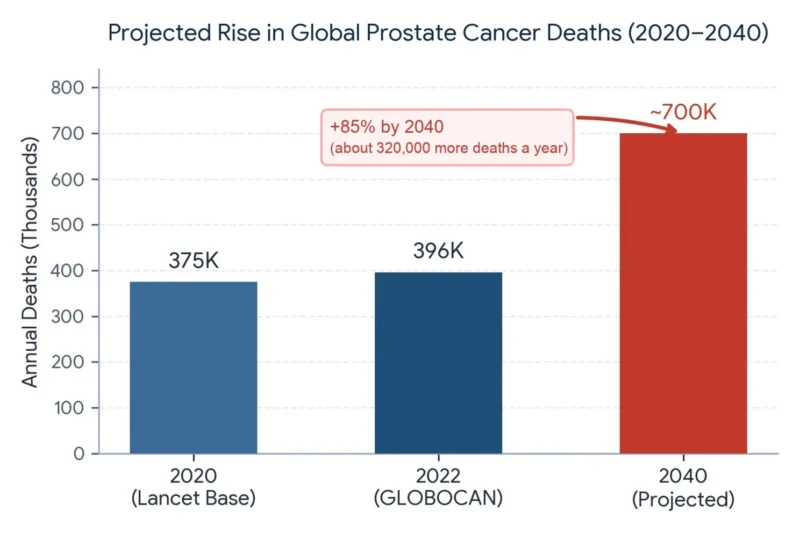
Projected prostate cancer deaths worldwide. Lancet Commission 2024 and GLOBOCAN 2022. Chart from my team’s slides; callout corrected to match the Lancet figure.
New cases could double, from 1.4 million to 2.9 million a year. The Commission found late diagnosis common everywhere, and the norm in low- and middle-income countries.
How many deaths could the new guideline prevent?
In the guideline’s own models, screening saves 14 to 16 lives for every 1,000 men screened. Any national total is only an estimate.
The 2026 American Cancer Society guideline now recommends regular screening. Men at average risk get a PSA test every 2 years from 50 to 69, after an informed discussion with their doctor.
Black men and men with a strong family history test every year from 45. A high PSA is repeated first, and an MRI or a biomarker test helps decide who needs a biopsy.
Those model figures assume a PSA test every 2 years from 50 to 69, with MRI before biopsy.
The benefit is larger where the risk is higher. It is 28 to 36 lives per 1,000 Black men, and 22 to 25 with a first-degree family history.
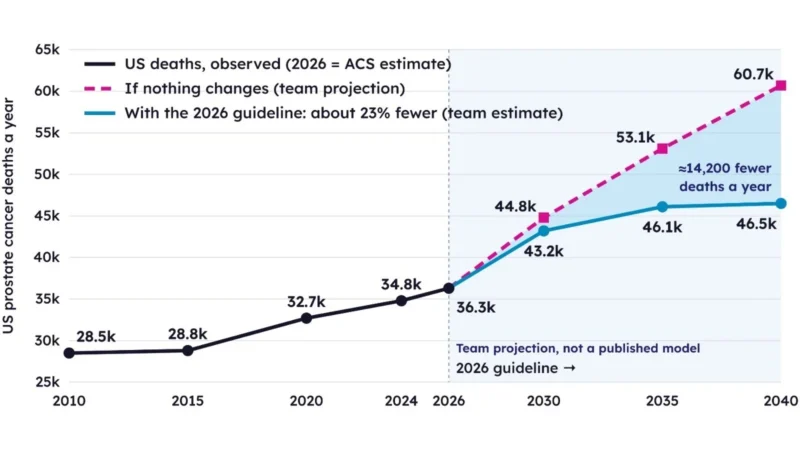
US prostate cancer deaths to 2040: “if nothing changes” (aging population plus a continued late-stage shift) against a 23% cut in deaths. Projection from my team’s slides, redrawn with the same values; not a published model. The 2026 point is the ACS estimate.
My team also asked what this could mean for the whole country. If nothing changes, their projection has US deaths climbing to about 60,700 a year by 2040.
In the European screening trial, men who were screened had 27% fewer prostate cancer deaths at 13 years. Among all men invited, the figure was 21%.
Taking about 23% off the 2040 number, between the trial’s two figures, gives roughly 14,000 deaths a year avoided. Please read that as a scenario, not a result.
Another US projection, by Rahib and colleagues, assumed death rates keep falling and expected about 26,000 prostate cancer deaths in 2040. If that is closer to the truth, the benefit would be smaller.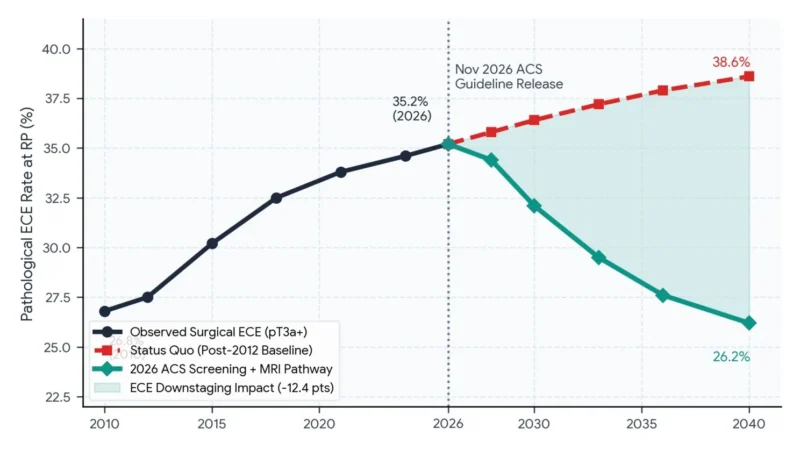
Cancer grown beyond the prostate at surgery, with and without the 2026 guideline. From my team’s slides. The values are not from a published series, and the curves after 2026 are an illustration.
My team drew the same idea for surgery. If more cancers are found early, fewer should have grown outside the prostate or into the lymph nodes by the time of the operation.
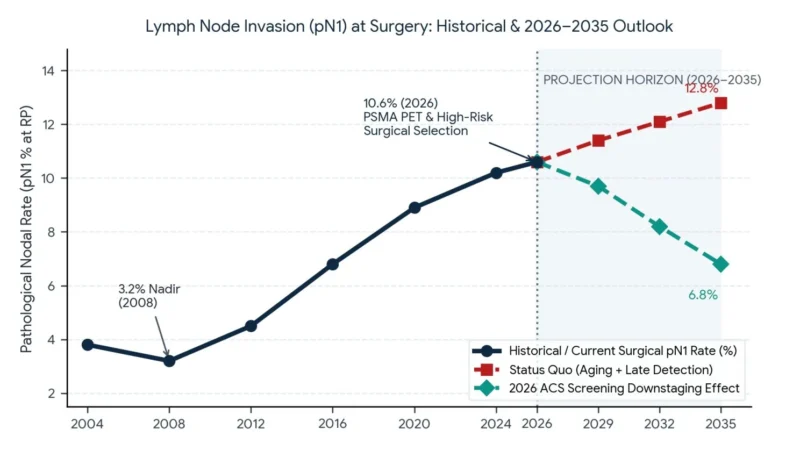
Cancer in the lymph nodes at surgery, with and without the 2026 guideline. From my team’s slides. The values are not from a published series, and the curves after 2026 are an illustration.
Those two charts show a direction, not a forecast. The published numbers are the ones in the text above.
What are the limits?
Most of the big numbers here are estimates. Yearly death figures are forecasts, and any 2040 projection depends on what we assume about death rates.
Screening also has harms, including what we call overdiagnosis: finding a cancer that would never have caused symptoms.
The same strategy that saves 14 to 16 lives would overdiagnose 17 to 41 of every 1,000 men screened, in the guideline’s models. The numbers are higher for Black men and men with a family history.
That is why the guideline repeats a high PSA first, uses MRI or a biomarker test before a biopsy, and offers active surveillance for low-risk cancer.
What should you do?
Bottom line is, know your risk and talk with your doctor about when to start. Not every high PSA needs a biopsy, but every man should know where he stands.
In New York, our mobile screening unit brings PSA testing to communities. Men 45 to 79 can call 646-531-8092; from 75, talk with your doctor first.
You can also read:
- American Cancer Society Journals Highlight New Evidence for PSA-Based Prostate Cancer Screening
- New Prostate Cancer Screening Guidelines Recommend Regular PSA Testing