
For years, prostate cancer screening has been surrounded by a difficult question: Can testing save lives without exposing too many men to unnecessary biopsies and treatments?
The new prostate cancer screening guidelines from the American Cancer Society (ACS) suggest that the balance has shifted.
Published on November 12, 2026, in CA: A Cancer Journal for Clinicians, the updated guidelines now directly recommend regular prostate-specific antigen (PSA) testing for men in defined age and risk groups.
For men at average risk, screening is recommended every two years between ages 50 and 69. Men at higher risk, including Black men and those with a strong family history of prostate cancer, should begin annual screening at age 45.
This represents an important change from the ACS’s previous 2010 recommendations, which emphasized informed decision-making rather than directly recommending routine screening.
The shift reflects growing evidence that PSA-based screening can reduce deaths from prostate cancer, alongside improvements in diagnostic imaging, risk assessment, and active surveillance that can help reduce unnecessary treatment.
Why Are Prostate Cancer Screening Guidelines Changing Now?
Prostate cancer remains one of the most frequently diagnosed cancers among men worldwide and the second leading cause of cancer-related death among men in the United States.
According to ACS estimates, approximately 333,830 men will be diagnosed with prostate cancer in the United States in 2026, and 36,320 will die from the disease.
The changing pattern of prostate cancer diagnoses has also raised concerns. Although many prostate cancers are slow-growing, the incidence of advanced-stage disease has increased in recent years.
One important factor behind the updated recommendations is the availability of longer-term evidence from randomized screening trials.
The European Randomized Study of Screening for Prostate Cancer (ERSPC), published with 23 years of follow-up in The New England Journal of Medicine in October 2025, reported a 13% relative reduction in prostate cancer mortality among men invited for PSA screening compared with those not invited.
The absolute reduction in prostate cancer mortality was 0.22 percentage points, corresponding to approximately one prostate cancer death prevented for every 456 men invited for screening over the follow-up period.
These findings reinforce the long-term benefits of screening while also demonstrating why minimizing overdiagnosis remains essential.
New Prostate Cancer Screening Guidelines: Who Should Be Tested?
The 2026 ACS guidelines introduce clearer recommendations based on age, family history, and risk.
| Population | Recommended screening |
|---|
For men aged 70–74 who choose to continue screening, the guideline recommends a two-year interval. Screening can be discontinued after a PSA result below 3 ng/mL.
Although routine screening is not recommended after age 75, exceptionally healthy men aged 75–79 may discuss continued testing with their clinician, particularly if previous PSA levels have been rising. Screening is not recommended for men aged 80 or older or those with a life expectancy below ten years.
Importantly, these general recommendations do not replace specialized recommendations for men with hereditary cancer syndromes, such as those carrying pathogenic BRCA2 variants, who may require earlier screening and genetic counseling.
An Elevated PSA No Longer Means an Immediate Biopsy
One of the most clinically relevant aspects of the updated guidelines concerns what happens after an abnormal PSA result.
An elevated PSA level does not necessarily indicate prostate cancer. Benign prostate enlargement, inflammation, and other conditions may also increase PSA concentrations.
The ACS recommends further evaluation at the following thresholds:
- Ages 45–69: PSA of 3.0 ng/mL or higher.
- Ages 70–74: PSA of 6.5 ng/mL or higher.
Rather than proceeding directly to biopsy, men with an initially elevated PSA should generally undergo repeat testing within two weeks to three months.
For most men whose PSA remains elevated, the next step should include prostate magnetic resonance imaging (MRI) and/or a validated biomarker test to better assess the likelihood of clinically significant cancer and guide decisions about biopsy.
This approach may help avoid unnecessary invasive procedures while preserving the ability to detect cancers that require treatment. However, a suspicious examination or markedly elevated PSA may justify a more direct diagnostic approach.
The guidelines also recommend against using digital rectal examination as the primary screening test.
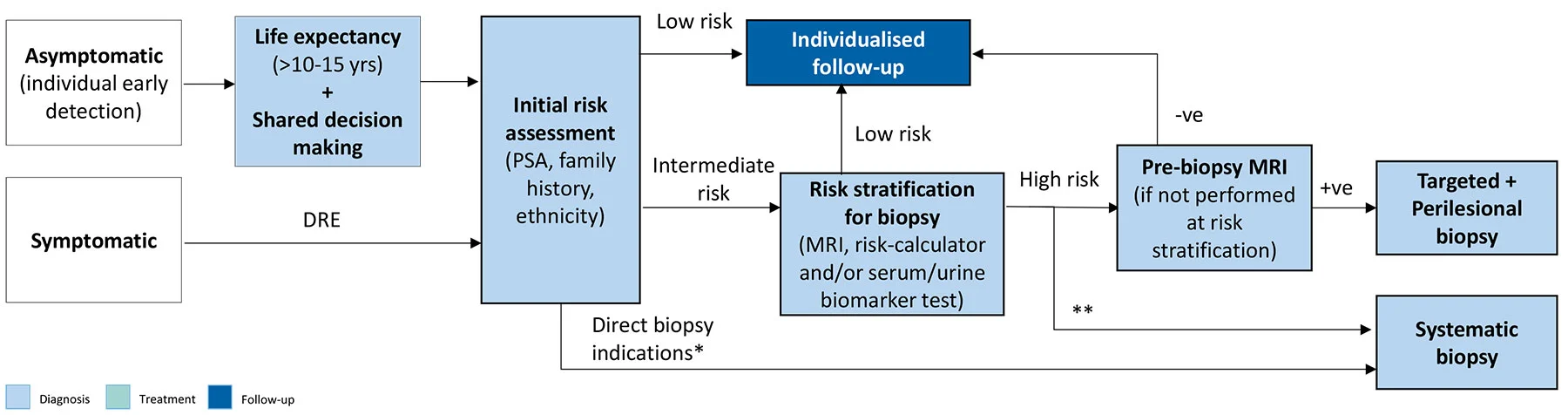
Risk-adapted diagnostic pathway for prostate biopsy according to the 2026 EAU guidelines. Source: European Association of Urology, Figure 5.1.
Finding Cancer Does Not Always Mean Treating It
Perhaps the most important change in modern prostate cancer screening is not the PSA test itself, but what happens after cancer is detected. In the past, screening raised concerns that too many men were undergoing surgery or radiotherapy for tumors that might never become clinically significant.
Such treatments can have substantial consequences, including urinary incontinence, erectile dysfunction, and bowel-related complications. The updated ACS recommendations emphasize active surveillance as the initial management option for low-risk prostate cancer.
Active surveillance involves structured monitoring with PSA testing, clinical assessment, MRI, and repeat biopsies when indicated, allowing treatment to be introduced if evidence of progression or higher-risk disease emerges.
This approach aims to preserve quality of life without compromising the timely treatment of clinically significant cancers.
How Do the New Guidelines Compare With NCCN and European Recommendations?
The ACS update is part of a broader movement toward risk-adapted prostate cancer screening.
The 2026 European Association of Urology (EAU) guidelines, developed with several collaborating organizations, also support individualized early detection.
The EAU recommends considering PSA testing from age 50 in men without additional risk factors, from age 45 in men of African descent or with a relevant family history, and from age 40 in men carrying BRCA2 mutations.
Unlike the ACS’s defined biennial schedule for average-risk men, the EAU emphasizes adjusting subsequent screening intervals according to baseline PSA levels and individual risk. It recommends considering early detection in appropriately informed men with a life expectancy of at least 15 years.
The National Comprehensive Cancer Network (NCCN) also maintains separate guidance on prostate cancer early detection, emphasizing risk assessment, family history, genetic susceptibility, and tailored screening decisions.
Although these organizations differ in some starting ages, intervals, and eligibility criteria, they increasingly share a central principle: prostate cancer screening should identify clinically significant disease while minimizing unnecessary interventions.
The new ACS recommendations also differ from the currently published US Preventive Services Task Force (USPSTF) recommendation, issued in 2018, which supports individualized PSA screening decisions for men aged 55–69 and recommends against screening at age 70 and older.
The USPSTF recommendation is undergoing an update.
Can Earlier Screening Reduce Prostate Cancer Disparities?
Another important feature of the ACS guidelines is their explicit emphasis on populations disproportionately affected by prostate cancer.
Black men in the United States have higher prostate cancer incidence and mortality rates than many other population groups. The recommendation for annual screening beginning at age 45 aims to improve opportunities for earlier detection.
However, disparities in cancer outcomes cannot be addressed through screening alone. Access to primary care, specialist consultations, MRI, biopsy, pathology, and appropriate treatment remains essential.
An abnormal PSA result is only clinically useful when patients can receive timely diagnostic evaluation and, when necessary, effective treatment.
The ACS acknowledges that the evidence supporting specific screening intervals for higher-risk populations is less certain than the evidence for average-risk screening. Some recommendations are based on expert consensus, modeling, and population-level risk estimates.
This distinction is important when translating guidelines into national screening programs.
What Do the 2026 Prostate Cancer Screening Guidelines Mean for Clinical Practice?
The updated ACS recommendations could influence how prostate cancer screening is discussed and implemented in primary care and oncology. Rather than presenting PSA testing solely as an optional test to consider, clinicians now have a more direct recommendation for eligible men.
Nevertheless, informed decision-making remains necessary. Before screening, patients should understand the potential benefits, false-positive results, possible investigations, and risks of overdiagnosis.
The guidelines also reinforce the importance of a coordinated diagnostic pathway, from PSA testing and risk assessment to MRI, biopsy, and management decisions. For health systems, particularly those with limited access to advanced diagnostic technologies, implementing these recommendations will require careful consideration of diagnostic capacity, referral pathways, and equitable access.
A New Direction for Prostate Cancer Screening
The 2026 American Cancer Society guidelines mark a significant development in the debate over prostate cancer screening.
The message is no longer simply about whether to perform a PSA test. It is about when to screen, whom to screen more frequently, how to investigate abnormal findings, and which cancers truly require treatment.
The evidence increasingly supports the benefits of PSA-based screening for appropriately selected men, while modern diagnostic and surveillance strategies offer opportunities to limit avoidable harm.
Ultimately, the success of the new guidelines will depend not only on increasing screening participation but also on ensuring that every subsequent step in the prostate cancer care pathway is appropriate, accessible, and evidence-based.
References
- American Cancer Society Guideline for the Early Detection of Prostate Cancer, 2026. CA: A Cancer Journal for Clinicians. 2026.
- American Cancer Society Updates Prostate Cancer Screening Guideline. American Cancer Society. November 12, 2026.
- EAU-EANM-ESTRO-ESUR-ISUP-SIOG Guidelines on Prostate Cancer, 2026. European Association of Urology. 2026.
- European Study of Prostate Cancer Screening—23-Year Follow-up. New England Journal of Medicine. 2025.
Read further on OncoDaily: Joe Biden Says Prostate Cancer Is Slowing Him Down Ahead of Memoir Release