Antonio Lázaro Sánchez, Consultant Medical Oncologist at Hospital Clínico Universitario Virgen de la Arrixaca, shared a post on LinkedIn:
“Our systematic review on immunotherapy for Bellini’s collecting duct carcinoma has just been published – one of the most comprehensive reviews to date on this orphan disease.
Bellini’s collecting duct carcinoma accounts for less than 1% of kidney tumors. In oncology, this usually means one thing: neglect.
No dedicated clinical trials. No established standard of care. With a median survival in the metastatic stage that historically did not exceed one year.
And yet, when we systematically reviewed the available evidence on immunotherapy for this condition – 24 studies, over 300 CDC patients identified in observational cohorts, 16 individual cases – we found something worthy of attention:
- Durable complete responses, some lasting over 3, 5 and even 6 years.
- A prospective signal for the first time: the SUNNIFORECAST trial showed a 40% response rate with ipilimumab + nivolumab compared to 20% with standard of care in the CDC subgroup.
- ICI + TKI combinations with disease control rates exceeding 80% in recent series.
The message is not that we already have the answer. It is that the signal exists – and that this disease deserves to be heard.
There is a conversation yet to be had in oncology, and it is not about the most common tumors.
Cancer research tends, almost by gravity, towards what is prevalent: more patients, more funding, more visibility. It makes sense. But that logic leaves behind thousands of patients with rare tumors, for whom treatment decisions are made based on low-quality evidence, small cohorts and extrapolations from completely different histologies.
We cannot continue to treat rare cancers as second-class citizens of cancer research.
We need:
- Coordinated international registries with centralized pathological review.
- Adaptive trials, basket designs and platforms that maximize the information from small sample sizes.
- Prospective studies enriched by biomarkers (PD-L1, MET/AXL, HER2) that allow us to better select patients.
- And, above all, a collective commitment not to abandon patients with rare diseases simply because their sample size is small.
This work is a first step. But the next step must be taken together – by researchers, clinicians, institutions and, crucially, the agencies and bodies that decide what gets funded and what doesn’t.
If you work in genitourinary oncology, in rare tumors, or simply believe that research should benefit all patients equally, I’d love to hear your views.”
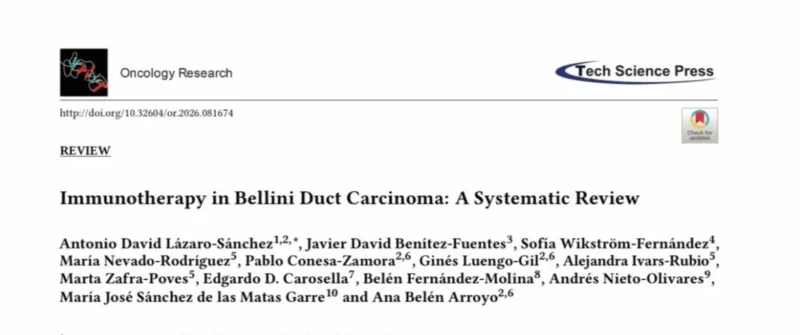
Title: Immunotherapy in Bellini Duct Carcinoma: A Systematic Review
Authors: Antonio David Lázaro-Sánchez, Javier David Benítez-Fuentes, Sofía Wikström-Fernández, María Nevado-Rodríguez, Pablo Conesa-Zamora, Ginés Luengo-Gil, Alejandra Ivars-Rubio, Marta Zafra-Poves, Edgardo Carosella, Belén Fernández-Molina, Andrés Nieto-Olivares, María José Sánchez de las Matas Garre, Ana Belén Arroyo
Read the Full Article.