Ani Hmayakyan, Oncology Resident, shared on LinkedIn:
“In this analogy, Doctor Doom represents ‘cancer‘, while his abilities reflect some of the biological mechanisms that make cancer so difficult to treat. And understanding these mechanisms is exactly where my Marvel-inspired studying journey begins.
Doctor Doom is just a person, not a god and without the alien blood. He wasn’t born with supernatural powers, wasn’t exposed to gamma radiation or injected with a super-soldier serum. He has transformed himself into one of the most dangerous figures in the Marvel Multiverse through extraordinary intelligence, advanced technology and mastering in some dark magic.
Cancer follows a similar principle. A cancer cell doesn’t begin as something entirely foreign to the body. It originates from a normal cell that through the combination of genetic and epigenetic alterations gradually develops characteristics allowing to survive, proliferate, hide from immune system, spread to other parts of the body and sometimes resist treatment.
Doctor Doom’s Armor
How Cancer Shields Itself?
Doom’s armor protects him from physical and energy attacks, while his force fields create an additional barrier against incoming threats. In cancer biology, a similar protective system can be found in tumor microenvironment and cellular drug-resistance mechanisms.
Today oncology increasingly uses precision medicine and advanced drug-delivery systems to overcome these barriers.
Before the Avengers launch an attack, they need reliable information about their enemy. F.R.I.D.A.Y. represents artificial intelligence, molecular diagnostics and clinical decision support in oncology. Without accurate diagnostic information, the team risks selecting ineffective treatments or overlooking important therapeutic opportunities.
Doctor Doom’s Diplomatic Immunity
How Cancer Escapes the Immune System?
As the ruler of Latveria, Doctor Doom benefits from diplomatic immunity, making it difficult for authorities to hold him accountable. His disguises and strategic deception also make it harder for his enemies to identify and defeat him.
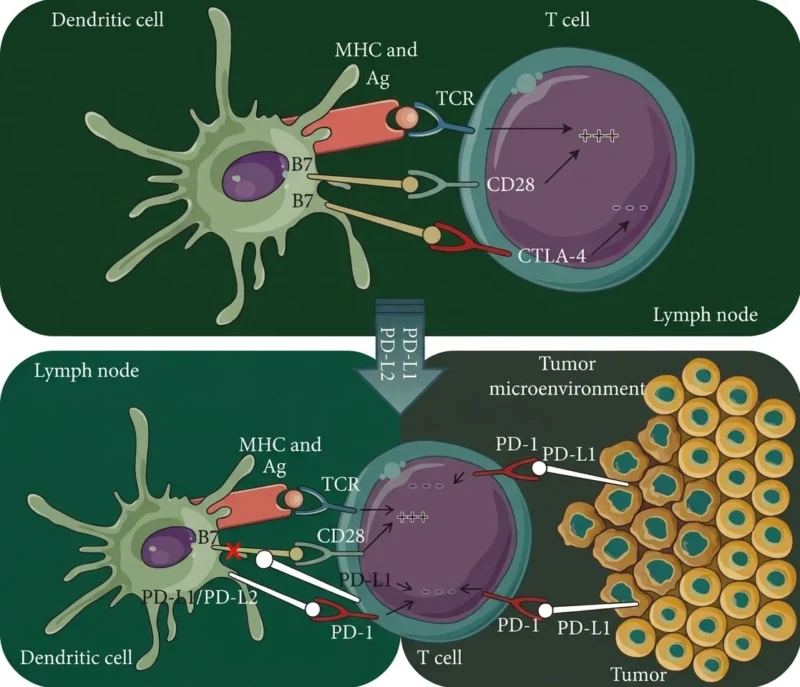
Cancer uses a comparable strategy through immune checkpoint signaling and impaired antigen presentation. It can express PD-L1, which binds to PD-1 receptors on T-cells and sends an inhibitory signal, reducing their ability to attack. Some tumors also reduce the expression of MHC I molecules, making it harder for T-cells to recognize tumor-associated antigens.
This is where the Avengers’ immune specialists enter the picture. Captain America represents the mobilization of the immune response, the field commander who rallies the troops. Doom uses PD-L1 and CTLA-4 to trick T-cells into standing down and Cap’s shield blocks him (anti-PD-1/anti-CTLA-4), awakening CD8+ T-cells to storm the battlefield.
ResearchGate.org
As Vision alters his density to phase through solid walls without breaking them, epigenetic drugs (like azacitidine) slip past the cell surface to rewrite how DNA is read, turning tumor-suppressor genes back on.
PROTACs (Proteolysis-Targeting Chimeras) act like Vision’s Mind Stone beam. They selectively eliminating ‘undruggable’ cancer proteins from the inside out.
Shuri (Black Panther of the Next Generation) will represent Next-Generation Sequencing (NGS) and personalized vaccines. Decodes the tumor’s full genetic blueprint to identify rare, actionable mutations and develop personalized cancer vaccines.
The Doombots:
Why Eliminating a Cancer Doesn’t Always Mean Defeating Cancer?
Whenever the Avengers believe they have finally defeated Doctor Doom, they may discover that they were fighting one of his robotic duplicates while the real Doom remained somewhere else.
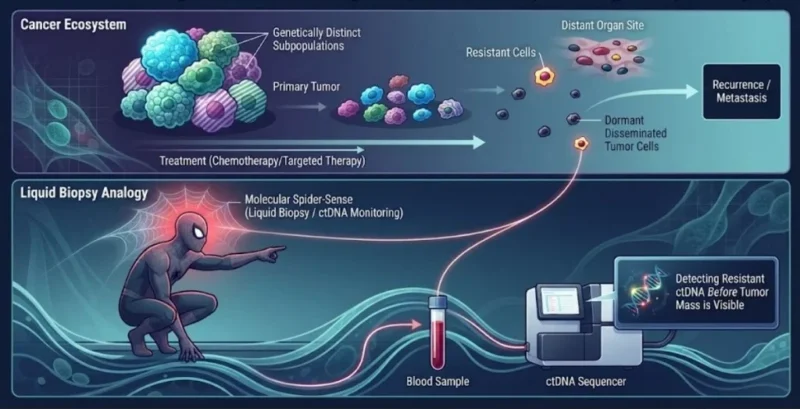
Cancer can create a similar illusion. It’s not always made up of identical cells. It can contain multiple genetically distinct subpopulations, some of which are sensitive to treatment while others are resistant. Treatment can eliminate most of the tumor while leaving behind small populations of resistant cells or dormant disseminated tumor cells. These surviving cells may eventually contribute to recurrence or metastasis.
Spider-Man is a natural fit for this part of the story. His ability to detect danger using his spider-sense before it becomes visible provides an analogy for liquid biopsies and ctDNA monitoring.
Doctor Doom’s Power Siphoning
How Cancer Hijacks the Body’s Resources?
Doctor Doom has repeatedly attempted to drain energy from Galactus, Silver Surfer and unfortunately, from Scarlet Witch, to strengthen himself.
Cancer cells develop similar resource-acquisition strategies. As they grow, their demand for oxygen and nutrients increases. To support this growth, cancer cells can release vascular endothelial growth factor (VEGF), stimulating the formation of new blood vessels. This process, known as tumor angiogenesis, helps supply the tumor with the resources needed for continued growth. This is where anti-angiogenic agents, such as bevacizumab, come into play by targeting VEGF signaling and cutting off the tumor’s abnormal blood supply. It’s like Thor cuts off Thanos’s head in Avengers: Endgame.
Thor’s power provides an interesting analogy for the radiation-based approaches used in oncology. Through precision radiotherapy techniques such as stereotactic body radiation therapy (SBRT) and proton therapy, radiation oncologists can target tumors while aiming to minimize exposure to surrounding healthy tissues.
The Fantastic Four provide a useful way to understand the different approaches used to control localized disease. The Thing represents surgical oncology, physically removing tumors. Human Torch Uses targeted heat or light-based ablation to destroy localized lesions directly, like thermal and local ablation. Invisible Woman protects the patient’s quality of life and healthy organs. Maybe at first sight the supportive care feels invisible, but it means a lot. And finally, Mr. Fantastic is the combination of molecular tumor board and clinical trials.
Hawkeye’s role is being like Selective Small-Molecule Inhibitors, such as TKIs. He delivers precision molecular strikes against specific driver mutations identified through genomic profiling.
‘Avengers Assemble’ in Oncology
Just as Doctor Doom cannot be defeated by relying on a single Avenger or a single strategy, cancer often requires a combination of approaches. Surgery, radiation therapy, systemic treatment, immunotherapy, molecular diagnostics and supportive care have different, but complementary roles.
The fight against cancer resembles the Avengers’ battles against Doctor Doom: understanding the enemy is just as important as having powerful weapons. Cancer can adapt, hide and develop new defenses, so defeating it requires more than one attack. It requires precision, teamwork and the ability to anticipate what comes next.”
You may also find this interesting: