






Ana Carolina Paniza, Medical Pathologist at Dasa, shared a post on LinkedIn about a paper she co-authored with Fabio Ynoe de Moraes, published in JNCI: Journal of the National Cancer Institute:
“While clinical practice is already profoundly impacted by precision medicine, genomics, and artificial intelligence, our medical curricula are still advancing at a slower pace.
With AI transforming pathology – from IHC quantification to methylation-based classifiers – it is imperative to bring these advances into the medical classroom.
As a pathologist, I see daily how much medical practice has changed – and how much medical training still needs to advance.
Pathology and oncology are at the heart of precision medicine, genomics, and AI, but these topics remain underrepresented in medical curricula.
Today, training doctors requires more than theoretical classes: it is necessary to prepare professionals to interpret NGS, work on molecular tumor boards, and critically evaluate algorithms that already impact diagnosis and decision-making.
Without a structured update of medical education, we run the risk of training clinicians disconnected from the reality of oncology in the twenty-first century.
In the paper we published this week, we discussed some paths for this scenario.”
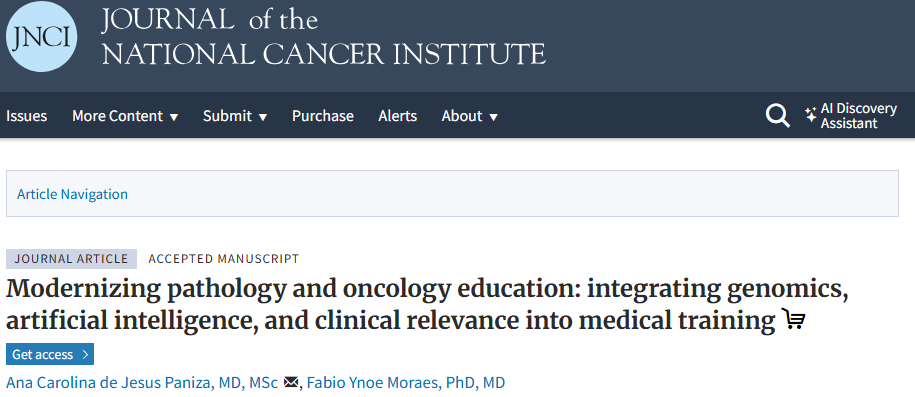
Title: Modernizing pathology and oncology education: integrating genomics, artificial intelligence, and clinical relevance into medical training
Authors: Ana Carolina Paniza, Fabio Ynoe de Moraes
You can read the Full Article in JNCI: Journal of the National Cancer Institute.
More posts featuring Ana Carolina Paniza.