





Alexandre Chan, President Elect of The Multinational Association of Supportive Care in Cancer (MASCC), Associate Editor-in-Chief at Supportive Care in Cancer, Founding Chair and Professor of Clinical Pharmacy Practice at UCI School of Pharmacy & Pharmaceutical Sciences, shared a post on LinkedIn:
“Our new pub in Phytomedicine (IF 11.3) this week: can a plant compound help reverse ‘chemobrain’?
Proud to share our latest work, a collaboration between my group and Munjal Acharya‘s lab at UC Irvine, testing catalpol as a candidate to treat cancer-related cognitive impairment (CRCI), aka ‘chemobrain.’
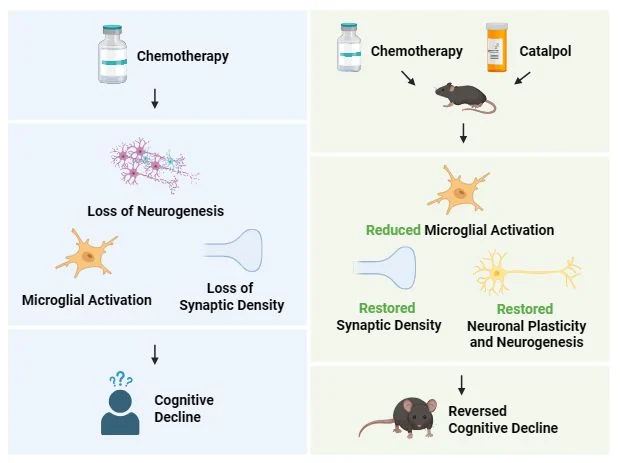
Catalpol is an iridoid glycoside isolated from the roots of Rehmannia glutinosa (地黃). In our mouse model exposed to doxorubicin, oral catalpol didn’t just raise dynamin-1 — it delivered across the board:
- Restored dynamin-1 and PSD-95 (key synaptic proteins)
- Reduced microglial activation / neuroinflammation
- Rescued neuronal plasticity (cFos) and hippocampal neurogenesis
- Reversed the spatial memory deficit in chemo-exposed mice
We have studied dynamin-1 and its role in CRCI for a few years. Dynamin-1 (DNM1) is maximally expressed in the CNS and plays a pivotal role in memory by enabling effective neurotransmission and synaptic plasticity. In breast cancer survivors, we first reported downregulation of DNM1 in plasma extracellular vesicle (EV) proteomes among those with perceived cognitive impairment. Since then, Quinton Ng and I have consistently found that DNM1 downregulation may underlie CRCI in AYA cancer patients — including ~46% lower DNM1 expression in patients with CRCI vs. those without, following neurotoxic chemotherapy. More importantly, this finding was replicated in a mouse model!
After years of identifying dynamin-1 as a driver of CRCI, it’s rewarding to find a compound that may actually mitigate it. Of course…more studies are still needed before we can figure out how to use catalpol in human – including proper tox studies!
Most importantly: I am so proud of this collaboration! Fan-Ying Chan and Munjal Acharya will be presenting this work at the MASCC Annual Meeting Rapid Poster session next Friday (June 26th) between 9-10:30am, Stage 3 — if you’re there, come say hello.
With thanks to UC Irvine College of Health Sciences Pilot Award for funding this piece of work.
And thanks Fan-Ying Chan for designing the graphical abstract!”
Title: Catalpol reverses doxorubicin-induced cognitive decline, neuroinflammation, and restores synaptic integrity
Authors: Anh Le, Sanad El-Khatib, Brandon Tran, Fan-Ying Chan, Alexandre Chan, Munjal Acharya
Read the Full Article.
Other articles featuring Alexandre Chan on OncoDaily.