
The NRG-GY018 trial returned to the ASCO 2026 stage with the question that matters more than any progression endpoint: do patients actually live longer? Presented by Ramez N. Eskander, MD from UC San Diego Moores Cancer Center, the updated analysis reported long-term overall survival (OS) for pembrolizumab added to carboplatin and paclitaxel in advanced or recurrent endometrial cancer. Just as importantly, it asked whether any survival benefit would hold up given how many patients in the control arm went on to receive immunotherapy after leaving the study.
NRG-GY018 is notable as the only phase 3 trial to evaluate mismatch repair–deficient (dMMR) and mismatch repair–proficient (pMMR) endometrial cancer as independent populations. Having already shown large reductions in the risk of progression or death in both groups, the trial’s central remaining question was whether those early gains would translate into durable survival once follow-up matured.
Background
Endometrial cancer is the most common gynecologic malignancy in many high-income countries, and outcomes in advanced or recurrent disease have historically been limited with chemotherapy alone. The addition of immune checkpoint inhibition to first-line chemotherapy reshaped the treatment landscape, with benefit expected to be greatest in dMMR tumors, which carry high mutational burden and are biologically primed to respond to immunotherapy.
In its primary analyses, NRG-GY018 reported a 70% reduction in the risk of progression or death in the dMMR cohort and a 46% reduction in the pMMR cohort with pembrolizumab plus chemotherapy. The analysis presented at ASCO 2026 extends follow-up to the overall survival endpoint and examines the influence of post-study immunotherapy in the control arm.
Study Design
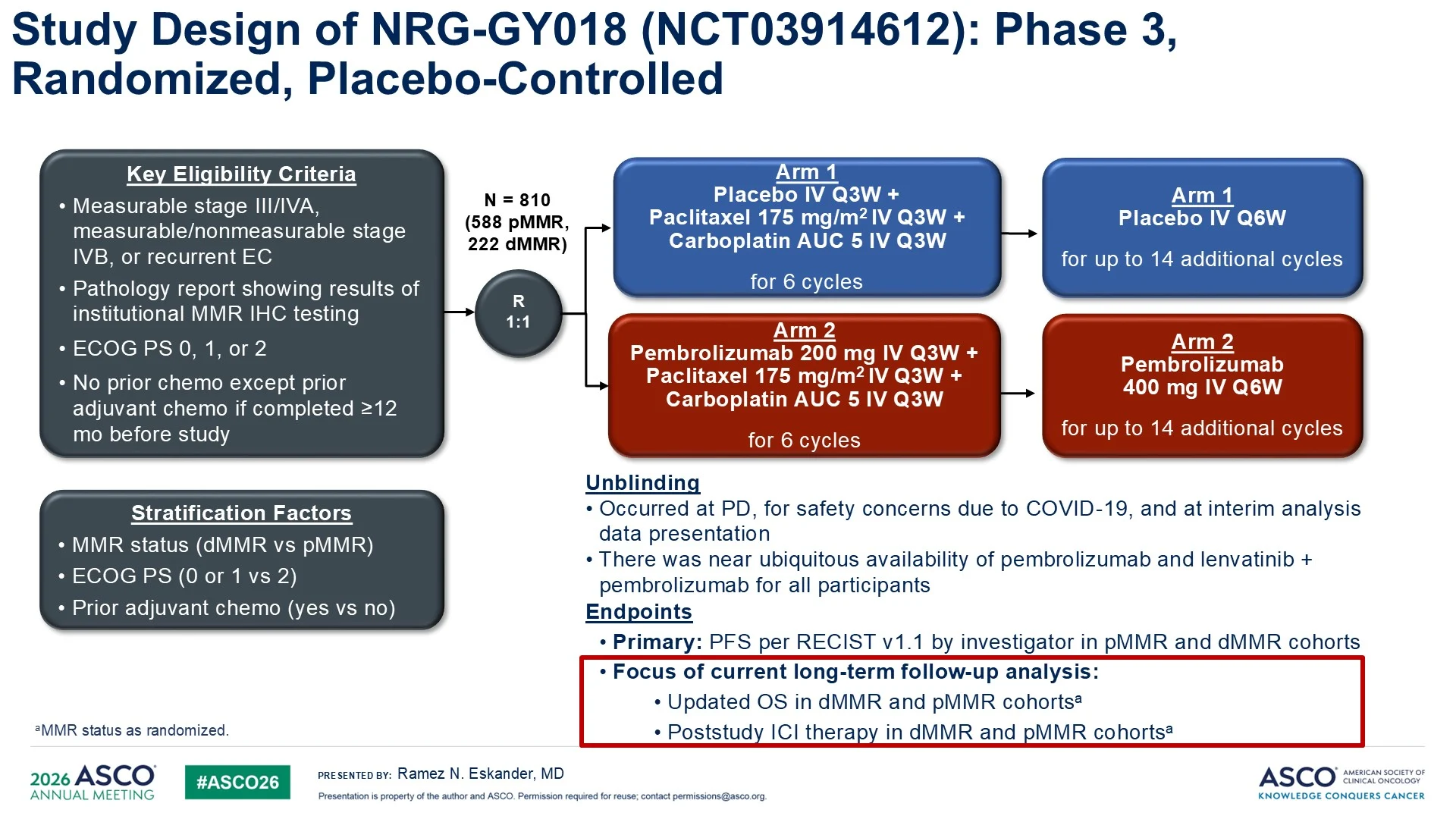
NRG-GY018 randomly assigned 810 patients with advanced-stage or recurrent endometrial cancer in a 1:1 ratio:
- Experimental arm: pembrolizumab plus carboplatin/paclitaxel (CP) every 3 weeks for 6 cycles, followed by maintenance pembrolizumab every 6 weeks for up to 24 months.
- Control arm: placebo plus CP on the same schedule, followed by maintenance placebo.
Key features of the updated analysis were as follows:
- The dMMR and pMMR populations were analyzed independently.
- Updated OS data cutoff was December 23, 2025.
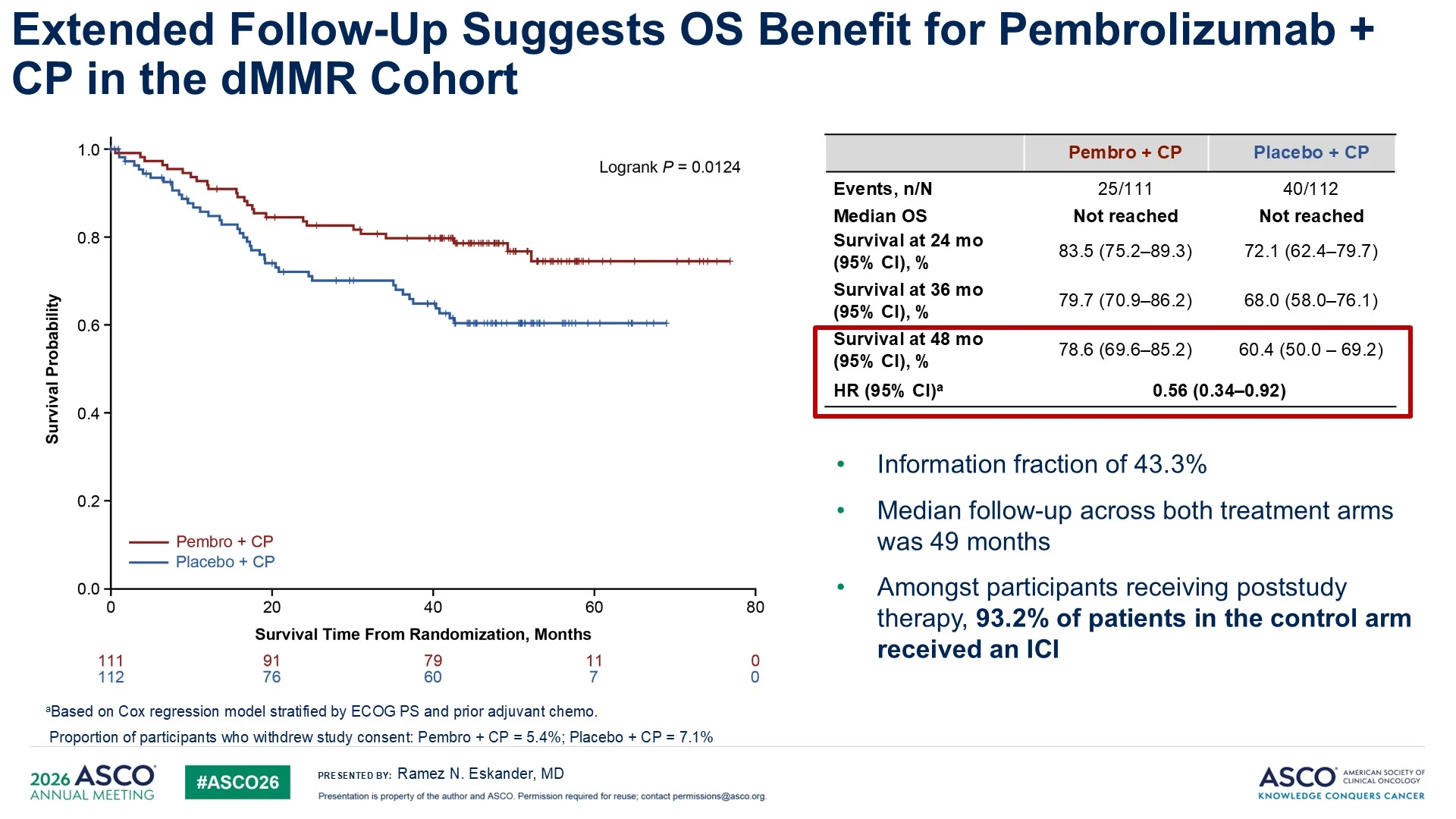
- Information fraction was 43.3% in the dMMR cohort and 78% in the pMMR cohort.
- Median follow-up was approximately 49 months across both treatment arms in the dMMR cohort and 40.1 months in the pMMR cohort.
- Sites were queried to capture the start and end dates of post-study immune checkpoint inhibitor (ICI) use.
Overall Survival Results
dMMR cohort
The addition of pembrolizumab produced a sustained OS benefit in the dMMR population:
- 48-month OS: 78.6% (95% CI, 69.6–85.2) with pembrolizumab plus CP versus 60.4% (95% CI, 50.0–69.2) with placebo plus CP.
- Hazard ratio: 0.56 (95% CI, 0.34–0.92); logrank P=0.0124.
- Median OS: not reached in either arm.
- Earlier landmarks: 83.5% versus 72.1% at 24 months; 79.7% versus 68.0% at 36 months.
- The benefit was maintained even though, among control-arm patients who received any post-study therapy, 93.2% went on to receive an ICI.
pMMR cohort
In the larger pMMR population, pembrolizumab showed a numerical survival advantage that did not reach statistical significance:
- Median OS: 46.9 versus 35.1 months — an approximately 11.8-month difference in favor of pembrolizumab plus CP.
- Hazard ratio: 0.86 (95% CI, 0.69–1.08); the confidence interval crossed 1, so the difference was not statistically significant.
- The advantage persisted despite heavy crossover, with the majority of control-arm patients receiving post-study ICI — most commonly lenvatinib plus pembrolizumab.
The Crossover Question
A defining feature of this update is that the OS benefit held up despite extensive use of immunotherapy in the control arm after progression. In the dMMR cohort, the overwhelming majority of control-arm patients who received further treatment went on to an ICI, and in the pMMR cohort at least 57% (n=167) of placebo-arm patients received post-study ICI. That the pembrolizumab arms still trended ahead suggests that giving immunotherapy in the first-line setting, rather than reserving it for later, may matter for long-term outcomes — though for pMMR disease this remains a directional signal rather than a statistically confirmed one.
Key Takeaway
With prolonged follow-up, NRG-GY018 showed that adding pembrolizumab to carboplatin/paclitaxel delivers a sustained overall survival benefit in advanced or recurrent endometrial cancer. The benefit is clearest and statistically significant in dMMR disease, while pMMR disease shows a meaningful numerical advantage that has not yet crossed the threshold for statistical significance. Notably, these gains persisted despite high rates of post-study immunotherapy in the control arm.
Taken together, the data reinforce the existing US FDA–approved use of the pembrolizumab regimen in the first-line treatment of advanced or recurrent endometrial cancer, irrespective of MMR status.
NRG-GY018 Trial at ASCO 2026 | Written by Anush Budumyan, MD, London, United Kingdom