Eikon Therapeutics has raised $381 million through its IPO, pricing at the top of its range in a strong sign of renewed investor appetite for biotech offerings. The South San Francisco–based company, led by former Merck R&D chief Roger Perlmutter, debuted on the Nasdaq (symbol: EIKN) with a valuation around $1 billion. Proceeds from the upsized IPO will fuel Eikon’s unique drug discovery platform, which marries advanced live-cell imaging technology with therapeutic development. Founded in 2019 by a team of scientists including Nobel laureate Eric Betzig, Eikon is built on the premise that directly visualizing molecular events inside living cells can revolutionize how new medicines – especially cancer treatments – are discovered.
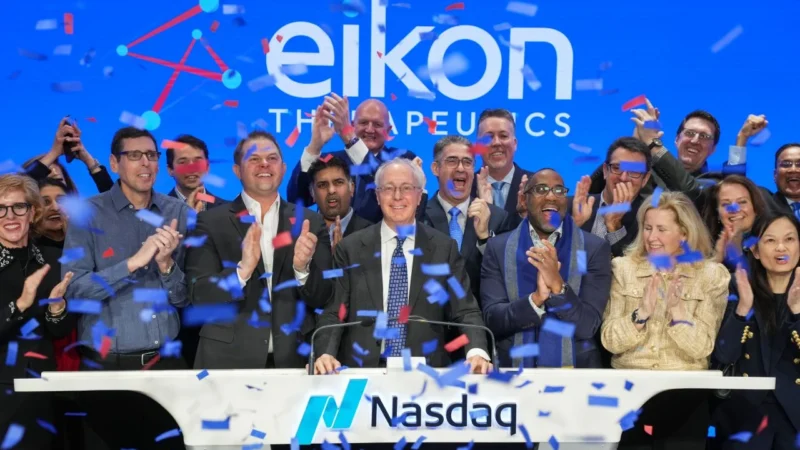
Nasdaq Exchange/LinkedIn
The company’s proprietary platform uses super-resolution fluorescence microscopy and single-molecule tracking to observe how proteins and other drug targets move and interact within live cells in real time. By applying machine learning to these rich imaging datasets, Eikon can rapidly screen compounds and identify those that produce desired cellular effects, enabling a data-driven approach to drug discovery. This technology-driven methodology is a departure from conventional biochemical assays, offering a window into dynamic biological processes that are especially relevant in oncology and immunology. Eikon’s successful IPO – one of the largest biotech debuts in recent years – provides the capital to translate its cutting-edge platform into clinical results.
Live-Cell Imaging Platform and Origins
Eikon’s drug discovery platform centers on single-molecule live-cell imaging, an innovation stemming from Betzig’s Nobel Prize–winning work in super-resolution microscopy. Traditional light microscopy cannot clearly resolve structures smaller than ~200 nanometers, but Eikon’s microscopes leverage advanced optics and computational techniques to visualize structures as small as 100 nm inside cells. This allows scientists to literally watch individual proteins in cancer cells as they carry out their functions or respond to drug molecules. By tagging specific proteins or signaling molecules with fluorescent markers, Eikon can track their motion and interactions over time – for example, monitoring whether a potential drug successfully binds to its target or disrupts a cancer-driving pathway.
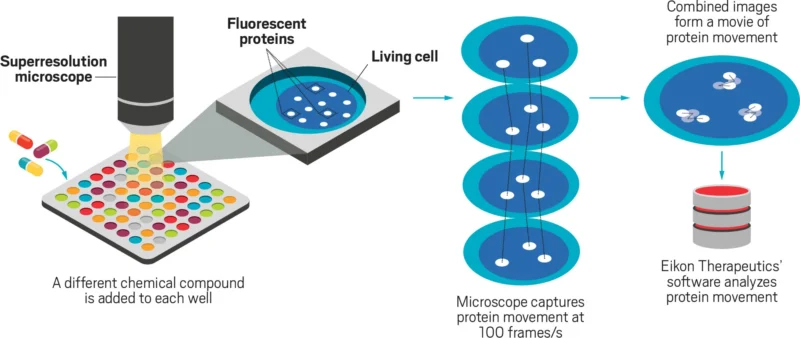
Eikon Therapeutics uses superresolution fluorescence microscopy to make short movies of how proteins move in living cells. The firm’s machine-learning software analyzes the movies to detect when small-molecule compounds subtly change the protein’s movement. Those compounds are then used as starting points for discovering drugs that target the protein. (Credit: Yang H. Ku/C&EN/Shutterstock)
The origins of this platform lie in fundamental research: Eikon’s founders recognized that observing how drugs work in situ within live cells could reveal subtle pharmacological effects that bulk assays might miss. The company has since integrated this microscopy technology with automation and high-performance computing, enabling high-throughput screening of compounds in a visually rich, biologically relevant context. This live-cell imaging approach is particularly powerful for oncology research, as cancer cells often rely on complex protein interactions and rapid signaling changes. By visualizing these processes, Eikon aims to uncover novel drug targets and mechanisms to intervene in cancer biology.
Oncology Applications and Pipeline
Though still early in its development, Eikon is already applying its platform to advance an oncology-focused drug pipeline. The company’s most advanced therapeutic candidate, EIK-1001, is a toll-like receptor 7/8 (TLR7/8) dual agonist acquired from a partner, now in Phase 2/3 trials for advanced melanoma and stage IV non-small cell lung cancer. EIK-1001 is being tested in combination with the PD-1 checkpoint inhibitor pembrolizumab (Keytruda), reflecting Eikon’s interest in immuno-oncology approaches. Initial clinical data from these trials, expected later this year, will indicate whether EIK-1001 can enhance anti-tumor immune responses in difficult cancers. In addition, Eikon has two novel PARP inhibitor compounds (EIK-1003 and EIK-1004) in early-stage trials.
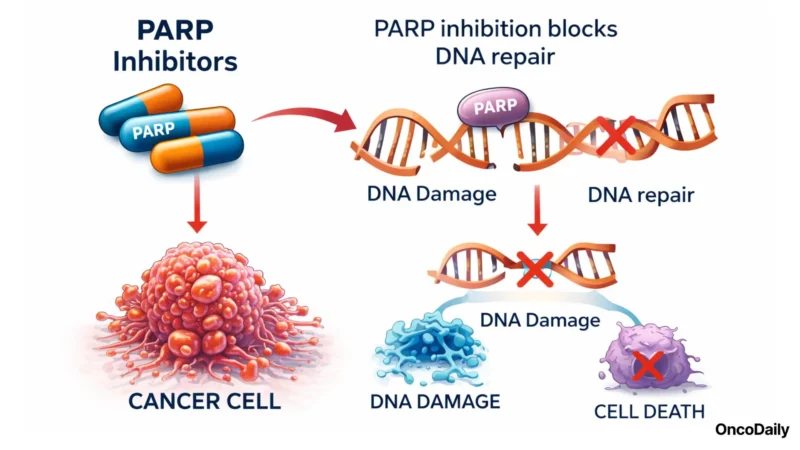
PARP inhibitors are a class of targeted therapy that exploit DNA repair weaknesses in cancer cells, and Eikon’s versions were licensed from Impact Therapeutics to complement its pipeline. These in-licensed programs suggest that Eikon is combining internal discovery with strategic partnerships to build a robust oncology portfolio.
Importantly, Eikon’s live-cell imaging platform continues to drive new insights – for example, the company has disclosed an in-house discovery project targeting WRN helicase (a DNA repair enzyme), which emerged from its single-molecule data analyses and is slated to enter clinical trials soon. The broader vision is that Eikon’s technology will enable it to identify and validate drug candidates that conventional screening might overlook, particularly in complex diseases like cancer where dynamic cellular behaviors are crucial.
Eikon’s IPO success underscores the excitement around technology-enabled drug discovery in oncology. By securing ample funding, Eikon can further develop its platform and pipeline, bridging the gap between groundbreaking microscopy science and tangible cancer therapies. If its approach proves fruitful, Eikon’s live-cell imaging paradigm could accelerate the discovery of next-generation cancer drugs, potentially tackling targets previously deemed “undruggable” or revealing new ways to disrupt cancer cell biology. The coming years will test whether this high-tech strategy can deliver clinical benefits, but the strong market debut reflects optimism that a new wave of visually guided drug discovery may significantly advance the oncology field.
You can read more oncology-focused biotech news on OncoDaily.
Written by: Semiramida Nina Markosyan, Editor, OncoDaily Canada