Antibody-drug conjugates (ADCs) have become the hottest modality in oncology. The template was Enhertu, AstraZeneca and Daiichi Sankyo‘s HER2-directed ADC, which turned a modest drug class into blockbuster territory and set off a wave of dealmaking, most visibly Pfizer’s $43 billion purchase of Seagen in 2023. But the chemistry that makes ADCs work, a tumor-seeking antibody, a chemical linker, and a potent cytotoxic “payload” is now well understood and increasingly commoditized.
The scarce ingredient is no longer the technology. It’s the target: a protein that sits on cancer cells, stays largely off healthy ones, and appears across enough tumors to justify years of trials. Target selection has become the real differentiator, and in 2026, attention is converging on one candidate: B7-H3.
What B7-H3 is, and how ADCs use it
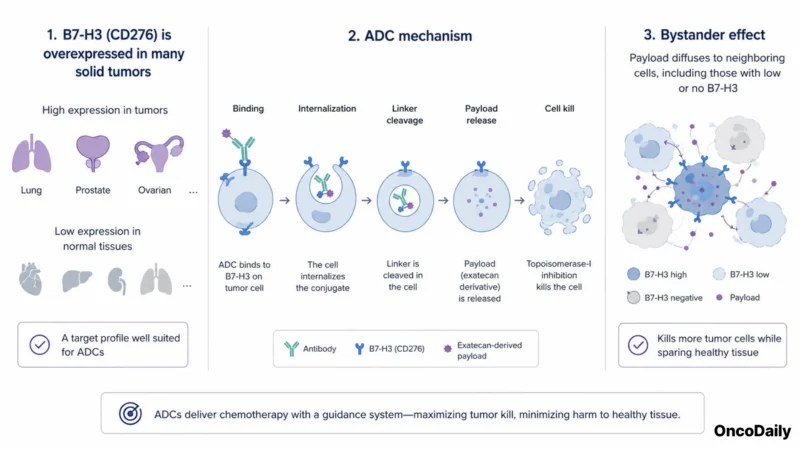
B7-H3 (also called CD276) is a cell-surface protein in the same family as PD-L1, the checkpoint that immunotherapies target. Its appeal for ADCs, though, is more mundane than immunological: it’s overexpressed across a remarkably wide range of solid tumors, lung, prostate, ovarian, and more, while showing comparatively low expression on normal tissues. That is close to the profile an ADC needs.
The mechanism is elegant. The antibody homes in on B7-H3-bearing tumor cells; the cell internalizes the conjugate, the linker is cleaved, and the payload, usually a topoisomerase-I inhibitor derived from exatecan, is released to kill it. Because these payloads can diffuse into neighboring cells (the “bystander effect”), an ADC can also hit tumor cells expressing little or no target, which helps in heterogeneous tumors. The point is to deliver chemotherapy with a guidance system, sparing healthy tissue in ways a traditional infusion cannot.
Two 2026 signals
The first, and weightiest, landed in July 2026. Hansoh Pharma announced that ARTEMIS-008, a pivotal Phase 3 trial in China, met its primary endpoint of overall survival: risvutatug rezetecan (“Ris-Rez”) extended survival versus topotecan, the standard of care, in patients with advanced or relapsed small cell lung cancer. SCLC is one of oncology’s grimmest settings, fast-growing, quick to relapse, thin on options after platinum chemotherapy.
The companies billed it as the first positive Phase 3 overall-survival result for any B7-H3 ADC in any tumor type. That matters because overall survival is the highest bar in oncology; clearing it in a disease this hard is the strongest possible evidence that engaging B7-H3 changes outcomes, not just tumor size. GSK, which licensed Ris-Rez from Hansoh for markets outside Greater China, is running its own global program, with a key extensive-stage SCLC readout expected in 2027.
The second signal broadened the story. In early July 2026, CSPC’s SYS6043, another B7-H3 ADC, received Breakthrough Therapy Designation from China’s NMPA for platinum-resistant ovarian cancer (along with primary peritoneal and fallopian tube cancers), as monotherapy.
A designation isn’t an approval, it’s a regulator fast-tracking a drug on early data, but the numbers were striking: in a Phase 1/2 study, SYS6043 produced responses in roughly 46% of ovarian-cancer patients and, per the company, roughly doubled progression-free survival versus non-platinum chemotherapy and the approved ADC mirvetuximab soravtansine. Responses appeared even in tumors with little B7-H3, the bystander effect in action. Between a survival win in lung cancer and a breakthrough tag in ovarian cancer, B7-H3 now has validation across more than one tumor type.
Against HER2 and TROP2
The comparison to established targets is instructive. HER2 is the precise, proven target, validated by Enhertu, which even earned the first tumor-agnostic ADC approval, but it’s expressed in a defined subset of cancers. TROP2, the target of Gilead’s Trodelvy and AstraZeneca/Daiichi’s Datroway, runs the other way: broadly expressed across epithelial tumors, which enlarges the addressable population but raises the stakes on safety. B7-H3 resembles TROP2 in breadth, potentially even wider. Breadth is the prize; it’s also the risk.
The field, the risks, and what to watch
B7-H3 is now a genuine race. The perceived US frontrunner is ifinatamab deruxtecan (I-DXd) from Daiichi Sankyo and Merck, which holds FDA Breakthrough status and Priority Review for pretreated ES-SCLC, with a decision due October 10, 2026, potentially the first B7-H3 ADC approved anywhere. Programs from BioNTech/DualityBio (DB-1311) and others are chasing overlapping indications.
The risks are real. The topoisomerase-I payloads carry class toxicities, interstitial lung disease and myelosuppression chief among them, that can be serious. B7-H3’s “limited” normal-tissue expression is relative, not absent, leaving room for on-target, off-tumor harm. Tumor heterogeneity means not every patient benefits equally. And much of the strongest data so far comes from China-based trials that will need confirmation in global populations before Western regulators sign off.
What to watch: the I-DXd decision in October; GSK’s global Phase 3 readouts in 2027; and whether the ovarian and prostate signals harden into pivotal wins. If they do, B7-H3 won’t just be the next big ADC target, it’ll be the one that proves breadth can beat precision.
Read more biotech insights on OncoDaily Biotech.
Written by: Semiramida Nina Markosyan, Editor, OncoDaily Canada
You can watch and learn more on the latest ADC Oncology news on OncoDaily TV.
Read more insights on the ADC Acquisition Wave on OncoDaily.