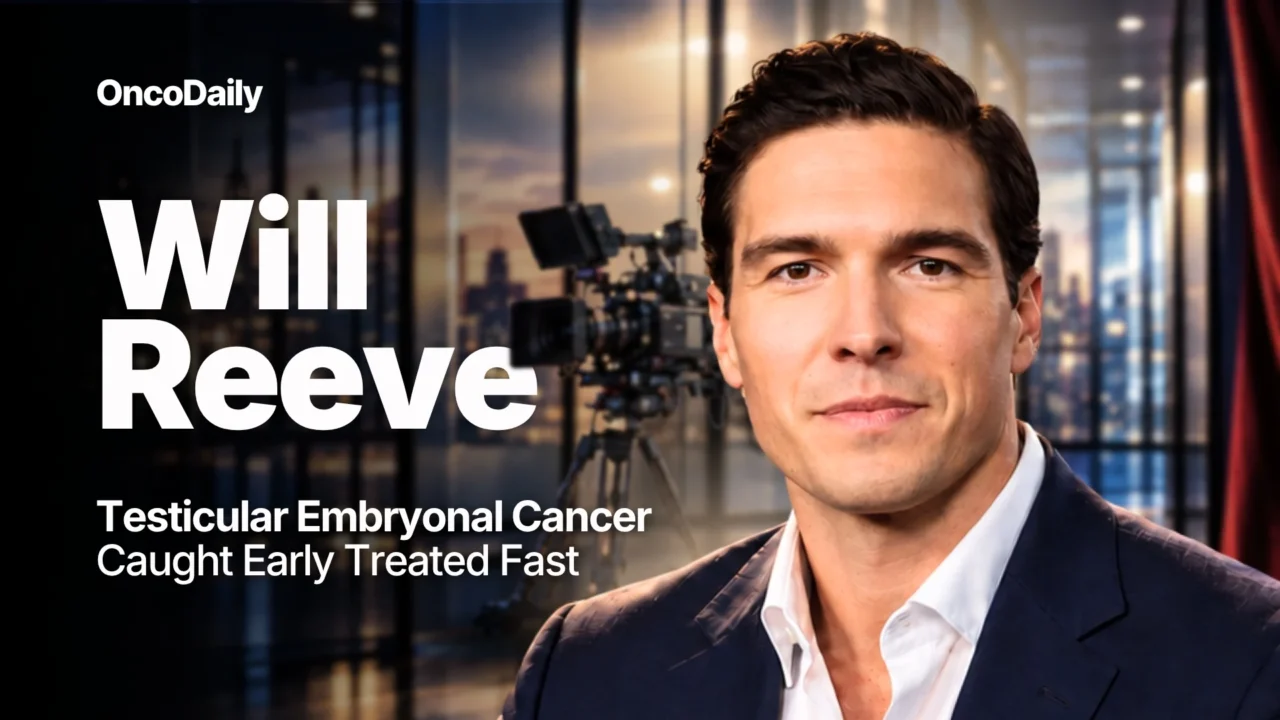
Will Reeve, the 34-year-old ABC News correspondent and son of actor Christopher Reeve, has revealed that he was diagnosed with testicular cancer in April 2026. His treatment included removal of the affected testicle, surgery on abdominal lymph nodes, and two cycles of chemotherapy. On September 29, 2026, Reeve publicly shared the details of his cancer journey, explaining that he wanted to raise awareness about testicular cancer and encourage people not to ignore unusual changes in their bodies. A follow-up scan on September 8 showed no evidence of cancer, according to Reeve. While this was very encouraging news, ongoing surveillance remains important after treatment for testicular cancer.
What Cancer Did Will Reeve Have?
Reeve was diagnosed with testicular cancer, with pathology showing that approximately 95% of the tumor was embryonal carcinoma. Embryonal carcinoma is a type of non-seminomatous germ-cell tumor. It can grow and spread relatively quickly compared with some other testicular cancer subtypes, but testicular germ-cell cancers are also among the most treatable cancers, particularly when appropriately diagnosed and managed. Testicular cancer develops in one or both testicles and occurs most often in younger and middle-aged men. Treatment depends on factors including the exact tumor subtype, stage, tumor-marker levels, and whether disease has spread beyond the testicle.
How Was Will Reeve’s Testicular Cancer Found?
Reeve said he first noticed a tender lump on his left testicle while showering in April 2026. He initially thought the change might disappear on its own, but his wife, Amanda Dubin Reeve, encouraged him to have it evaluated. An ultrasound revealed a mass in the testicle, leading to further testing and treatment. A lump, swelling, feeling of heaviness, or another persistent change in a testicle does not automatically mean cancer. However, a new testicular mass should be evaluated promptly by a healthcare professional.
What Surgery Did Will Reeve Have?
In early May 2026, Reeve underwent an orchiectomy, meaning surgical removal of the affected left testicle. Orchiectomy is a standard part of both diagnosing and treating testicular cancer because examination of the removed tumor allows pathologists to determine the exact type of cancer. Reeve said he took several days away from work while recovering from the procedure.
Retroperitoneal Lymph Node Dissection
Further evaluation showed that cancer had spread to lymph nodes in the abdomen. On June 10, 2026, Reeve underwent a six-hour retroperitoneal lymph node dissection, or RPLND, in which dozens of abdominal lymph nodes were removed. Three of the removed lymph nodes were found to contain cancer. Because disease had spread beyond the original testicle, Reeve and his medical team decided to add chemotherapy to reduce the risk that remaining cancer cells could lead to recurrence.
What Chemotherapy Did Will Reeve Receive?
Reeve began chemotherapy in early July 2026 and completed two cycles by the end of the month. He received treatment at Memorial Sloan Kettering Cancer Center in New York City. Reeve described treatment days lasting approximately nine hours. According to his account, around two hours involved chemotherapy while additional time was spent using scalp cooling, also known as cold capping.
He said the purpose of chemotherapy was to reduce his risk of recurrence to approximately 1%. Chemotherapy is systemic treatment, meaning the medication travels through the bloodstream and can reach cancer cells beyond the original tumor site. In testicular cancer, chemotherapy may be recommended when disease has spread or when pathology suggests a meaningful risk that microscopic cancer remains after surgery.
What Side Effects Did Will Reeve Experience?
Reeve described several treatment-related problems during the recovery periods between chemotherapy cycles. He reported bone pain, ringing in the ears, night sweats, blood clots, and headaches. He also said that anti-nausea medications helped him avoid significant nausea during treatment. Chemotherapy side effects vary according to the drugs used, dose, schedule, and individual patient. Depending on the regimen, effects may include fatigue, nausea, hair loss, low blood counts, infection risk, neuropathy, hearing-related effects, and fertility problems. The National Cancer Institute notes that some treatments used for testicular cancer can affect fertility, which is why fertility preservation may be discussed before treatment begins.
What Is Cold Capping?
Reeve also used scalp cooling, commonly known as cold capping, during chemotherapy. Scalp cooling lowers the temperature of the scalp and reduces blood flow to hair follicles. This may decrease the amount of chemotherapy reaching the follicles and help reduce treatment-related hair loss. Cold capping does not treat the cancer itself. It is a supportive measure used alongside certain chemotherapy regimens. Reeve described the experience as difficult but personally meaningful. He said it reminded him of his mother, Dana Reeve, who also underwent chemotherapy at Memorial Sloan Kettering before her death from lung cancer in 2006.
Is Will Reeve Cancer-Free?
Reeve said that a follow-up scan and medical assessment on September 8, 2026, showed no evidence of cancer. He described receiving “really good news” from his doctors and said that he could proudly say that he did not currently have cancer. The medical distinction is important, however. No evidence of disease is not necessarily the same as being permanently cured. It means that available testing currently shows no detectable cancer. Testicular cancer survivors continue to undergo surveillance because recurrence can occur after treatment. Reeve said that his initial follow-up will include scans and bloodwork around three to four times a year, with monitoring becoming less frequent over time if he continues to do well.
What Does Follow-Up After Testicular Cancer Involve?
Follow-up after testicular cancer is designed to detect recurrence as early as possible and monitor long-term health after treatment. Depending on the individual situation, surveillance can involve regular medical examinations, blood testing for tumor markers, imaging such as CT scans when appropriate, and attention to any new symptoms. Monitoring is generally more frequent during the earlier period after treatment and becomes less frequent over time. People who have previously had testicular cancer also have an increased risk of developing cancer in the remaining testicle, making long-term medical follow-up important.
What Is Embryonal Carcinoma?
Embryonal carcinoma is an aggressive type of nonseminomatous testicular germ-cell tumor (NSGCT) arising from primitive malignant germ cells. More than 90% of testicular cancers originate from germ cells, and approximately 40% of testicular germ-cell tumors are classified as nonseminomas. Pure embryonal carcinoma is relatively uncommon, accounting for only about 2–3% of testicular germ-cell tumors. However, embryonal carcinoma is much more frequently found as one component of a mixed germ-cell tumor. In a pathology series of 180 testicular cancers containing embryonal carcinoma, 84% occurred as part of a mixed tumor and only 16% were pure embryonal carcinomas.
Compared with seminoma, embryonal carcinoma generally has a more aggressive biological behavior. It can grow rapidly and has a greater tendency for early lymphatic and blood-borne spread, including to the retroperitoneal lymph nodes and, in more advanced disease, other organs. Serum tumor markers such as alpha-fetoprotein (AFP), beta-human chorionic gonadotropin (β-hCG), and lactate dehydrogenase (LDH) are important for staging and treatment planning, although normal tumor-marker levels do not exclude embryonal carcinoma.
Despite this aggressive biology, testicular germ-cell cancers are among the most curable solid tumors. The National Cancer Institute reports that stage I nonseminoma is more than 99% curable. Orchiectomy alone cures approximately 70% of patients with stage I nonseminoma, while the remaining patients who relapse can usually still be successfully treated. Across all testicular cancer types and stages, the current U.S. 5-year relative survival is 94.6%, based on SEER data from 2016–2022. These population statistics should not be interpreted as an individual prognosis for a patient with embryonal carcinoma.
Treatment begins with radical inguinal orchiectomy and is then guided by the pathological findings, stage, serum tumor-marker levels, lymph-node involvement, and other evidence of metastatic disease. Depending on these factors, subsequent management may include active surveillance, retroperitoneal lymph-node dissection (RPLND) or cisplatin-based chemotherapy. Unlike seminoma, embryonal carcinoma and other nonseminomatous tumors are not generally treated with radiotherapy.
Why Did Will Reeve Need Chemotherapy After Lymph-Node Surgery?
Reeve’s lymph-node surgery found cancer in three abdominal lymph nodes. Even after affected lymph nodes are surgically removed, microscopic cancer cells may remain elsewhere in the body and may not yet be visible on scans. Chemotherapy was therefore added to lower his risk of recurrence. This does not mean that every patient whose testicular cancer reaches the abdominal lymph nodes will receive exactly the same treatment. Management is individualized according to pathology, stage, tumor markers, surgical findings, and other clinical factors.
Fertility Preservation and Sperm Banking
One particularly important part of Reeve’s story is fertility preservation. He said that he and his wife banked sperm after his diagnosis because they hope to have children in the future. Reeve said they expect that they may be able to have children using medically necessary in-vitro fertilization, or IVF. Testicular cancer itself, removal of a testicle, and chemotherapy can all affect fertility in different ways. For younger patients who may want biological children in the future, sperm banking should be discussed as early as possible—ideally before chemotherapy and, when feasible, before other treatments that could affect fertility. The National Cancer Institute notes that infertility following testicular cancer treatment can sometimes be permanent.
What Did Will Reeve Say About His Cancer Experience?
Reeve said he chose to share his cancer story partly to reduce stigma around testicular cancer and encourage men to pay attention to changes in their bodies. He said he felt fortunate that he sought medical care when he did and suggested that the outcome could have been worse if he had continued to ignore the lump. He also described the experience as changing the way he thinks about life, encouraging him to live more intentionally and depend more openly on the people around him.
Reeve thanked his wife, family, friends, and ABC colleagues for supporting him through diagnosis and treatment. His parents, Christopher and Dana Reeve, became widely known for turning personal adversity into advocacy. Reeve has said that their example influenced his own decision to speak publicly about cancer.
What Are the Warning Signs of Testicular Cancer?
A testicular lump is one of the most recognized warning signs, but testicular cancer can present in several ways. Possible symptoms include a new lump, swelling or enlargement of one testicle, a feeling of heaviness in the scrotum, persistent discomfort or tenderness, dull pain in the groin or lower abdomen, lower-back pain in some cases, or a sudden collection of fluid in the scrotum. Some testicular cancers are painless, while others may cause tenderness or discomfort.
These symptoms do not necessarily mean cancer is present, but a persistent or unexplained testicular change should be medically evaluated. Early assessment matters because testicular cancer is highly treatable, including in many cases where the disease has spread beyond the testicle.
Will Reeve’s Family and Wife: What We Know
Will Reeve is the youngest child of actor Christopher Reeve and Dana Reeve. He married Amanda Dubin Reeve on January 17, 2026, in Miami—only about three months before he was diagnosed with testicular cancer.
Will Reeve’s parents
Will’s father was actor Christopher Reeve, best known for playing Superman in the 1978 film and its sequels. Christopher Reeve became paralyzed in 1995 after a horse-riding accident and later died of heart failure in 2004 at age 52. Will was 12 years old when his father died. Will’s mother was Dana Reeve, an actress, singer, and advocate. She died from lung cancer in 2006 at age 44, less than two years after Christopher Reeve’s death.
Will has said that his mother’s experience with cancer shaped his decision to speak publicly about his own testicular cancer diagnosis. He received treatment at Memorial Sloan Kettering Cancer Center, the same hospital where his mother had received chemotherapy. Although Christopher and Dana Reeve had only one child together, Will has two older half-siblings from Christopher Reeve’s earlier relationship with Gae Exton:
Who is Amanda Dubin?
Amanda Dubin is a New York-based luxury event planner and producer. She works with her mother, Victoria Dubin, at Victoria Dubin Events. Amanda is also the daughter of Victoria Dubin, and the two run the event-planning business together.
How did Will and Amanda Meet?
Will and Amanda made their relationship public in April 2023, sharing a photo in front of the Eiffel Tower in Paris. They announced their engagement on November 8, 2024.
When did They Get Married?
They married on January 17, 2026, at the Rubell Museum in Miami, Florida. The wedding was attended by family, friends, and several of Will’s ABC News colleagues. At the wedding, Will honored both of his late parents. He wore gold cufflinks that belonged to Christopher Reeve and a brooch that belonged to Dana Reeve.

Photo: Instagram @amandadubin and @Willreeve_
How Amanda Supported Will during Cancer
Amanda played an important role in Will’s cancer journey. He said she encouraged him to seek medical care after he noticed a lump on his testicle in April 2026. An ultrasound then found a mass, leading to his diagnosis.Reeve said Amanda joined him during his long chemotherapy treatment days. He also said that he and Amanda banked sperm after his diagnosis because they hope to have children in the future. The National Cancer Institute notes that some testicular cancer treatments can cause infertility, which may be permanent, so sperm banking before treatment is an important option for men who may want children later.
Will’s family has experienced cancer more than once: His mother, Dana Reeve, died of lung cancer in 2006. Will was diagnosed with testicular cancer in April 2026. He said the “irony” of being treated at the same hospital where his mother received chemotherapy was not lost on him. His parents’ experiences with illness, disability, and advocacy influenced his decision to speak openly about his own diagnosis.
Why Will Reeve’s Treatment Should Not Be Generalized
Reeve’s treatment pathway should not be considered a template for every person with testicular cancer. His care was based on his particular tumor pathology, embryonal carcinoma component, spread to abdominal lymph nodes, surgical findings, and recurrence risk. Another person with seminoma, a different non-seminomatous tumor, localized disease, different tumor markers, or more extensive metastatic disease may receive a very different treatment plan. It is also important to distinguish “no evidence of cancer” from “cured.” Reeve’s September scan represents a very positive treatment outcome, but continued blood tests, imaging, and clinical follow-up remain part of his care.
You Can Also Read Alex Singleton’s Testicular Cancer Battle: From Shock Diagnosis to Inspiring Recovery by OncoDaily
Written by Aharon Tsaturyan, MD, Editor at OncoDaily Intelligence Unit
FAQ
What type of cancer does Will Reeve have?
Will Reeve was diagnosed with testicular cancer, with approximately 95% of the tumor reported as embryonal carcinoma.
Is Will Reeve cancer-free now?
Reeve said his September 8, 2026 follow-up showed no evidence of cancer. This is encouraging, although surveillance remains necessary after testicular cancer treatment.
What is embryonal carcinoma, and is it curable?
Embryonal carcinoma is an aggressive nonseminomatous germ-cell tumor. Despite its ability to grow and spread relatively quickly, testicular nonseminomas are highly curable; NCI reports cure rates above 99% for stage I nonseminoma.
What treatment did Will Reeve receive for testicular cancer?
His treatment included an orchiectomy, retroperitoneal lymph-node dissection (RPLND), and two cycles of chemotherapy after cancer was found in abdominal lymph nodes.
Why is a testicle removed when treating testicular cancer?
Radical inguinal orchiectomy removes the affected testicle and provides tissue needed to establish the tumor type and guide staging and further treatment.
What is retroperitoneal lymph-node dissection (RPLND)?
RPLND is surgery to remove lymph nodes in the back of the abdomen, an important potential site of spread for testicular cancer. It may be used in selected patients with nonseminomatous germ-cell tumors.
Why did Will Reeve need chemotherapy after surgery?
Three of the lymph nodes removed during his RPLND contained cancer. Reeve said he then received two cycles of chemotherapy to reduce the chance of recurrence.
Can testicular cancer spread to abdominal lymph nodes?
Yes. Testicular cancer commonly spreads first through lymphatic pathways to retroperitoneal lymph nodes in the abdomen, which is why imaging, tumor markers, chemotherapy, and sometimes RPLND can be important parts of management.
Can testicular cancer come back after surgery and chemotherapy?
Yes, recurrence is possible, although many patients are cured. Follow-up typically involves examinations, tumor-marker blood tests, and imaging, with surveillance generally most intensive during the first years after treatment.
Can you still have children after testicular cancer treatment?
Many survivors can have children, but testicular cancer and treatments such as chemotherapy can affect fertility. Sperm banking before treatment is therefore an important discussion for patients who may want biological children in the future.