
Tommy John, the Major League Baseball legend whose 1974 elbow surgery transformed sports medicine, died at 83 after a battle with recurrent bladder cancer. His life left two very different legacies: one on the baseball field and another in the history of modern medicine. Tommy John was far more than the name attached to one of the most famous procedures in sports medicine.
Born in 1943, John built an extraordinary Major League career that lasted 26 seasons, from his debut with the Cleveland Indians in 1963 to his final appearance with the New York Yankees in 1989. He finished with 288 wins, 231 losses, a 3.34 ERA, 2,245 strikeouts, 162 complete games, and 46 shutouts. He was also a four-time All-Star.

Photo: Depositphotos
John pitched for the Cleveland Indians, Chicago White Sox, Los Angeles Dodgers, New York Yankees, California Angels, and Oakland Athletics. His longevity was extraordinary even by Major League standards: only Nolan Ryan played more seasons during the modern era. But the most remarkable part of John’s career came in the middle of it. In July 1974, at age 31, he suffered what appeared to be a career-ending injury to his pitching elbow. Instead, the injury would change baseball and medicine forever.
The 1974 Injury That Changed Sports Medicine
On July 17, 1974, while pitching for the Los Angeles Dodgers, John felt something go wrong in his left elbow while throwing a pitch. The injury was eventually identified as a complete tear of the ulnar collateral ligament (UCL). At the time, a serious UCL injury was generally viewed as devastating for a professional pitcher. There was no established surgical pathway that could reliably restore the ligament and allow a pitcher to return to Major League competition.
John and Dodgers team physician Dr. Frank Jobe faced an extraordinary problem: there was no proven operation that could give John his career back. So they attempted something that had never been done on a Major League pitcher.
The Operation That Became Tommy John Surgery
On September 25, 1974, Jobe performed the experimental procedure. He harvested a tendon from John’s right forearm and used it to reconstruct the damaged ligament in John’s left elbow. The procedure involved drilling holes through the humerus and ulna and securing the transplanted tendon in a figure-eight configuration. Jobe reportedly estimated John’s chance of returning to Major League pitching at approximately 1%. John accepted the risk.
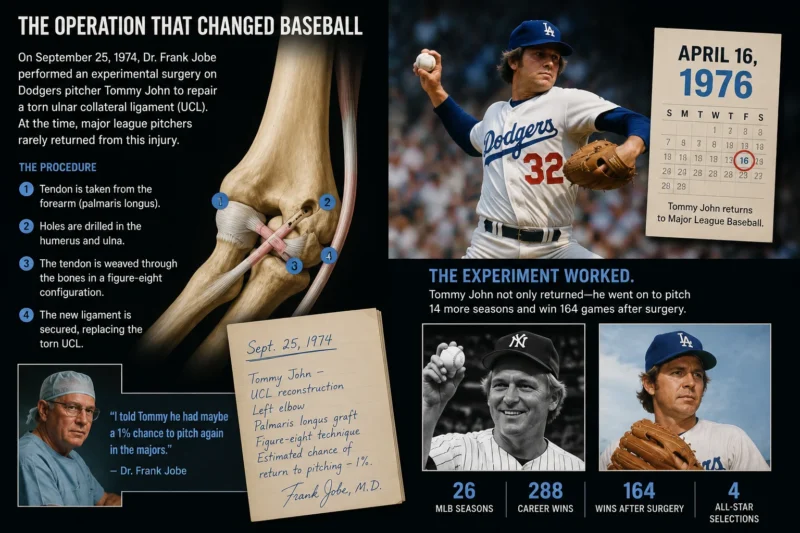
The surgery itself was only the beginning. There was no established rehabilitation protocol for returning a professional pitcher to competition after this type of reconstruction because nobody had successfully done it before. John spent months rebuilding his arm and gradually progressed from rehabilitation to throwing and eventually competitive pitching. On April 16, 1976, he returned to Major League baseball. The experiment had worked.
John Didn’t Just Return He Built Another Career
John’s comeback was extraordinary even without considering the novelty of the operation. He went on to pitch for another 14 seasons after the surgery and won 164 games after his reconstruction more than half of his eventual career total of 288 wins. His post-surgery career included three consecutive All-Star selections from 1978 through 1980 and multiple outstanding seasons with the Dodgers and Yankees. The procedure that had initially been considered a desperate experiment gradually became one of the most important operations in sports medicine. It eventually became known simply as “Tommy John surgery.”
What Is Tommy John Surgery?
Today, Tommy John surgery generally refers to ulnar collateral ligament reconstruction, a procedure used to repair or reconstruct a damaged UCL in the elbow. The UCL is an important stabilizing structure on the inner side of the elbow. For baseball pitchers, it is subjected to enormous repetitive forces during throwing.
Modern reconstruction techniques and rehabilitation programs are far more sophisticated than those available to John in 1974. Thousands of athletes have since undergone the procedure. MLB notes that John’s operation helped establish a pathway that has allowed countless pitchers to return to competition after serious UCL injuries. John’s role was particularly unusual: he wasn’t the surgeon who invented the procedure, but he was the first Major League pitcher to undergo it successfully. His recovery demonstrated that the operation could work at the highest level of professional baseball.
The Surgeon Behind the Procedure: Dr. Frank Jobe
Tommy John’s medical legacy cannot be separated from Dr. Frank Jobe, the orthopedic surgeon who performed the operation. Jobe had the surgical expertise to attempt the reconstruction, but John also had an important role: he was willing to take the risk when conventional thinking suggested that his pitching career was over.
Jobe himself later emphasized that the underlying surgical concept was not created entirely from nothing. Tendon-transfer procedures had been used in other medical settings, including for patients with paralysis. His innovation was applying the concept to a pitcher’s damaged UCL. Together, Jobe and John created one of the most recognizable patient-surgeon stories in sports medicine.
A Career That Outlived the Operation’s Expectations
His 288 victories remain one of the highest totals among modern-era pitchers who have not been elected to the Baseball Hall of Fame.

His career therefore stands on two foundations: exceptional longevity as a pitcher and an extraordinary medical comeback.
Tommy John’s Bladder Cancer Diagnosis
Away from baseball, John faced another major health challenge later in life. He was diagnosed with bladder cancer in 2024, according to reporting surrounding his final years. Later reports described recurrent bladder cancer, and in 2026 he entered home hospice care. John died on August 15, 2026, at his home in Florida, aged 83. His wife, Cheryl John, identified bladder cancer as the cause of death.
Unlike his baseball career, the detailed medical history of his cancer has not been publicly documented in the same way. Specific information about his tumor characteristics, stage, pathology, molecular profile, and treatment regimen has not been publicly established in reliable sources. That distinction matters. A public figure’s cancer diagnosis can raise awareness, but it does not provide enough information to reconstruct an individual’s medical course or determine why a particular treatment was selected.
What Is Bladder Cancer?
Bladder cancer develops when abnormal cells grow within the tissues of the bladder. The most common form is urothelial carcinoma, which begins in the cells lining the inside of the urinary tract. Bladder cancer can behave very differently depending on how deeply it has invaded the bladder wall and whether it has spread elsewhere. Clinicians broadly distinguish between:
- Non-muscle-invasive bladder cancer
- Muscle-invasive bladder cancer
- Metastatic bladder cancer
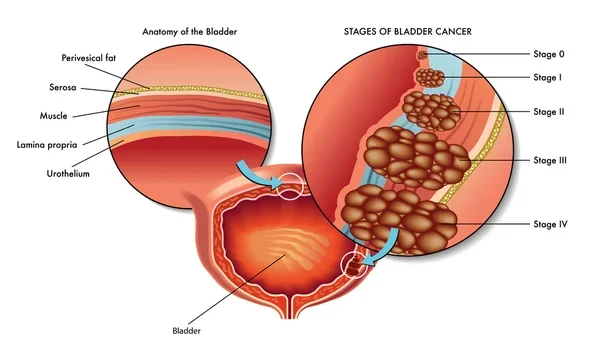
Photo: Depositphotos
The distinction is important because treatment, prognosis, and follow-up can differ substantially between these groups.
What Are the Warning Signs?
The most common warning sign of bladder cancer is blood in the urine, also called hematuria. Blood may be visible to the patient or detected only through laboratory testing. Other possible symptoms include:
- Burning or pain during urination
- Increased urinary frequency
- Urgency
- Difficulty urinating
- Pelvic pain
- Back pain in some cases
These symptoms do not automatically mean someone has bladder cancer. Urinary infections, stones, prostate conditions, and other problems can cause similar symptoms. However, unexplained blood in the urine should be medically evaluated.
What Increases the Risk of Bladder Cancer?
Several factors are associated with an increased risk of bladder cancer, including tobacco use, older age, occupational exposure to certain industrial chemicals, previous cancer treatment, and chronic bladder irritation or certain infections. Smoking is one of the most important preventable risk factors because chemicals from tobacco smoke enter the bloodstream, are filtered by the kidneys, and become concentrated in urine, exposing the bladder lining to carcinogens. Bladder cancer is more common among older adults, while long-term exposure to certain chemicals in manufacturing and other industries may also increase risk.

Previous treatment with certain chemotherapy drugs or radiation involving the pelvis can contribute to risk in some patients, as can long-standing bladder irritation and certain chronic infections.
How Is Bladder Cancer Diagnosed?
Evaluation usually begins with a medical history, physical examination, and urine testing. Depending on the clinical situation, physicians may use:
- Urinalysis
- Urine cytology
- Cystoscopy
- CT or MRI imaging
- Biopsy or tumor resection
- Cystoscopy is particularly important because it allows physicians to directly examine the bladder lining.
If a suspicious lesion is identified, tissue can be removed and examined by a pathologist. Pathology determines important characteristics such as the tumor type, grade, and depth of invasion.
How Is Bladder Cancer Treated?
Treatment depends heavily on the stage and characteristics of the disease. For non-muscle-invasive bladder cancer, treatment may involve removing the tumor through the urethra, followed by bladder-directed therapy such as intravesical treatment when appropriate. For muscle-invasive disease, treatment may involve combinations of chemotherapy, surgery, radiation, immunotherapy, or other systemic approaches depending on the patient’s circumstances. For advanced or metastatic bladder cancer, treatment may include systemic therapies such as chemotherapy, immune checkpoint inhibitors, antibody-drug conjugates, or targeted treatments for selected patients. Treatment decisions are increasingly influenced by tumor biology, patient health, previous therapy, and molecular or biomarker information.
Tommy John’s Final Chapter
Tommy John’s death adds a very different dimension to a life that had already become part of medical history. His first major medical story was one of recovery. At 31, he faced an injury that appeared likely to end his career. Instead, he became the first Major League pitcher to successfully undergo a revolutionary UCL reconstruction and then returned to pitch for another 14 years. His final medical chapter was very different.
After being diagnosed with bladder cancer in 2024 and later experiencing recurrent disease, John ultimately died at home in Florida in August 2026. The contrast is striking: one medical crisis became a story of extraordinary recovery, while the other ended his life. But neither should define him completely.
A Legacy Beyond Baseball
Tommy John’s name will remain embedded in medicine. Every time a professional or amateur athlete undergoes Tommy John surgery, his story is indirectly recalled. Yet the operation was only one part of his legacy. He was a pitcher who accumulated 288 Major League wins, competed across four decades, returned from an injury that once seemed career-ending, and demonstrated what could happen when a patient and surgeon were willing to attempt something unprecedented.
His life also demonstrates an important principle in medicine: innovation is often built through collaboration between patients, physicians, researchers, and rehabilitation teams. Dr. Frank Jobe supplied the surgical innovation. Tommy John supplied the willingness to take the chance and then put in the extraordinary work required to make that chance successful. Together, their story changed sports medicine.
Why Recurrence Matters in Bladder Cancer
Bladder cancer can recur even after the initial tumor has been successfully removed, particularly in non-muscle-invasive bladder cancer (NMIBC). The risk varies substantially according to tumor characteristics and risk group. According to the 2026 EAU Guidelines, patients with low-risk NMIBC have an estimated 10–35% risk of recurrence within 5 years, while recurrence in intermediate-risk disease is reported at approximately 18–50% over 5 years.
Recurrence does not necessarily mean that bladder cancer has become invasive or metastatic. However, repeated recurrences can require additional procedures and bladder-directed treatments and may be associated with a greater risk of progression in higher-risk disease. The AUA/SUO guidelines emphasize that recurrence and progression are important determinants of long-term outcomes in NMIBC.
Treatment can reduce recurrence risk. For example, the EAU cites a systematic review and individual-patient meta-analysis of 2,278 patients in which a single immediate postoperative chemotherapy instillation reduced the 5-year recurrence rate from 59% to 45%, an absolute reduction of 14 percentage points in the appropriate patient population. Because recurrence is common, long-term surveillance is an essential part of NMIBC management. The EAU recommends follow-up because of the ongoing risks of recurrence and progression, with cystoscopy forming a central component of surveillance.
Tommy John’s Final Chapter
Tommy John’s death adds a very different dimension to a life that had already become part of medical history. His first major medical story was one of recovery. At 31, he faced an injury that appeared likely to end his career. Instead, he became the first Major League pitcher to successfully undergo a revolutionary UCL reconstruction and then returned to pitch for another 14 years. His final medical chapter was very different.
After being diagnosed with bladder cancer in 2024 and later experiencing recurrent disease, John ultimately died at home in Florida in August 2026. The contrast is striking: one medical crisis became a story of extraordinary recovery, while the other ended his life. But neither should define him completely.
A Legacy Beyond Baseball
Tommy John’s name will remain embedded in medicine. Every time a professional or amateur athlete undergoes Tommy John surgery, his story is indirectly recalled. Yet the operation was only one part of his legacy. He was a pitcher who accumulated 288 Major League wins, competed across four decades, returned from an injury that once seemed career-ending, and demonstrated what could happen when a patient and surgeon were willing to attempt something unprecedented.
His life also demonstrates an important principle in medicine: innovation is often built through collaboration between patients, physicians, researchers, and rehabilitation teams. Dr. Frank Jobe supplied the surgical innovation. Tommy John supplied the willingness to take the chance and then put in the extraordinary work required to make that chance successful. Together, their story changed sports medicine.
You Can Also Read Deion Sanders and Bladder Cancer: His Diagnosis, New Bladder Surgery, and Cancer-Free Update by OncoDaily

Written by Aharon Tsaturyan, MD, Editor at OncoDaily Intelligence Unit
FAQ
Who was Tommy John?
Tommy John was a legendary Major League Baseball pitcher who played for 26 seasons and won 288 games. He became internationally known after successfully returning to baseball following the 1974 UCL reconstruction that later became known as Tommy John surgery.
What type of cancer did Tommy John have?
Tommy John was diagnosed with bladder cancer in 2024 and later developed recurrent disease. He died on August 15, 2026, at age 83, with bladder cancer reported as the cause of death.
How did Tommy John change baseball?
His successful return after UCL reconstruction demonstrated that a severe elbow ligament injury did not necessarily have to end a pitcher's career. The procedure subsequently became known as Tommy John surgery and transformed the treatment of UCL injuries in baseball.
What is Tommy John surgery?
Tommy John surgery is another name for ulnar collateral ligament (UCL) reconstruction. It involves replacing a damaged elbow ligament with a tendon graft to restore stability and function.
Who performed Tommy John surgery on Tommy John?
Dr. Frank Jobe, the Los Angeles Dodgers' orthopedic surgeon, performed the experimental UCL reconstruction on John on September 25, 1974. John's successful return helped establish the procedure's significance in sports medicine.
How many games did Tommy John win after surgery?
Tommy John won 164 Major League games after his 1974 UCL reconstruction. He ultimately finished his career with 288 victories over 26 MLB seasons.
What are the most common symptoms of bladder cancer?
The most common warning sign is blood in the urine (hematuria). Other symptoms can include painful urination, increased frequency or urgency, difficulty urinating, and pelvic or back pain.
What are the main risk factors for bladder cancer?
Smoking is the leading preventable risk factor for bladder cancer. Other factors include older age, occupational exposure to certain chemicals, previous pelvic radiation or certain cancer treatments, and chronic bladder irritation.
How is bladder cancer diagnosed and treated?
Diagnosis may involve urine testing, cystoscopy, imaging, and biopsy or tumor resection. Treatment depends on the cancer's stage and may include tumor removal, intravesical therapy, surgery, chemotherapy, radiation, immunotherapy, or targeted treatments.