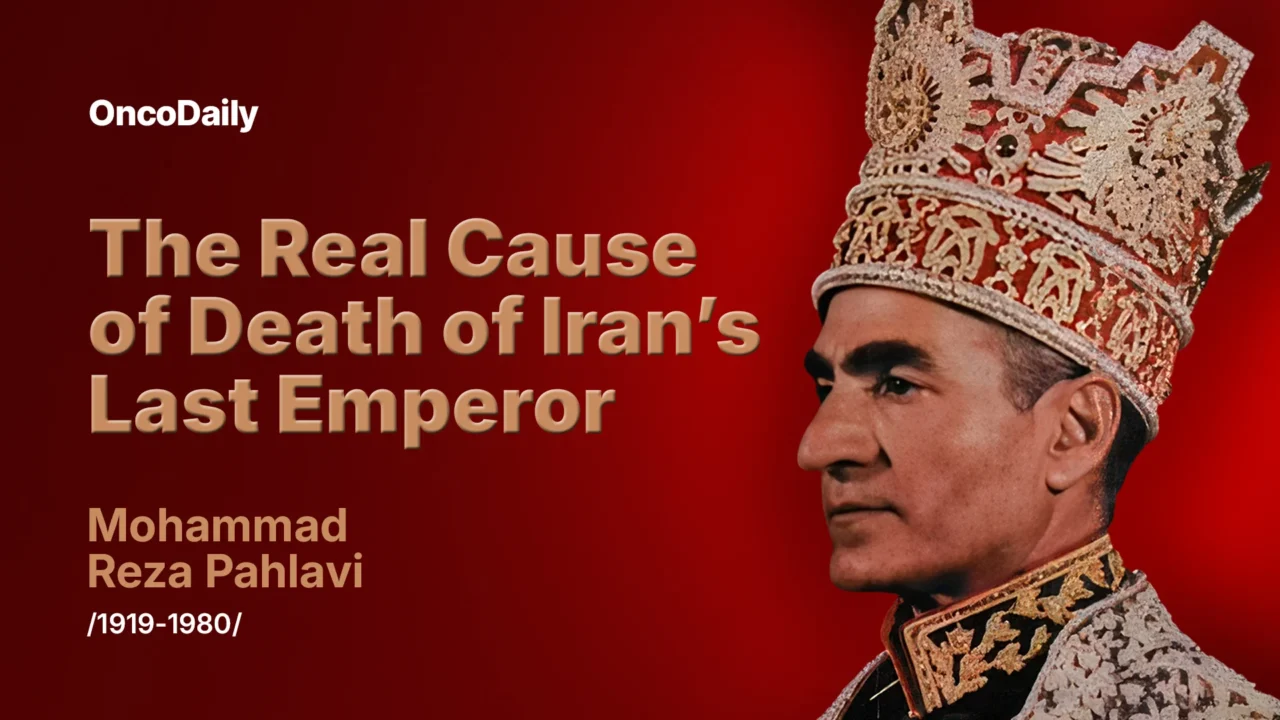
Noruz 1974, Caspian Sea Mohammad Reza Shah Pahlavi, architect of Iran’s modern renaissance, slices through turquoise waves on waterskis. At 54, the Shah of Shahs exudes vigor, his speedboat flanked by SAVAK speedboats scanning for threats. But as he dismounts, a servant notices the unthinkable: his abdomen protrudes unnaturally. The ruler who transformed Persia into a regional superpower feels a deep, tender mass a splenomegaly that medical advisors initially dismiss as “athlete’s fatigue.”
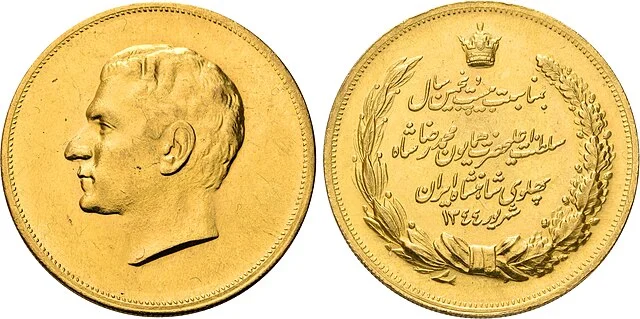
25th anniversary of Mohammad Reza Pahlavi commemorative Medal
This article traces The Shah of Iran’s Hidden Cancer, from a secret diagnosis of chronic lymphocytic leukemia through revolution-fueled exile to a fatal splenectomy in Cairo, revealing how medical secrecy ultimately doomed the Peacock Throne.
Autumn 1973: The First Shadow
During OPEC’s Tehran oil summit triumph, Mohammad Reza Shah then at peak power with $20B petrodollars fueling the White Revolution begins experiencing progressive fatigue, night sweats, and early satiety. At 54, the fitness-obsessed monarch attributes symptoms to “summit jet lag” and 18-hour state dinners. Court physician Dr. Hossein Ayadi notes pallor, cervical lymphadenopathy (1cm nodes), and WBC 14,500/μL with 65% lymphocytes on routine exam. Peripheral smear reveals smudge cells pathognomonic for CLL but diagnosis withheld amid rising Shi’a unrest.
April 9, 1974: The Splenomegaly Bombshell
Post-Noruz Caspian waterskiing, servant alerts Ayadi to abdominal asymmetry. Physical exam confirms splenomegaly 3cm below left costal margin, firm, non-tender. Urgent labs: Hb 12.2 g/dL, platelets 140K, lymphocytosis 18,200/μL. Shah demands utmost secrecy—SAVAK shadows medical staff; no written records permitted. Empress Farah later recalls:
“He joked about ‘athlete’s spleen’ from skiing falls.”
Vienna Medical Pilgrimage (April 20-25, 1974)
Royal Gulfstream jets Shah to Kaiser-Franz-Josef-Spital under Prof. Karl Fellinger. Bone marrow biopsy confirms chronic lymphocytic leukemia, Rai Stage B (lymphocytosis + splenomegaly, no anemia/thrombocytopenia). Shah told “precancerous blood disorder responsive to vitamins” full diagnosis communicated only to Ayadi/Farah via encrypted cable. Fellinger recommends chlorambucil + prednisone; Shah receives placebo initially.
Flandrin’s Clandestine Campaign (Oct 1974-1979)
Paris Cochin Hospital’s Georges Flandrin, world-class hematologist, flies 39 times to Tehran via private jet (total 18,000 flight miles). Disguised as “nutrition consultant,” administers chlorambucil 4mg PO daily starting October 17, 1974. Initial response excellent: spleen shrinks to 1cm below costal margin by March 1975; WBC drops to 8,200/μL. Flandrin’s classified letters plead “Majesty must know truth for proper care” burned unread by Alam. Side effects masked as “flu-like symptoms.”
Alam’s Diary: Lethal Deception ExposedCourt Minister Asadollah Alam’s secret journals (later smuggled to Harvard) document the inner circle’s moral collapse:
- March 12, 1975: “Doctors unanimous truth would shatter His Majesty’s will to rule. Chlorambucil disguised as ‘blood tonic.'”
- Sept 1976: “Spleen rebounding; Shah notices girdle tightness. SAVAK intercepts Khomeini nurses asking ‘Is Shah dying?'”
- Feb 1978: “US Ambassador learns via Mossad; Carter NSC debates disclosure. Shah’s denial becomes national security crisis.”
- Medical-Political Fuse Lit: By late 1974, spleen regrows amid rising Black Friday protests. Chlorambucil resistance emerges (lymphocyte doubling time accelerates); Flandrin urges radiotherapy refused publicly. Secrecy breeds revolution while leukemic cells multiply unchecked.
By late 1974, spleen regrows amid rising Black Friday protests. Chlorambucil resistance emerges (lymphocyte doubling time accelerates); Flandrin urges radiotherapy—refused publicly. Secrecy breeds revolution while leukemic cells multiply unchecked.
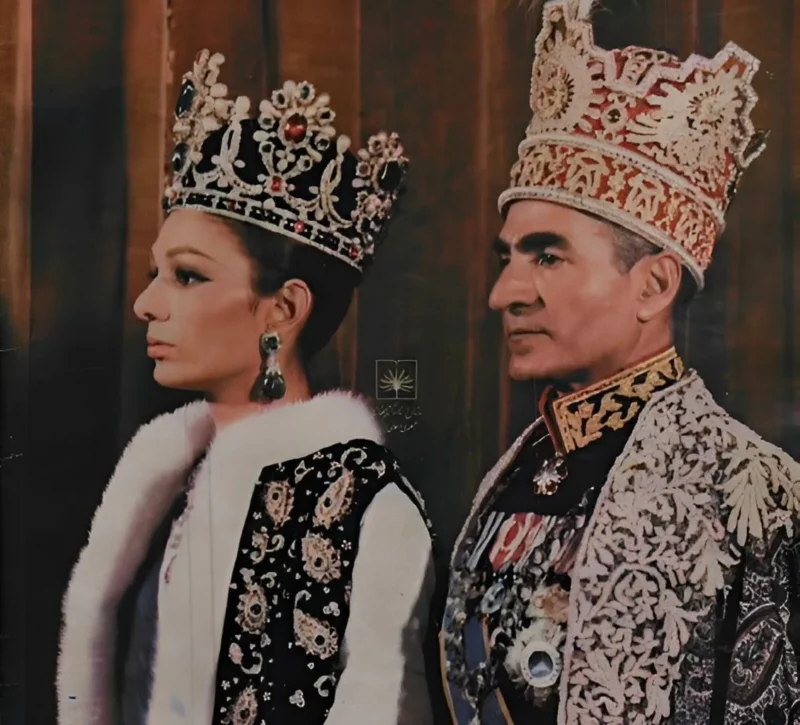
Shah Mohammad Reza Pahlavi and Empress Farah on the day of their coronation ceremony.
Cancer vs. Revolution: The Shah of Iran’s Hidden Cancer (1975-1979)
Chlorambucil yields partial response spleen shrinks to 1cm below costal margin, WBC stabilizes at 8,200/μL. Shah experiences deceptive good health, launching 6th Five-Year Plan ($96B investment). However, lymphocyte doubling time accelerates by late 1975, signaling Richter’s transformation (CLL → aggressive lymphoma). Flandrin notes gallbladder distension from massive spleen compression. Court physicians rotate “stress vitamins,” masking recurrent infections (otitis, tonsillitis). Empress Farah observes: “His once-iron stamina wanes.”
1977: Spleen Rebounds, Decisions Falter
Spleen reaches 8cm below costal margin; abdominal girth expands from 84cm to 102cm. Shah requires custom-tailored uniforms. US Embassy cables (declassified 2017) confirm CIA awareness via Mossad intercepts: “Shah receives regular chemotherapy; prognosis guarded.” Carter administration debates intervention as religious protests escalate in Qom. Shah rejects splenectomy (“cannot appear weak during bicentennial celebrations”); radiation proposed at Pars Hospital refused publicly.
1978: Medical Crisis Meets Revolutionary Fire
January: Spleen basketball-sized (12cm below costal margin); WBC surges to 45,000/μL. Flandrin administers covert spleen radiation (20Gy over 10 fractions) during “rest cure” at Niavaran Palace. Shah hospitalized 45 days disguised as “influenza.”
September 8, 1978 – Black Friday Massacre: While Shah receives emergency blood transfusions at Pars Hospital, security forces kill 94 protesters in Zhaleh Square. Radiology logs later reveal Shah watched events from isolation ward: “My doctors say rest; my people say revolution.”
Political Intrigue: Global Powers Watch Shah Wither
- CIA Station Chief George Cave cables Langley: “Shah’s leukemia transforms to non-Hodgkin lymphoma; physical decline evident.”
- Zbigniew Brzezinski urges disclosure; Rockefeller interests oppose destabilization.
- Khomeini tapes from Neauphle-le-Château amplify rumors: “Cancerous Shah bleeds white blood.” SAVAK assassination plots foiled.
- Treatment Paralysis Fatal: Flandrin begs fludarabine (experimental); unavailable due to secrecy. Shah’s delirium episodes (hypercalcemia from bone marrow infiltration) mistaken for “leadership fatigue.” By December 1978, abdominal girth 120cm, Hb 8.2 g/dL walking requires cane. Revolution erupts as medical team fractures: Ayadi flees, Flandrin recalled to Paris․
Spleen size inversely correlates with state stability. Each centimeter of splenomegaly weakened Shah’s grip while clerics seized narrative control. Medical secrecy didn’t just hide cancer it hid the dying king, fueling divine-right collapse.
Exile and Desperate Measures (Jan-Feb 1979)
January 16, 1979: Tehran falls silent under revolutionary thunder as Mohammad Reza Shah, once unchallenged sovereign, boards a royal Boeing 707 at Mehrabad Airport. His abdomen, grotesquely distended by a basketball-sized spleen (20cm below costal margin), forces him into a custom wheelchair. En route to Aswan, Egypt—temporary refuge courtesy of Anwar Sadat—urgent labs drawn mid-flight reveal catastrophe: WBC 62,000/μL (92% lymphocytes), Hb 7.1 g/dL, platelets 85,000/μL. Hyperuricemia from tumor lysis syndrome risks acute renal failure; IV allopurinol drips alongside morphine for constant left upper quadrant pain. Empress Farah, clutching his hand, later recounts in her memoirs:
“He whispered, ‘My spleen weighs me down heavier than the crown.'”
The nomadic exile begins: Morocco’s Skhirat Palace (Feb 2), then the Bahamas’ Paradise Island (March), Cuernavaca, Mexico (May), circling like a wounded eagle. Each stop brings rotating physicians Tehran’s Dr. Ayadi shadows via private jet—but secrecy persists. SAVAK remnants guard medical charts; no biopsies dared amid flight risks. Splenomegaly compresses the stomach, causing intractable early satiety; Shah survives on fortified milkshakes disguised as “exile tonics.” By summer, nocturnal sweats soak silk pajamas; weight plummets from 85kg to 62kg.
New York Medical Ordeal
October 22, 1979: A US Air Force C-141 Starlifter lands the Shah at Stewart Airfield, New York, evading paparazzi under CIA cover. Admitted to New York Hospital-Cornell (now NewYork-Presbyterian), he falls under Dr. Arthur Sawitsky, Memorial Sloan Kettering’s CLL maestro. Cervical nodes now 4cm, axillary masses palpable; bone marrow aspirate confirms Rai Stage IV chronic lymphocytic leukemia with Richter’s transformation 40% diffuse large B-cell lymphoma on immunophenotyping (CD20+, CD5+). Prognosis: 12-18 months with aggressive therapy.
Sawitsky launches CHOP chemotherapy (cyclophosphamide 750 mg/m², doxorubicin 50 mg/m², vincristine 1.4 mg/m², prednisone 100 mg x5 days) on Day 1, preceded by allopurinol 300mg TID + aggressive hydration (3L/day) to avert tumor lysis. Initial response promising: spleen shrinks 4cm after Cycle 1; WBC halves to 28,000/μL. But nausea ravages the ex-monarch Shah quips to nurses, “Revolution was easier than this poison.” Radiation (20Gy to retroperitoneal nodes) follows in December, masked as “physical therapy.”
Carter’s Bind
Jimmy Carter’s White House reels. Declassified NSC memos (released 2017) capture the vise: admitting the Shah honors 1972 treaty obligations but ignites Tehran fury student riots at US Embassy escalate to hostage crisis (Nov 4). Khomeini, from Paris exile, broadcasts via cassette: “The cancerous Shah invades America to spread his white blood plague.” CIA cables warn: “Shah’s visible decline cane-dependent, jaundiced fuels Ayatollah narrative of divine judgment.” Zbigniew Brzezinski urges extraction; Rockefeller pleads sustainment. Medical secrecy, once a throne shield, now poisons alliances.
Terminal Decline in Panama and Cairo (March 1979–Jan 1980)
March 23, 1979: Evicted from Mexico amid diplomatic backlash, the Shah lands in Panama at dictator Omar Torrijos’ Contadora Island estate. Splenomegaly rages unchecked at 20cm below costal margin; abdominal girth balloons to 140cm, custom caftans barely concealing the bulge. Covert trials of Torudex (a methotrexate analog, smuggled via Gulfstream) yield fleeting lymphocyte suppression—but neutropenia ensues (ANC <500/μL), sparking recurrent sepsis: E. coli bacteremia (Febrile neutropenia x3 admissions), treated with ticarcillin-clavulanate. Shah, bedbound and jaundiced (bilirubin 4.2 mg/dL from splenic vein thrombosis), pens a handwritten note to David Rockefeller, smuggled out April 12: “This blood beast devours my empire from within.” Isolation deepens; Farah reads Kipling aloud as morphine doses climb to 20mg q4h.
Return to Cairo (Dec 1979)
December 22, 1979: Anwar Sadat, defying Khomeini threats, welcomes the Shah to Cairo’s Maadi Military Hospital. Georges Flandrin, the Paris hematologist who’d logged 18,000 miles for Tehran house calls, reunites for a desperate chlorambucil redux (8mg PO daily). But leukemia accelerates: WBC peaks at 120,000/μL (95% lymphs), hyperuricemia triggers acute kidney injury (Cr 3.2 mg/dL, uric acid 15 mg/dL). Dialysis thrice weekly; gallbladder distends further from compression. Sadat visits bedside: “Brother, fight like you fought the mullahs.” Shah replies weakly, “The mullahs were mortal; this is immortal.”
June 27, 1980: In a last gambit, Dr. Michael DeBakey’s Houston team flies to Cairo for open splenectomy excising an 8kg behemoth riddled with infarction. Pathology: CLL with 40% large-cell transformation (Richter’s confirmed retrospectively). Brief post-op rally (WBC drops to 15,000/μL), shattered by ventilator-dependent pneumonia (Pseudomonas aeruginosa).
Mohammad Reza Shah Pahlavi died in the early hours of July 27, 1980, in Cairo, aged 60, alone except for Empress Farah and his physicians, as pulmonary embolism and multiorgan failure overwhelmed his body after a failed attempt to save the throne with his own spleen. His final days unfolded in a quiet, muffled hospital room, far from the Peacock Throne, but the world’s reaction to his death was anything but silent: it became a mirror of Cold War politics, revolutionary ideology, and the lingering shadow of Iran’s lost empire Final words to Empress Farah:
“I wanted to see our boy on the throne.”
Empress Farah later described the scene with quiet dignity: he died “not with a cry, but with a whisper,” expressing regret that he would not see his son Reza as Shah of Iran. With characteristic secrecy still in place, his personal doctors and aides kept most clinical details strictly confidential, consistent with the pattern of concealment that had defined his illness from the beginning.
Autopsy Insights
Cairo’s declassified 2015 autopsy report exposes the tragedy: a 6-year arc from Rai Stage B to fatal transformation, with missed rituximab window (approved 1997) offering 70% 5-year survival odds versus Shah’s era chlorambucil (20-30%). Bone marrow fibrosis and splenic rupture scars underscore delayed intervention costs.
The Funeral in Cairo
A simple, state-sponsored funeral was held in Cairo on July 28, 1980, under the personal protection of President Anwar Sadat, who had granted him asylum and treated him as an honored guest rather than a fugitive monarch. The service was Shia Muslim in form, reflecting the Pahlavi dynasty’s nominal adherence to Twelver Shi’ism, but deliberately restrained and small in scale to avoid provoking Khomeini or further destabilizing Egypt’s position in the Arab world.
The Shah was buried in Cairo’s historic Al‑Rifa’i Mosque, near the tomb of Sultan al‑Husayn and close to the resting place of his father, Reza Shah Pahlavi, who had also died in exile in South Africa and was later reburied in Egypt. That mosque, once a symbol of imperial and religious grandeur, became the exiled dynasty’s final resting place—a quiet, almost hidden conclusion to the Pahlavi era.
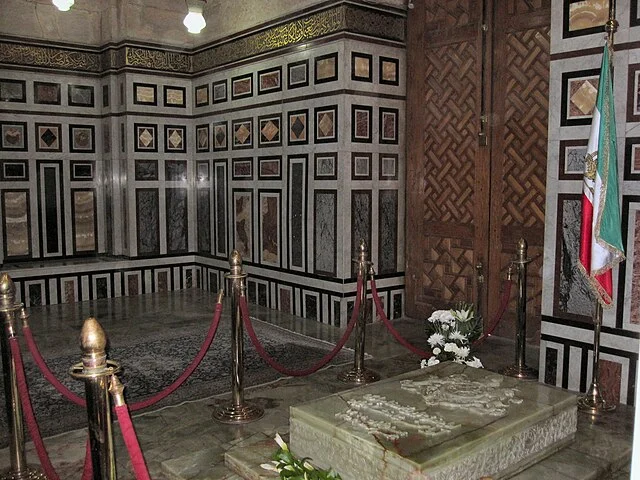
Tomb of Mohammad Reza Pahlavi at Al Rifai Mosque in Cairo
Reactions of World Leaders
Cold War leaders reacted with a mix of formal condolence and strategic relief or caution. The U.S. under Jimmy Carter issued a brief, careful statement acknowledging the Shah’s role as a key Cold War ally but scrupulously avoiding emotional language, given the ongoing hostage crisis in Tehran and domestic political sensitivity. Privately, American officials noted that his death removed a major obstacle to resolving the Iran hostage impasse, though the revolution’s hardline turn continued regardless.
Britain’s government likewise offered a restrained tribute, recognizing the Shah’s geopolitical importance during the Cold War while carefully distancing itself from the more controversial aspects of his rule. Across Europe, leaders in France, Germany, and Italy generally echoed this tone: respectful but reserved, acknowledging his role in global oil politics without overtly grieving him as a fallen monarch.
In the Arab world, Sadat’s Egypt was the only country to give the Shah full state funeral honors. Other Arab leaders, including those in Saudi Arabia, Jordan, and the Gulf monarchies, remained cautious; they respected his status as a former king but avoided overt demonstrations of support in deference to the Iranian revolution and broader regional tensions.
The Iranian Revolution’s Response
Back in Tehran, the Islamic Republic under Ayatollah Khomeini marked the Shah’s death not with mourning, but with official triumphalism. Government broadcasts declared that God had removed a tyrant, and Friday sermons celebrated his end as divine justice for the “crimes” of the White Revolution and SAVAK repression. The regime emphasized that the Shah had died in exile, condemned by his own people, and that his cancer was a sign of God’s punishment for his “unjust” rule.
Ordinary Iranians reacted more ambivalently; some celebrated the death of the deposed monarch, while others, especially secular Iranians and members of the old elite, viewed it as a personal tragedy, a symbol of lost modernity and national fracture. Decades later, the Shah’s tomb in Al‑Rifa’i continues to be a pilgrimage site for Iranian exiles and monarchists, standing in silent contrast to the loud, official narrative of his downfall.
You Can Also Read King Albert II’s Brave Battle: A Decade of Fighting Skin Cancer by OncoDaily
Written by Aharon Tsaturyan, MD, Editor at OncoDaily Intelligence Unit
FAQ
What cancer did the Shah of Iran have?
The Shah of Iran, Mohammad Reza Pahlavi, was diagnosed with chronic lymphocytic leukemia (CLL), a type of blood cancer, in the early 1970s.
When was Mohammad Reza Shah Pahlavi diagnosed with leukemia?
He was diagnosed in 1974, although his symptoms began earlier and the diagnosis was kept secret from the public.
Did the Shah of Iran die from cancer?
Yes. The Shah died in July 1980 from complications related to advanced leukemia with Richter’s transformation, following years of concealed illness.
Why was the Shah of Iran’s illness kept secret?
His illness was hidden due to fears that public disclosure would weaken his authority, destabilize the monarchy, and embolden opposition forces during a politically volatile period.
How did leukemia affect the Shah of Iran’s leadership?
Leukemia caused progressive fatigue, infections, cognitive decline, and physical weakness, which impaired decision-making during the critical years leading up to the Iranian Revolution.
Did the Shah of Iran receive proper cancer treatment?
He received limited and delayed treatment, primarily chlorambucil, due to secrecy, political concerns, and restricted access to emerging therapies available later in oncology.
What role did medical secrecy play in the Iranian Revolution?
Medical secrecy contributed to political paralysis, rumor proliferation, and loss of public confidence, indirectly accelerating the collapse of the Pahlavi regime.
Was the Shah’s leukemia curable at the time?
At the time, CLL was treatable but not curable. Modern therapies introduced decades later could have significantly improved survival.
Where did the Shah of Iran receive medical treatment during exile?
He was treated in Iran, Austria, the United States, Panama, and Egypt, including care at New York Hospital–Cornell and Cairo’s Maadi Military Hospital.
How does the Shah of Iran’s illness compare to modern cancer care?
Today, patients with CLL benefit from targeted therapies and immunotherapy, highlighting how medical secrecy and delayed intervention dramatically worsened the Shah’s outcome.