





Pope Leo XIV Lung Cancer Diagnosis has been confirmed by the Vatican following surgery at Rome’s Agostino Gemelli Polyclinic on October 13, 2026. The 71-year-old pontiff was diagnosed with lung adenocarcinoma, the most common histological subtype of lung cancer, after undergoing a right lower lobectomy to remove a suspicious lung nodule.
The nodule was initially discovered during routine medical examinations. Surgeons removed the lower lobe of his right lung, and an intraoperative histological examination confirmed adenocarcinoma, consistent with findings suspected during the preoperative assessment. The operation lasted approximately 90 minutes and was completed without complications, according to the Holy See Press Office. Pope Leo XIV regained consciousness normally and returned to his hospital room after a brief period of observation.
On October 14, the Vatican reported that the Pope had spent a tranquil night following surgery. Although the initial reports are encouraging, the final pathological stage of his cancer has not yet been publicly disclosed. His diagnosis has brought renewed attention to lung cancer, particularly the importance of early detection, surgical treatment, and the substantial differences in survival outcomes between localized and advanced disease.
What Happened During Pope Leo XIV’s Lung Surgery?
Pope Leo XIV was admitted to Gemelli Hospital in Rome on October 13 for the planned removal of a pulmonary nodule. The operation was performed by a thoracic surgical team led by Professor Stefano Margaritora, with Professor Elisa Meacci, Dr. Maria Teresa Congedo, and Dr. Leonardo Petracca Caravella also participating. Surgeons performed a video-assisted right lower lobectomy, removing the lower lobe of the Pope’s right lung. This technique allows surgeons to perform thoracic operations using specialized instruments and camera guidance through relatively small incisions.
According to the Vatican’s medical bulletin, the Pope spent approximately three hours in the operating room, although the surgical procedure itself lasted about 90 minutes. During the operation, tissue was examined by pathologists, who confirmed lung adenocarcinoma. The diagnosis had already been suspected based on examinations performed before surgery. The Vatican described the operation as successful and reported no complications. However, confirmation of a successful surgical procedure is not the same as confirmation that the cancer has been permanently eliminated. Final histopathological examination remains essential for assessing the disease.
How Was Pope Leo XIV’s Lung Cancer Discovered?
The diagnosis followed the identification of a suspicious lung nodule during a routine medical evaluation. On October 11, Pope Leo publicly disclosed that doctors had discovered a small, well-localized abnormality in his lung and recommended surgical removal. At that time, no confirmed cancer diagnosis had been announced. A pulmonary nodule is an abnormal area of tissue within the lung that may result from several conditions, including previous infections, inflammation, benign growths, or malignancy.
Further assessment is usually determined by the nodule’s size, appearance on imaging, growth over time, and the patient’s clinical risk factors.
On October 13, intraoperative examination confirmed that the Pope’s nodule was malignant and represented lung adenocarcinoma. The Vatican has not published the full diagnostic imaging findings or preoperative staging results. It has also not reported respiratory symptoms that prompted the initial investigation. This distinction matters because early lung cancer may develop without obvious symptoms and can occasionally be discovered during examinations performed for unrelated reasons.
What Is Lung Adenocarcinoma?
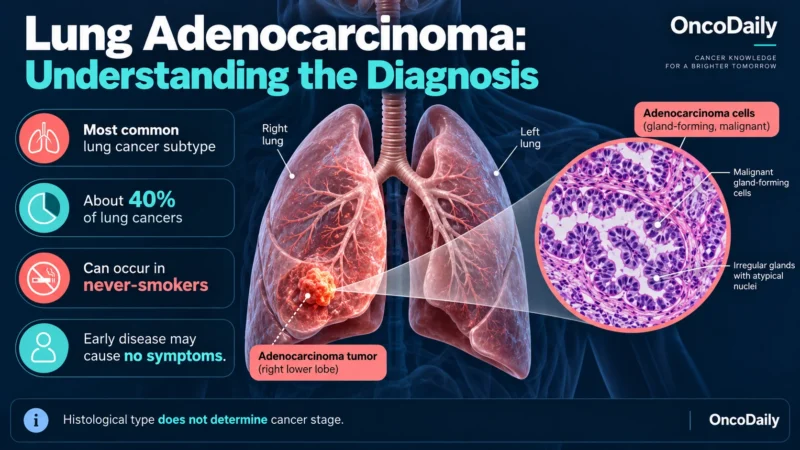
Lung adenocarcinoma is a histological subtype of non-small cell lung cancer (NSCLC) and accounts for approximately 40% of lung cancer cases. It originates from epithelial cells with glandular differentiation and commonly develops in the peripheral regions of the lungs. Unlike certain other lung cancer subtypes, adenocarcinoma is frequently diagnosed in people who have never smoked, although tobacco exposure remains an important risk factor.
Other recognized risk factors include radon, secondhand smoke, air pollution, occupational exposure to carcinogens, and genetic susceptibility. The disease can remain asymptomatic during its early development. When symptoms occur, they may include persistent coughing, chest discomfort, shortness of breath, coughing up blood, and unexplained weight loss.
Lung adenocarcinoma also has considerable molecular heterogeneity. Some tumors contain alterations in genes such as EGFR, ALK, ROS1, BRAF, MET, RET, and KRAS, which may influence treatment decisions in appropriate clinical settings. Importantly, adenocarcinoma describes the type of cancer, not its stage. The histological diagnosis alone does not establish whether the malignancy is confined to the lung, involves regional lymph nodes, or has spread elsewhere.
Why Is Lobectomy Performed for Lung Cancer?
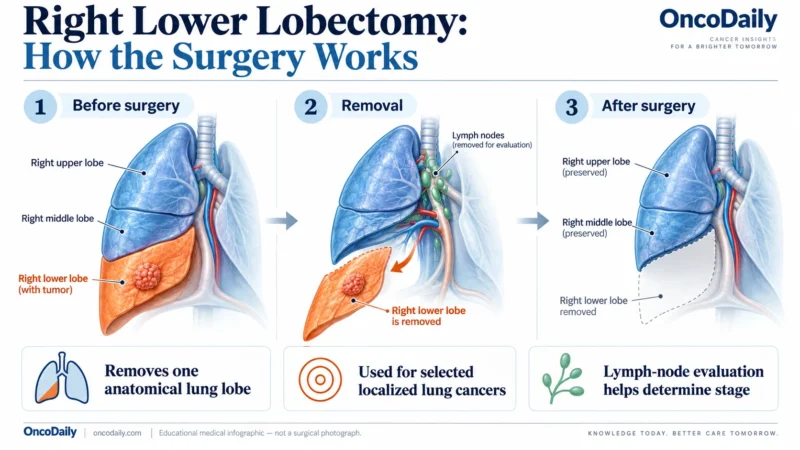
Surgical removal is one of the principal potentially curative treatments for localized non-small cell lung cancer. A lobectomy involves removing an entire anatomical lobe of the lung. The right lung contains three lobes, while the left contains two. In Pope Leo’s case, surgeons removed the lower lobe of the right lung while preserving the upper and middle lobes. For medically fit patients with resectable disease, lobectomy can provide effective local cancer control and allow pathological assessment of the primary tumor.
The extent of surgery is individualized. Smaller peripheral tumors may sometimes be treated with segmentectomy, particularly when tumor characteristics and anatomical factors make lung-sparing surgery appropriate. When surgery is performed for lung cancer, assessment of regional lymph nodes is also important because nodal involvement can substantially alter pathological staging and postoperative treatment recommendations. According to reporting from the Associated Press, lymph nodes were removed during the Pope’s operation and were undergoing examination for possible malignant involvement. The Vatican has not released the final lymph-node findings or microscopic surgical margin status.
What Stage Is Pope Leo XIV’s Lung Cancer?
The Vatican has characterized the detected lesion as small and localized, but a definitive pathological stage has not been publicly announced. Non-small cell lung cancer is staged using the TNM system, which evaluates the extent of the primary tumor (T), the presence of regional lymph-node involvement (N), and distant metastasis (M).
A small pulmonary lesion does not necessarily correspond to Stage I disease. Even relatively small tumors may demonstrate regional nodal involvement or other features that influence their final classification. The removed tissue will require detailed pathological examination to determine the tumor’s characteristics and the presence or absence of microscopic disease at the surgical margins.
Lymph-node results will be particularly important in clarifying whether the disease is confined to the lung or has regional involvement. Until those findings are available, describing the Pope’s diagnosis as confirmed Stage I lung cancer would be premature.
Lung Adenocarcinoma Prognosis: Survival Rates, Disease Stage, and Outcomes After Surgery
Lung cancer prognosis varies considerably according to the stage at diagnosis, histological subtype, molecular characteristics, and whether complete surgical resection is possible. For patients diagnosed with localized non-small cell lung cancer (NSCLC), including adenocarcinoma, survival outcomes are substantially better than for those with regional or metastatic disease.
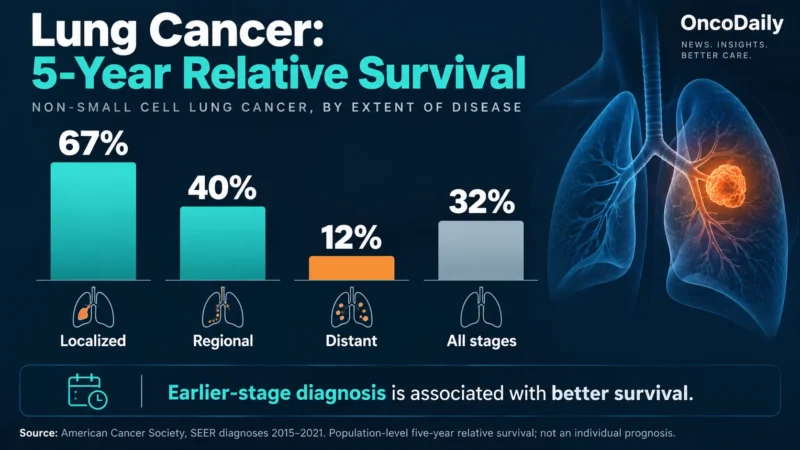
According to the American Cancer Society, based on patients diagnosed between 2015 and 2021, the five-year relative survival rate for localized NSCLC was 67%, compared with 40% for regional disease and 12% for distant metastatic disease. Five-year relative survival compares the survival of people diagnosed with cancer with that of people in the general population of similar characteristics. It is not equivalent to the probability of cure and cannot predict the outcome for an individual patient.
According to the American Cancer Society (ACS), five-year relative survival rates for non-small cell lung cancer (NSCLC) vary significantly depending on the extent of disease at diagnosis. Based on SEER data for patients diagnosed between 2015 and 2021, the five-year relative survival rate is 67% for localized NSCLC confined to the lung, 40% for regional disease involving nearby lymph nodes or structures, and 12% for distant metastatic disease.
Across all stages combined, the five-year relative survival rate is approximately 32%. Similar findings have been reported by the National Cancer Institute (NCI) through its SEER program. Based on data from 2016 to 2022, five-year relative survival rates for lung and bronchus cancer were 65.5% for localized disease, 38.2% for regional disease, and 10.5% for distant disease. Unlike the ACS figures, which specifically describe NSCLC, the NCI estimates include multiple lung cancer histological subtypes. These population-based statistics highlight the substantial prognostic importance of disease extent at diagnosis but should not be interpreted as adenocarcinoma-specific survival rates or predictions of individual outcomes following surgery.
Survival Following Surgical Resection of Early-Stage Lung Cancer
Clinical trials of patients with carefully selected early-stage NSCLC demonstrate that long-term survival after surgical resection can be substantially higher than the overall population figures. In the phase III JCOG0802/WJOG4607L trial, published in The Lancet in 2022, researchers evaluated 1,106 patients with peripheral clinical Stage IA NSCLC measuring 2 cm or less. Five-year overall survival was 91.1% following lobectomy and 94.3% following segmentectomy. Five-year relapse-free survival was 87.9% and 88.0%, respectively. The findings demonstrated favorable long-term outcomes for both surgical approaches in this specific population, although local recurrence was more frequent after segmentectomy.
Similarly, the phase III CALGB 140503 trial, published in The New England Journal of Medicine in 2023, investigated patients with peripheral NSCLC measuring 2 cm or less and pathologically confirmed node-negative disease. Five-year overall survival was 78.9% following lobar resection and 80.3% following sublobar resection. Five-year disease-free survival was 64.1% and 63.6%, respectively. These trials enrolled selected patients with small, early-stage tumors, and their survival differences reflect distinct populations, eligibility criteria, and study designs. Their findings should not be directly applied to patients whose stage or lymph-node status has not been established.
What Do These Statistics Mean for Pope Leo XIV?
The Vatican’s description of a small, localized lesion and the successful completion of a right lower lobectomy are encouraging clinical findings. Surgical resection offers the possibility of long-term disease control and potential cure when lung cancer is confined and completely removed. However, the Pope’s pathological stage, lymph-node findings, surgical margin status, and other prognostic features remain undisclosed. His age, baseline cardiopulmonary function, postoperative recovery, and any need for additional treatment will also influence his long-term outlook.
Therefore, while published studies demonstrate favorable outcomes in appropriately selected patients with surgically treated early-stage NSCLC, no reliable individual survival estimate can currently be assigned to Pope Leo XIV.
Will Pope Leo XIV Need Chemotherapy or Other Treatment?
No decision regarding postoperative systemic therapy or radiation treatment has been publicly announced. Treatment following lung cancer surgery depends on the final pathological stage, surgical margins, lymph-node involvement, molecular findings, and the patient’s overall condition. For certain patients with completely resected Stage IA NSCLC, observation following surgery is generally appropriate. For higher-risk or more advanced resected disease, additional treatment may be recommended.
Platinum-based adjuvant chemotherapy is an established treatment for suitable patients with resected Stage II and III NSCLC. Molecularly selected patients may also be eligible for postoperative targeted therapy, while immunotherapy can be appropriate in selected clinical situations. At this stage, predicting which treatment, if any, Pope Leo may require would be premature.
How Is Pope Leo XIV Recovering After Surgery?
On October 14, the Vatican reported that the Pope had spent a calm first night at Gemelli Hospital. He regained consciousness normally after the operation and returned to his room following postoperative observation. Vatican News also reported that he requested dinner and spent the evening in the company of his secretaries and Vatican staff. The expected hospitalization remains approximately one week, although the duration of recovery will depend on his postoperative condition and the medical team’s assessment. Further examination of the removed tissue is planned during the coming days.
Why Early Detection of Lung Cancer Remains Important
Lung cancer remains one of the world’s most significant cancer burdens, both in incidence and mortality. According to the International Agency for Research on Cancer (IARC), approximately 2.48 million new lung cancer cases and 1.82 million deaths occurred worldwide in 2022, making lung cancer the leading cause of cancer-related mortality globally. In the United States, the National Cancer Institute estimates approximately 229,410 new lung and bronchus cancer diagnoses and 124,990 deaths in 2026.
Cancer Stat Facts
Despite advances in treatment, many patients continue to be diagnosed after their cancer has spread. SEER data show that approximately 24% of lung and bronchus cancers are diagnosed while localized, whereas about 51% are diagnosed after distant spread.
Cancer Stat Facts
These differences help explain why early diagnosis is so important. When lung cancer is identified while confined to the lung, patients are more likely to be candidates for potentially curative treatment. Low-dose CT screening has been shown to reduce lung cancer mortality in appropriately selected high-risk populations. However, screening recommendations are based on individual risk factors and should not be confused with incidental detection during routine examinations. The circumstances of Pope Leo’s diagnosis highlight both the potential value of identifying pulmonary abnormalities before symptoms develop and the importance of obtaining a definitive pathological diagnosis.
What Happens Next for Pope Leo XIV?
Pope Leo XIV is recovering at Gemelli Hospital after an operation that confirmed lung adenocarcinoma and removed the lower lobe of his right lung. The next important step is the final pathological assessment of the resected tissue, including evaluation of regional lymph nodes and surgical margins. Those results are expected to help determine the extent of the disease and whether any additional treatment is necessary.
Although the operation was successful, long-term prognosis cannot be determined from surgical outcomes alone. His case is a reminder of how dramatically lung cancer outcomes can differ depending on when the disease is detected. For selected patients with small, localized tumors, surgery can offer excellent long-term results. Yet the broader global burden of lung cancer demonstrates why early detection, accurate staging, and access to effective treatment remain central priorities in oncology. For now, the Pope’s immediate priority is recovery, while the full clinical significance of his diagnosis awaits further pathological findings.
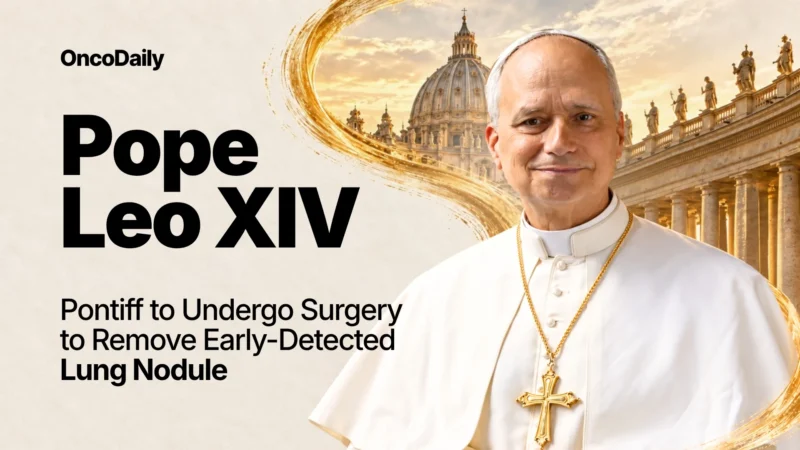
You Can Also Read Pope Leo XIV to Undergo Surgery to Remove Early-Detected Lung Nodule by OncoDaily
Written by Aharon Tsaturyan, MD, Editor at OncoDaily Intelligence Unit
FAQ
Does Pope Leo XIV have lung cancer?
According to the reported Vatican medical announcement of October 13, 2026, Pope Leo XIV was diagnosed with lung adenocarcinoma following surgery at Gemelli Hospital in Rome. Lung adenocarcinoma is the most common subtype of non-small cell lung cancer (NSCLC).
What type of lung cancer does Pope Leo XIV have?
Pope Leo XIV was reported to have lung adenocarcinoma, a type of non-small cell lung cancer that commonly develops in the outer regions of the lungs. Adenocarcinoma accounts for approximately 40% of lung cancers and can occur in people who have never smoked.
What stage is Pope Leo XIV's lung cancer?
The Vatican has not publicly disclosed a formal TNM stage. Although the lung nodule was described as small and localized, the final stage depends on tumor characteristics, lymph-node involvement, and whether cancer has spread beyond the lung.
What surgery did Pope Leo XIV undergo?
On October 13, 2026, Pope Leo XIV reportedly underwent a right lower lobectomy, a procedure that removes the lower lobe of the right lung. Lobectomy is an established surgical treatment for selected patients with localized non-small cell lung cancer.
Was Pope Leo XIV's lung cancer surgery successful?
The Vatican reportedly described the approximately 90-minute operation as successful and without complications. However, successful surgery does not automatically confirm that all cancer cells have been eliminated. Final pathology results are important for determining the extent of the disease.
What is Pope Leo XIV's prognosis after lung cancer surgery?
The Pope's individual prognosis cannot yet be determined because his final pathological stage and lymph-node findings have not been released. However, localized NSCLC has a substantially better prognosis than metastatic disease. According to the American Cancer Society, the five-year relative survival rate for localized NSCLC is approximately 67%.
Can lung adenocarcinoma be completely cured?
Yes. Lung adenocarcinoma can potentially be cured when diagnosed at an early stage and completely removed through surgery. However, recurrence remains possible, and outcomes depend on tumor stage, lymph-node involvement, surgical margins, and other pathological characteristics.
Will Pope Leo XIV need chemotherapy after surgery?
The Vatican has not announced whether Pope Leo XIV will require chemotherapy, immunotherapy, or targeted therapy. Some patients with early-stage lung cancer need only surgery and surveillance, while others benefit from additional treatment depending on the final pathological findings.
How long does recovery take after lung lobectomy?
Hospitalization after minimally invasive lung lobectomy commonly lasts several days, although recovery varies according to age, lung function, and postoperative complications. The Vatican initially anticipated approximately one week of hospitalization for Pope Leo XIV. Full recovery following lobectomy often takes several weeks.
How was Pope Leo XIV's lung cancer detected, and did he have symptoms?
Pope Leo XIV's lung nodule was discovered during medical examinations, according to the Vatican. No specific symptoms leading to the discovery have been publicly reported. Early lung adenocarcinoma can develop without noticeable symptoms, which is one reason appropriately targeted lung cancer screening and evaluation of suspicious nodules are important.