
Napoleon Bonaparte died on May 5, 1821, on the island of Saint Helena after almost six years in exile. The following day, on May 6, 1821, an autopsy was performed by Dr. Francesco Antommarchi, the Corsican physician chosen by the Bonaparte family to care for the exiled emperor. The examination took place in the presence of 16 people, including seven British medical observers.

A gilt-bronze flag eagle from the Empire period, 1804 model, probably used by a regiment during a Napoleonic battle
The cause of Napoleon’s death has remained debated for almost two centuries. The original autopsy pointed toward severe gastric disease, but the discovery of elevated arsenic concentrations in Napoleon’s hair in 1961 prompted theories of poisoning, conspiracy, and toxic exposure. Over time, three main explanations emerged: advanced gastric cancer, arsenic poisoning, and cardiac arrhythmia or treatment-related toxicity.
Modern pathological re-evaluations have strengthened the gastric-cancer interpretation. A 2021 international review of the available autopsy documentation concluded that the strongest evidence supports advanced malignant gastric neoplasia with gastric hemorrhage as the immediate cause of death, while acknowledging that some aspects of the historical record remain uncertain (Lugli et al., 2021, Virchows Archiv).
Diagnostic Controversy
For nearly two centuries, the cause of Napoleon Bonaparte’s death has remained one of medicine’s most debated historical mysteries. The evidence has fueled competing theories of advanced gastric cancer, arsenic poisoning, and cardiac arrhythmia or treatment-related toxicity, each shaped by the limits of historical records, evolving forensic methods, and later scientific interpretation.
The Three Main Hypotheses
he gastric-cancer hypothesis is supported by the documented autopsy findings: an extensive ulcerated gastric lesion, hardened tissue, a perforation, adhesions to the liver, and black granular material in the stomach consistent with upper gastrointestinal bleeding.
The arsenic hypothesis gained momentum after a 1961 Nature report found elevated arsenic concentrations in hair believed to have been taken shortly after Napoleon’s death (Forshufvud et al., 1961, Nature). Later hair analyses complicated this theory by suggesting that arsenic exposure may have predated Napoleon’s exile and may not necessarily indicate deliberate poisoning.
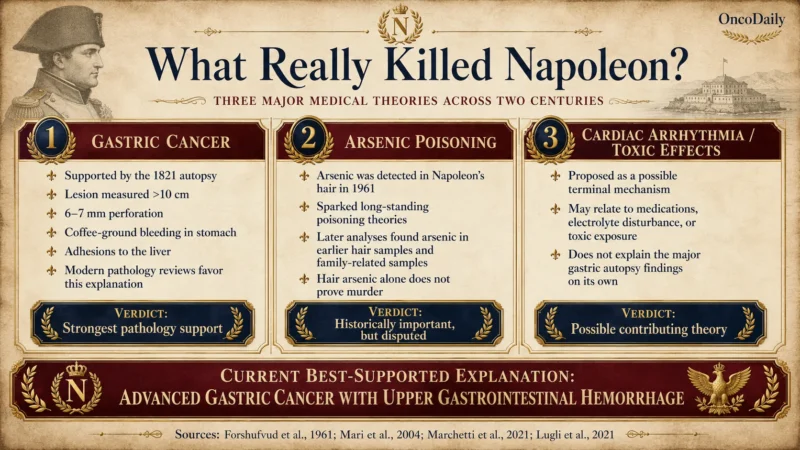
A systematic review published in 2021 concluded that gastric bleeding was considered the primary cause of death in most published accounts, whether attributed to gastric cancer alone or potentially worsened by medications containing antimony, mercury, or arsenic (Marchetti et al., 2021, Clinical Toxicology).
Key Evidence Supporting Gastric Cancer
The modern gastric-cancer interpretation is based on several converging findings:
- An ulcerated gastric lesion measuring more than 10 cm in length
- Extensive involvement of the stomach, with only a limited healthy area near the cardiac extremity
- Hardened, indurated tissue and a scirrhous mass near the pyloric region
- A 6–7 mm perforation near the pylorus
- Strong adhesions between the stomach and the left lobe of the liver
- Black granular, coffee-ground-like stomach contents consistent with upper gastrointestinal bleeding
- Progressive weakness, weight loss exceeding 10 kg, vomiting, indigestion, and anemia in the final months of life
A 2007 clinicopathologic reconstruction interpreted the lesion as at least T3N1M0 gastric cancer, corresponding to stage IIIA in the staging system used by the authors (Lugli et al., 2007, Nature Clinical Practice Gastroenterology & Hepatology). A later patho-historical analysis concluded that the gross morphology described in the autopsy was compatible with advanced gastric cancer and Borrmann-type morphology (Dawson et al., 2016, Digestive and Liver Disease).
The Autopsy: Methodology
Napoleon’s autopsy was conducted on May 6, 1821, one day after his death, under the exceptional political and medical circumstances of exile on Saint Helena.

The contemporaneous reports by Antommarchi and the British medical observers were considered the strongest available sources because they were produced close to the event by direct witnesses (Lugli et al., 2021, Virchows Archiv). The 1823 letter by Walter Henry was treated as moderate evidence because it was written later, despite its value as a witness account.
Pathological Findings
Only the cardiac extremity near the esophagus was described as relatively healthy. The autopsy suggested that nearly the entire stomach was diseased. The only preserved area was near the cardiac extremity, where the esophagus joins the stomach.
This extensive involvement was later interpreted as compatible with an advanced malignant process affecting most of the stomach. The preservation of the uppermost region may suggest that the disease began in the middle or lower stomach and extended upward, rather than originating at the gastroesophageal junction.
Coffee-Ground Stomach Contents
Both the French and British accounts described dark, granular material in the stomach. Antommarchi referred to an unpleasant or infectious odor, while the British physicians noted a disagreeable odor. Coffee-ground material is compatible with upper gastrointestinal bleeding because blood can darken after exposure to gastric acid and digestive enzymes.
This finding strongly supports the conclusion that active gastric hemorrhage occurred at or near the time of death. The bleeding may have resulted from an ulcerated lesion eroding into a blood vessel within the diseased stomach wall.
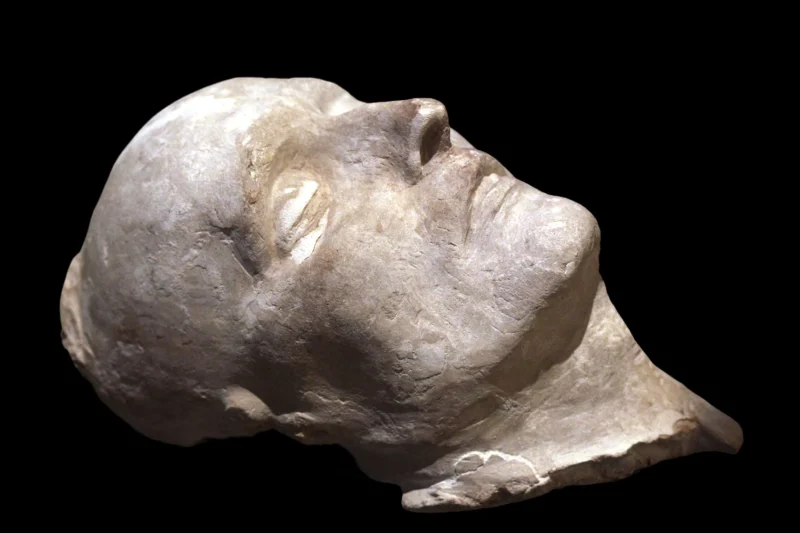
Death Mask of Napoleon. Musée de l’Armée, Paris
Extensive Ulcerated Gastric Lesion
The autopsy described a large ulcerated lesion involving most of the stomach’s length. The lesion extended from the upper stomach toward the pylorus, ending approximately 1 inch, or 2.5 cm, before the gastric outlet. It measured more than 10 cm, or around 4 inches, in length.
The ulcer surface was described as swollen and indurated, meaning hardened. These features were interpreted in later pathological analyses as more compatible with malignancy than with a benign ulcer.
Modern pathological data cited in the 2007 reconstruction noted that:
- Tumours larger than 6.5 cm are associated with advanced pT3–4 disease, with an odds ratio of 1.397.
- Tumours larger than 6 cm are associated with lymph-node metastases, with an odds ratio of 1.389.
Based on tumour size, gross morphology, and the historical description, the lesion was interpreted as advanced gastric carcinoma (Lugli et al., 2007, Nature Clinical Practice Gastroenterology & Hepatology).
Perforated Ulcer
A complete perforation through the stomach wall was described near the pyloric region. The opening measured 6–7 mm in diameter and was located about 1 inch, or 2.5 cm, from the pylorus. The perforation represented a breach through the main layers of the stomach wall:
- Mucosa
- Submucosa
- Muscularis propria
- Serosa
It was described as “covered,” meaning that surrounding tissue and adhesions partially sealed the opening.
This may have prevented diffuse leakage of gastric contents into the abdominal cavity and reduced the likelihood of generalized peritonitis. However, the ulcerated and perforated area may also have created conditions for substantial gastrointestinal bleeding. The combination of a large ulcerated lesion, perforation, and adhesions is compatible with advanced gastric cancer, including a Borrmann subtype III pattern (Dawson et al., 2016, Digestive and Liver Disease).
Adhesions to the Liver
The autopsy documented firm adhesions between the diseased stomach wall and the left lobe of the liver. These adhesions may represent an inflammatory response around the perforated ulcer. They may also be consistent with local extension of disease beyond the stomach wall. The adhesions could have helped contain the perforation, creating a localized rather than free perforation. This would have reduced the risk of widespread peritoneal contamination but would not have prevented hemorrhage from the ulcerated lesion.
Scirrhous Mass Near the Pylorus
Near the pyloric region, the autopsy described a circular mass with scirrhous hardness. Scirrhous tissue refers to dense, fibrotic tissue that can be associated with malignancy. In the context of the other autopsy findings, the description was later interpreted as compatible with gastric adenocarcinoma. The location near the pylorus is clinically relevant because tumours in this region may cause gastric outlet obstruction.
Clinicopathological Diagnosis
The most defensible modern interpretation is advanced malignant gastric neoplasia, most likely gastric carcinoma.
The lesion was described as:
- More than 10 cm long
- Ulcerated
- Hardened and indurated
- Associated with a scirrhous mass
- Perforated near the pylorus
- Adherent to the liver
The 2007 clinicopathologic study interpreted these findings as at least T3N1M0 gastric carcinoma. The 2016 analysis supported the use of the historical macroscopic description to infer advanced tumour progression and Borrmann-type morphology (Lugli et al., 2007, Nature Clinical Practice Gastroenterology & Hepatology; Dawson et al., 2016, Digestive and Liver Disease).
Upper Gastrointestinal Bleeding as the Immediate Cause of Death
The black granular material found in the stomach is compatible with partially digested blood. This supports the interpretation that upper gastrointestinal hemorrhage occurred near the time of death. The ulcerated lesion may have eroded into a vessel, causing severe bleeding. The 2021 pathology review concluded that advanced malignant gastric neoplasia with gastric hemorrhage was the strongest explanation for the terminal event (Lugli et al., 2021, Virchows Archiv).
Were Napoleon’s Symptoms Compatible With Gastric Cancer?
Historical accounts describe a progressive decline in Napoleon’s health from approximately October 1820 until his death in May 1821.
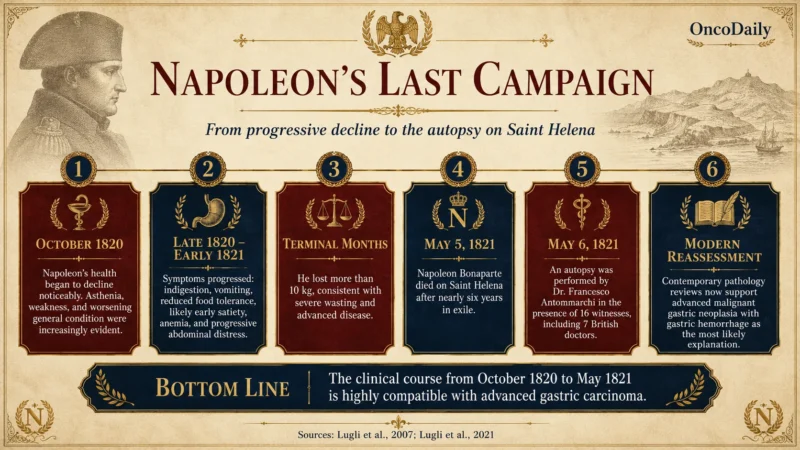
The clinical progression described across the final six months is compatible with advanced gastric carcinoma, although historical sources cannot provide the same precision as modern medical records (Lugli et al., 2007, Nature Clinical Practice Gastroenterology & Hepatology).
What May Have Caused Napoleon’s Gastric Cancer?
The 2007 clinicopathologic analysis proposed chronic Helicobacter pylori infection as the most likely etiological factor. This is a historical medical hypothesis rather than a proven diagnosis because direct tumour tissue and microbiological testing are unavailable. The proposed pathway follows the Correa cascade:
- Chronic Helicobacter pylori infection
- Chronic active gastritis
- Atrophic gastritis
- Intestinal metaplasia
- Dysplasia
- Gastric adenocarcinoma
This sequence typically develops over decades.The study considered the following findings supportive of an H. pylori-related origin: The 2007 authors considered chronic H. pylori infection more plausible than a hereditary cancer syndrome as the leading risk factor, based on the lesion’s pyloric location, extensive malignant ulceration, the estimated 60–80% prevalence of H. pylori in 19th-century Europe, and possible contributions from salt-preserved foods and tobacco exposure (Lugli et al., 2007, Nature Clinical Practice Gastroenterology & Hepatology).
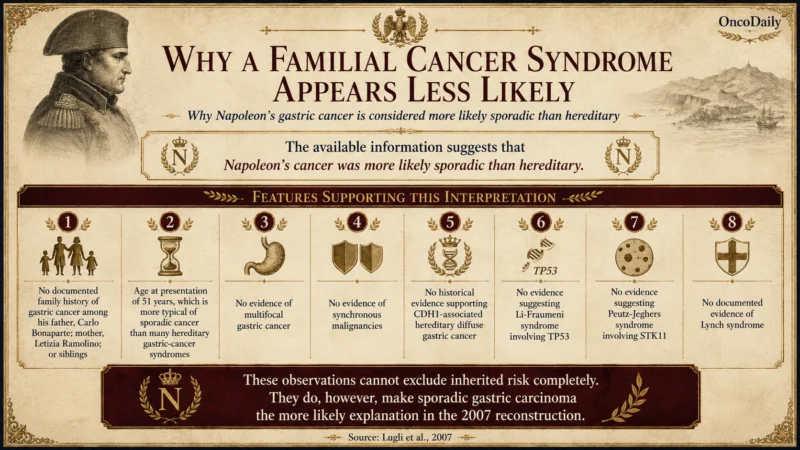
Why a Familial Cancer Syndrome Appears Less Likely
The available information suggests that Napoleon’s cancer was more likely sporadic than hereditary. The absence of a documented family history of gastric cancer, multifocal disease, synchronous malignancies, or evidence of CDH1-, TP53-, STK11-, or Lynch syndrome–related cancer, together with Napoleon’s age of 51 years, makes sporadic gastric carcinoma the more likely explanation, although inherited risk cannot be completely excluded.
What About Arsenic?
The arsenic debate intensified after a 1961 study reported elevated arsenic levels in hair believed to have been taken soon after Napoleon’s death (Forshufvud et al., 1961, Nature). This finding led to theories that Napoleon may have been deliberately poisoned during his exile. However, elevated arsenic in hair does not automatically prove lethal or intentional poisoning. Arsenic exposure was relatively common in the 19th century and could arise from medications, dyes, wallpaper pigments, environmental sources, or other exposures.
Later Hair Analyses
Later analyses detected arsenic in hair samples from before Napoleon’s exile and in samples associated with members of his family. These findings weakened the argument that arsenic in hair alone proves a deliberate terminal poisoning event. The toxicology literature remains divided. Some researchers have argued that arsenic, antimony, mercury, or medication effects could have contributed to Napoleon’s deterioration or triggered a fatal event. Others consider gastric cancer with gastrointestinal bleeding the most convincing explanation.
A 2021 systematic review concluded that toxicological findings were heterogeneous and affected by methodological limitations, while most reviewed accounts still considered gastric bleeding the primary mechanism of death (Marchetti et al., 2021, Clinical Toxicology).
Cardiac Arrhythmia Theory
A separate hypothesis proposed that treatment-related electrolyte abnormalities, arsenic exposure, and medications could have contributed to a fatal cardiac arrhythmia, including torsades de pointes (Mari et al., 2004, Journal of the Royal Society of Medicine). This theory remains part of the broader debate. It does not negate the extensive pathological evidence of severe gastric disease but suggests that additional factors may have influenced the terminal event.
The Most Defensible Conclusion
The strongest available historical and pathological evidence indicates that Napoleon Bonaparte had advanced gastric cancer, marked by an ulcerated lesion measuring more than 10 cm, a scirrhous mass near the pylorus, a 6–7 mm perforation, adhesions to the left lobe of the liver, and black granular stomach contents consistent with upper gastrointestinal bleeding, alongside progressive weakness, vomiting, anemia, and weight loss exceeding 10 kg. The best-supported immediate cause of death was upper gastrointestinal hemorrhage in the setting of advanced malignant gastric neoplasia.
Although arsenic exposure, medication effects, and cardiac arrhythmia remain important competing or potentially contributing explanations, modern pathology literature most strongly supports advanced gastric cancer as Napoleon’s terminal illness (Lugli et al., 2021, Virchows Archiv).
What Happened to Napoleon’s Body: Where Is He Buried and Why?
After Napoleon’s death on Saint Helena on May 5, 1821, he was buried on the island, where he remained for nearly two decades. In 1840, King Louis-Philippe I decided to return Napoleon’s remains to France in what became known as the Retour des Cendres, or “Return of the Ashes.” The coffin arrived in Paris on December 15, 1840, after a journey of more than 7,200 km from Saint Helena.

Photo: Depositphotos . Napoleon Bonaparte is buried at Les Invalides in Paris, France, beneath the gilded dome of the Dôme des Invalides.
Napoleon was initially placed at Les Invalides while a permanent imperial tomb was designed and constructed beneath the gilded dome. Architect Louis Visconti created the monumental burial site, and Napoleon’s body was finally laid to rest in the tomb on April 2, 1861.
You Can Also Read The Shah of Iran’s Hidden Cancer: How Leukemia and Medical Secrecy Shaped His Fall by OncoDaily
Written by Aharon Tsaturyan, MD, Editor at OncoDaily Intelligence Unit
FAQ
What did Napoleon Bonaparte die from?
The strongest modern pathological interpretation is that Napoleon died from upper gastrointestinal hemorrhage in the setting of advanced malignant gastric neoplasia, most likely gastric cancer.
Did Napoleon die of stomach cancer?
Modern reviews of the autopsy reports support advanced gastric cancer as the most likely underlying terminal illness, although definitive modern diagnostic testing is not possible.
Was Napoleon poisoned with arsenic?
Arsenic was found in Napoleon’s hair, but this alone does not prove deliberate poisoning or that arsenic caused his death. Later analyses found arsenic exposure may have occurred before his exile.
What did Napoleon’s autopsy reveal?
The autopsy described extensive gastric disease, an ulcerated lesion more than 10 cm long, a perforation near the pylorus, adhesions to the liver, and dark stomach contents compatible with gastrointestinal bleeding.
Who performed Napoleon’s autopsy?
Dr. Francesco Antommarchi, Napoleon’s personal physician, performed the autopsy on May 6, 1821, one day after Napoleon’s death.
How many people attended Napoleon’s autopsy?
Sixteen people were present, including seven British medical observers.
What was the immediate cause of Napoleon’s death?
The best-supported immediate cause was upper gastrointestinal hemorrhage, likely caused by bleeding from the ulcerated gastric lesion.
Did Napoleon have a perforated ulcer?
The autopsy described a 6–7 mm perforation in the stomach wall near the pylorus, partially covered by adhesions to the liver.
Could Helicobacter pylori have caused Napoleon’s gastric cancer?
Chronic Helicobacter pylori infection has been proposed as the most likely etiological factor, but this remains a historical medical hypothesis because direct tissue testing is not possible.
Did Napoleon’s family history suggest hereditary gastric cancer?
Available historical information does not show a clear familial cancer pattern. Modern reconstructions therefore consider sporadic gastric carcinoma more likely than a hereditary cancer syndrome.