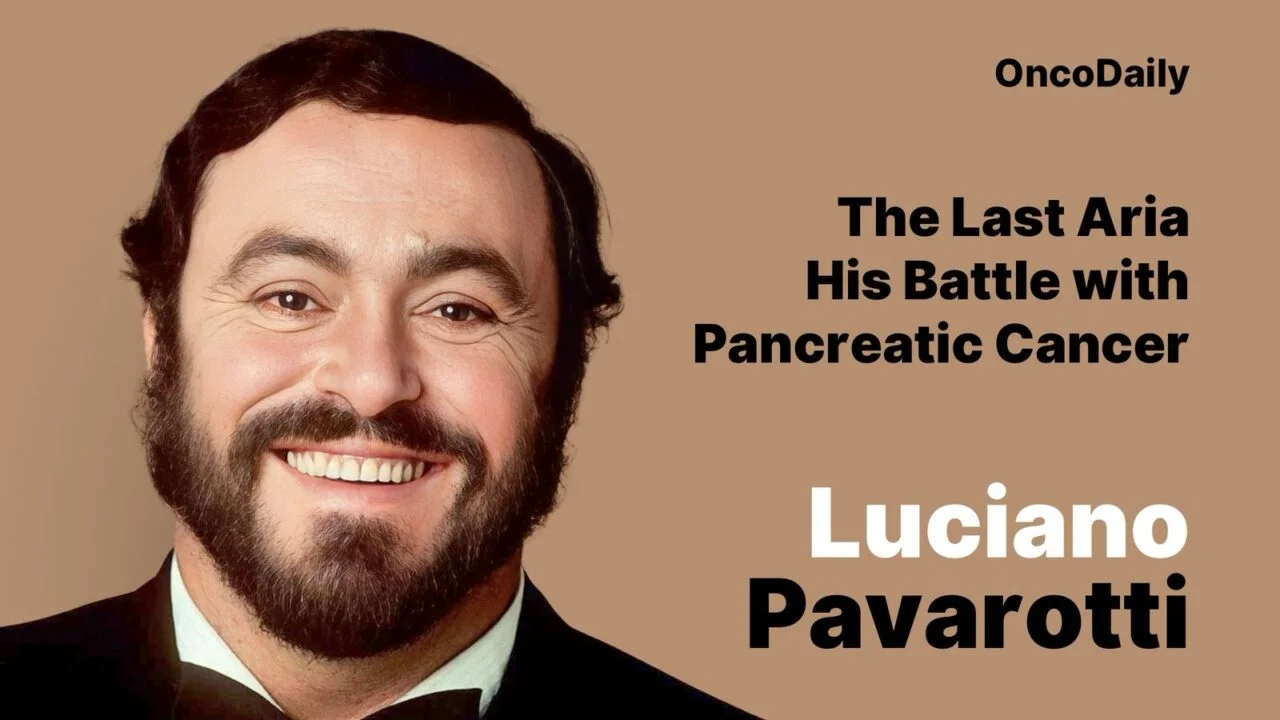
Luciano Pavarotti, one of the most celebrated voices in musical history, died on September 6, 2007, at the age of 71, after a year-long battle with pancreatic cancer. His death followed a diagnosis made in 2006, when the disease was already advanced a common and devastating reality for pancreatic cancer, which is frequently detected late due to its silent progression. Pavarotti’s final months unfolded far from the world’s stages, highlighting how even global fame offers no protection against one of oncology’s most lethal diseases.

Photo: Depositphotos Modena, Italy, October 2017
Who Was Luciano Pavarotti? A Voice That Defined an Era
Luciano Pavarotti was not only one of the greatest opera singers in history he was a cultural phenomenon who reshaped how the world experienced classical music. Born in Modena, Italy, he rose to international fame in the 1960s and became universally celebrated for his radiant tenor voice, effortless high Cs, and unmatched vocal clarity. Often called “The King of the High Cs,” Pavarotti set new standards for operatic excellence, particularly in roles from La Bohème, Rigoletto, Turandot, and L’elisir d’amore.
Over the course of his career, Pavarotti received some of the highest honors in music. He won five Grammy Awards, including a Grammy Legend Award, and was inducted into the Grammy Hall of Fame. He performed at the world’s most prestigious opera houses La Scala, the Metropolitan Opera, the Royal Opera Houseand shattered attendance records, most famously through The Three Tenors concerts alongside Plácido Domingo and José Carreras. Their 1990 World Cup performance became the best-selling classical album of all time, introducing opera to millions who had never attended an opera house.
Beyond classical stages, Pavarotti collaborated with pop and rock artists such as Bono, Elton John, Sting, and Céline Dion, using his fame to raise millions for humanitarian causes through the Pavarotti & Friends concerts. He was awarded numerous international honors, including Italy’s Order of Merit of the Italian Republic, recognizing both his artistic achievements and philanthropic impact.
This towering public legacy is precisely why his illness resonated so deeply worldwide. Pavarotti was widely perceived as physically powerful and vocally indestructible a symbol of endurance and vitality. When he was diagnosed with pancreatic cancer in 2006, the contrast between his public image and the private reality of an aggressive, late-detected disease was stark and unsettling. His death in September 2007 marked not only the loss of an operatic icon, but also brought global attention to a cancer known for its silent progression and poor prognosis, even in individuals with access to the best medical care.
When Was Luciano Pavarotti Diagnosed With Pancreatic Cancer
Luciano Pavarotti was diagnosed with pancreatic cancer in July 2006, a diagnosis that immediately raised concern among physicians given the disease’s well-known aggressiveness. The cancer was discovered after nonspecific symptoms such as abdominal discomfort and weight loss—common early signs that often appear only after the disease has progressed, contributing to delayed diagnosis in many patients.
Surgery in New York (2006)
Soon after the diagnosis, Pavarotti underwent pancreatic surgery at Memorial Sloan Kettering Cancer Center in New York, where surgeons removed the visible tumor. At the time, public statements emphasized cautious optimism, suggesting that the cancer was operable and that surgery offered a chance for prolonged survival.
However, even in cases where surgery is possible, pancreatic cancer outcomes remain poor. In 2006, only 15–20% of patients were considered eligible for surgical resection, and surgery alone was rarely curative.
Why Pancreatic Cancer Was Likely Already Advanced
Pancreatic cancer is biologically aggressive and often micrometastatic at diagnosis, meaning cancer cells may have already spread beyond the pancreas even when imaging suggests localized disease. This explains why recurrence is common despite apparently successful surgery.
At the time of Pavarotti’s diagnosis:
- The overall 5-year survival rate for pancreatic cancer was ~5–6%
- Even among patients who underwent surgery, 5-year survival ranged from 15–20%
- Median survival for advanced or recurrent disease was less than 12 months
These statistics reflect the limited effectiveness of available treatments in the mid-2000s, before the widespread use of modern combination chemotherapy regimens.
Early Public Optimism and the Reality That Followed
In the months after surgery, Pavarotti expressed hope about returning to the stage and briefly appeared in public in early 2007. This optimism was consistent with how many patients feel after initial treatment, particularly when surgery has been completed.
However, by mid-2007, his condition deteriorated, suggesting disease recurrence or progression—an outcome that affects the majority of patients even after resection. Pavarotti died on September 6, 2007, just over 14 months after diagnosis, a timeline tragically consistent with survival patterns seen in pancreatic cancer.
Why His Story Still Matters
Luciano Pavarotti’s battle with pancreatic cancer underscores a central challenge in oncology that continues to this day: pancreatic cancer remains one of the most lethal and silent malignancies, often detected too late for curative treatment.
Pancreatic cancer continues to rise as a global health burden. In 2021 alone, there were an estimated 508,532 new cases of pancreatic cancer worldwide, with approximately 505,752 deaths attributed to the disease—nearly as many deaths as cases, reflecting its high fatality rate.
Even with advances in medicine, five-year survival remains dismal. Contemporary data show global pancreatic cancer five-year survival rates around 10% or less, meaning only about one in ten people diagnosed will live five years or more after diagnosis.
In the United States, the trend mirrors the global picture: in 2025, an estimated 67,440 Americans will be diagnosed with pancreatic cancer and 51,980 are expected to die from it, making it the third leading cause of cancer-related death in the nation and projected to rise further. Premila Devi Leiphrakpam, J Gastrointest Cancer . 2025 Feb
These sobering statistics illustrate why Pavarotti’s experience remains deeply relevant. Pancreatic cancer’s poor prognosis is largely due to its silent progression, non-specific symptoms, and lack of effective routine screening tests. As a result, the disease is often advanced at the time of detection, sharply limiting treatment options and long-term survival.
Pavarotti’s story therefore continues to highlight critical gaps in oncology: the urgent need for earlier detection methods, reliable biomarkers, and more effective systemic therapies. Progress in these areas could improve outcomes and reduce the enormous global burden of one of medicine’s deadliest cancers.
You Can Also Read Radiotherapy for Pancreatic Cancer: Types, Success Rate, Side Effects by OncoDaily

How Can Pancreatic Cancer Be Prevented?
Pancreatic cancer is difficult to prevent because it often develops without early symptoms and has no approved population-wide screening program. For this reason, international guidelines from NCCN, ASCO, and the World Health Organization (WHO) focus on reducing known risk factors and identifying individuals who may benefit from targeted surveillance rather than routine screening.
The most important preventable risk factor is smoking. Tobacco use accounts for approximately 20–30% of pancreatic cancer cases, and current smokers have a two- to threefold higher risk than never-smokers. Risk declines steadily after smoking cessation and approaches baseline after 10–15 years, making quitting smoking the most effective preventive intervention.
Obesity and metabolic dysfunction are also well-established contributors. Excess body weight increases pancreatic cancer risk by up to 50%, while long-standing type 2 diabetes is associated with higher incidence. Particular attention is warranted for new-onset diabetes after age 50, which may occasionally signal underlying pancreatic disease and should prompt clinical evaluation.
Dietary patterns influence risk indirectly through inflammation and metabolic health. Diets rich in fruits, vegetables, and whole grains are associated with lower cancer risk, while frequent consumption of processed meats and high-calorie foods increases inflammatory burden. Heavy alcohol use increases risk primarily by causing chronic pancreatitis, a condition associated with a markedly elevated lifetime risk of pancreatic cancer.
Routine screening of the general population is not recommended. However, targeted surveillance is advised for individuals at substantially increased genetic risk, including those with BRCA1, BRCA2, PALB2, CDKN2A, or Lynch syndrome, or with strong family histories of pancreatic cancer. In these groups, surveillance with MRI and endoscopic ultrasound in specialized centers may detect early disease.
Because prevention is imperfect, early evaluation of symptoms remains critical. Persistent abdominal or back pain, unexplained weight loss, jaundice, appetite loss, or new-onset diabetes should never be ignored.
In summary, pancreatic cancer prevention relies on risk reduction, genetic awareness, and timely medical evaluation, rather than screening. While healthy behaviors lower risk, continued research into early detection and biomarkers remains essential to improving outcomes in this highly lethal disease.
You Can Also Read George Harrison Cancer Battle: A Beatles Legend’s Struggle with Throat and Lung Cancer by OncoDaily

Written by Aharon Tsaturyan, MD, Editor at OncoDaily Intelligence Unit
FAQ
What type of cancer did Luciano Pavarotti have?
Luciano Pavarotti was diagnosed with pancreatic cancer, one of the most aggressive and deadly forms of cancer, characterized by late detection and limited treatment options.
When was Luciano Pavarotti diagnosed with pancreatic cancer?
He was diagnosed in July 2006, after developing nonspecific symptoms such as abdominal discomfort and weight loss symptoms that commonly appear only after pancreatic cancer has progressed.
How did Luciano Pavarotti die?
Luciano Pavarotti died on September 6, 2007, at the age of 71, following disease progression approximately 14 months after diagnosis, a survival timeline consistent with advanced pancreatic cancer.
Why is pancreatic cancer often diagnosed late?
Pancreatic cancer typically causes few or vague early symptoms and lacks effective population-wide screening tests. As a result, most patients are diagnosed when the disease is already advanced or metastatic.
What are the survival rates for pancreatic cancer?
Pancreatic cancer has one of the lowest survival rates of all cancers. Globally, the five-year survival rate is around 10% or less, and was approximately 5–6% at the time of Pavarotti’s diagnosis in the mid-2000s.
Can pancreatic cancer be cured?
A cure is possible only in a small subset of patients whose cancer is detected early and can be surgically removed. However, fewer than 20% of patients are eligible for surgery at diagnosis, and recurrence remains common even after resection.
What are the early symptoms of pancreatic cancer?
Early symptoms are often subtle and nonspecific and may include abdominal or back pain, unexplained weight loss, loss of appetite, fatigue, or new-onset diabetes, which contributes to delayed diagnosis.
Is pancreatic cancer hereditary?
Most cases are sporadic, but 5–10% are linked to inherited genetic mutations, including BRCA1, BRCA2, PALB2, CDKN2A, and Lynch syndrome. Individuals with strong family histories may benefit from targeted surveillance.
Why does Luciano Pavarotti’s story still matter today?
Pavarotti’s experience highlights a persistent reality: even with world-class medical care, pancreatic cancer outcomes remain poor. His story underscores the urgent need for earlier detection, better biomarkers, and more effective therapies, making it highly relevant to modern oncology and public health.
Can pancreatic cancer be prevented?
There is no guaranteed prevention, but risk can be reduced by not smoking, maintaining a healthy weight, limiting alcohol intake, managing diabetes, and seeking genetic counseling when appropriate. Routine screening is not recommended for the general population.