A hush falls across 80,000 voices as the stadium lights dim and a cancer survivor walks onto the pitch holding the match ball not as a player, but as a symbol. Around the world, millions of fans watch the same image: football’s spectacle transformed into a public-health message. A single statistic gives the moment its weight: cancer remains one of the world’s leading causes of death, accounting for nearly one in six deaths globally.
FIFA World Cup and Cancer Awareness may seem like two different worlds, but together they reveal the power of football as a global public-health platform. Under the brightest lights of the world’s game, a single halftime message can reach millions with a call for awareness, charity, and early detection. Tonight’s halftime is not about tactics, standings, or rivalries. It is about using the emotional force of football to reach people who may never read a medical report, attend a prevention lecture, or schedule a screening appointment unless the message meets them where they already are.
Photo: Depositphotos
That is where FIFA and the wider football ecosystem have become increasingly important. From World Cup health campaigns to club-led fundraising, survivor visibility, viral awareness moments, and community initiatives, football has shown that it can do more than entertain. It can direct attention toward prevention, raise funds for cancer organizations, and help normalize conversations about symptoms, screening, and timely care.
Why Can Football Carry a Cancer Message So Far?
Football reaches audiences that public-health agencies often struggle to access directly. It cuts across age, language, geography, income, and culture. A message delivered through a player, a club, a matchday ritual, or a World Cup fan zone can travel faster and further than a traditional health campaign.
That is the logic behind FIFA’s health partnership with the World Health Organization. FIFA and WHO first signed a Memorandum of Understanding in October 2019, and in May 2023 they extended the collaboration for another four years to promote healthy lifestyles, safe stadiums, and equal access to health services worldwide.
The partnership has already supported several public-health campaigns through football, including #ReachOut for mental health, #SafeHome against domestic violence, #ACTogether for equitable access to COVID-19 vaccines, treatments, and diagnostics, and “Pass the message to kick out coronavirus.”
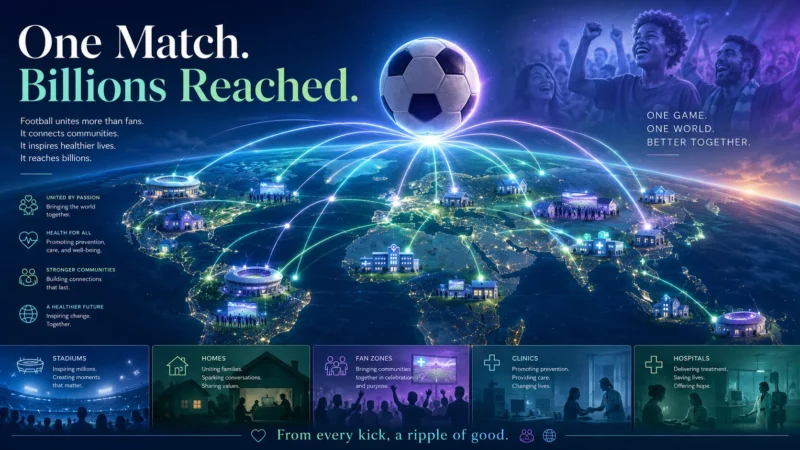
The scale is difficult to match. FIFA reported that around 5 billion people engaged with the FIFA World Cup Qatar 2022, while the final reached close to 1.5 billion viewers globally. For cancer awareness, that means one carefully designed campaign can place a message about symptoms, screening, prevention, or survivor support in front of an audience larger than almost any health system could reach alone.
From “Football Unites the World” to Health in the Stadium
At the FIFA World Cup Qatar 2022, FIFA launched “Football Unites the World,” a global campaign built around football’s ability to bring people together across borders, identities, and cultures. The same tournament was also used as a platform for health-related planning and public-health visibility. WHO, Qatar’s Ministry of Public Health, and FIFA worked together on the “Healthy FIFA World Cup Qatar 2022” initiative, which addressed health risks at mass gatherings and supported safer tournament environments.
Those efforts included smoke-free stadium seating, stronger tobacco-control measures, and healthier food options across the 64 matches. Reports from the FIFA-WHO collaboration noted healthy and vegetarian food quotas across stadiums, showing how major sporting events can be used to shift the health environment around fans, not just deliver messages to them.
Cancer also entered the World Cup space through survivor visibility. FIFA, in collaboration with the Qatar Cancer Society, invited cancer survivors to attend matches at the 2022 World Cup, turning the tournament into a symbolic space for hope, recognition, and public awareness. That model matters. A survivor walking into a stadium, appearing on a screen, or being honored before a match can make cancer visible without reducing patients to statistics. It reminds fans that behind every campaign are people living through diagnosis, treatment, recovery, grief, and survivorship.
The 2026 World Cup: Fans Learning Lifesaving Skills
The 2026 FIFA World Cup has continued the pattern of using football spaces for practical health education. FIFA and the American Heart Association launched CPR activations at FIFA Fan Festivals, giving supporters the chance to learn how to recognize cardiac arrest and practice cardiopulmonary resuscitation.
The American Heart Association’s Nation of Lifesavers Mobile CPR Unit was scheduled to appear at fan festivals in Atlanta, Dallas, and Philadelphia from June to July 2026, with an additional activation at the New York New Jersey Bronx Fan Zone in June.

Photo: Depositphotos
Although this is a heart-health initiative rather than a cancer campaign, it provides a strong model for oncology. It shows that fans are willing to engage with health education when the service is visible, simple, free, and placed inside a football setting. A similar approach could be used for cancer symptom education, screening referrals, HPV vaccination information, tobacco cessation support, or mobile clinic sign-ups.
The FIFA Women’s World Cup Australia & New Zealand 2023 offered another useful example. At the Sydney/Gadigal FIFA Fan Festival, FIFA worked with Heartbeat of Football to provide free blood sugar, blood pressure, and cholesterol checks, with results delivered on the spot. This shows how tournament sites can become low-barrier entry points to prevention and early health engagement.
Charity: Where Football Attention Becomes Support
Football’s cancer-related charity work extends far beyond FIFA. It includes national federations, club foundations, player-led donations, shirt auctions, awareness matchdays, grassroots campaigns, and partnerships with cancer charities. The FIFA Foundation, established in 2018, uses football to support social development. Its Community Programme funds non-profit organizations working in areas such as health, education, peacebuilding, refugee support, leadership, and gender equality. In 2023, the FIFA Foundation supported 114 not-for-profit organizations across 54 countries through this programme.
At club level, Chelsea’s men’s squad provided a clear example in 2023 when players made a donation to three cancer-related organizations: Teens Unite, Real Eazy, and The Royal Marsden Cancer Charity. Chelsea described the donation as a way for players to support people living with cancer, while the club foundation used the moment to strengthen longer-term relationships with beneficiary organizations.
Community football can be just as powerful. Levittown Soccer Club’s “Kick It To Cancer” campaign raised more than $45,300 over four years for the Breast Cancer Research Foundation. The club used pink socks, hats, T-shirts, special jerseys, and recurring Breast Cancer Awareness Month activities to turn a local football tradition into meaningful research support. One annual donation alone reached $17,500. The lesson is simple: football fundraising works best when it is visible, local, and repeated. A single shirt auction or charity match can attract attention once. A recurring club tradition can build identity, trust, and sustained support over time.
Matchday Awareness: Armbands, Jerseys, and Symbols That Travel
Some of football’s most effective cancer-awareness campaigns use symbols that fans can immediately recognize. Armbands, shirt patches, pink kits, pitch-side banners, survivor ceremonies, and social-media graphics can make the message visible to stadium crowds and television audiences at the same time. In Spain, LALIGA has worked with the Spanish Association Against Cancer on the “Bracelets of Hope” campaign. During World Cancer Day matchdays, players, coaches, referees, and media representatives wore green armbands as a symbol of hope, support, and unity in the fight against cancer.
The Royal Spanish Football Federation also joined the Spanish Association Against Cancer’s “Armbands for Hope” initiative, promoting green armbands across official competitions to increase visibility around World Cancer Day. Clubs such as Valencia CF, Real Madrid, Levante UD, and others have taken part in similar matchday actions, using armbands, ribbons, signed jerseys, and auction-based fundraising to support cancer awareness.
In Brazil, football has also been used for cancer-awareness messaging. Clube Atlético Mineiro partnered with Hospital Mário Penna to promote prevention and early diagnosis messaging on World Cancer Day, while Brazilian clubs and kit partners have used “Outubro Rosa” pink-shirt campaigns to raise breast cancer awareness.
These campaigns show that cancer awareness does not always need a long speech. Sometimes the message begins with a visible symbol that prompts a question: Why are the players wearing green? Why is the jersey pink? Why is the stadium screen showing a survivor story? From there, awareness can become conversation.
The Viral Example: CD Leganés and Testicular Cancer Awareness
One of the most striking football-health campaigns in recent years came from CD Leganés. In April 2025, during Testicular Cancer Awareness Month, the Spanish club partnered with the Testicular Cancer Society on a campaign that placed the organization’s logo on the testicular area of players’ shorts. The campaign, called “Tenemos un par” or “Sponsored Balls,” was designed to encourage men to talk about testicular cancer and self-examination. AP reported that the Testicular Cancer Society describes testicular cancer as the most common cancer among men aged 15 to 35 and encourages regular self-checks.
CD Leganés later noted that the campaign was used during the match against FC Barcelona at Butarque Stadium and was recognized at Cannes Lions 2025. The campaign worked because it was impossible to ignore. It was bold, uncomfortable, humorous, and medically relevant. Most importantly, it connected the placement of the message to the part of the body affected by the disease. In a crowded digital environment, that kind of creative clarity can break through stigma and generate global discussion.
Why Early Detection Is the Strongest Cancer Angle
Early detection is one of the strongest public-health arguments for football-linked cancer campaigns. WHO emphasizes that early diagnosis improves cancer outcomes by helping patients receive care at the earliest possible stage; delays in diagnosis and access to care reduce survival, increase treatment complications, and raise costs.
That makes stadiums, fan zones, club matchdays, and football festivals valuable entry points. These spaces can host awareness booths where fans learn warning signs and risk factors. They can offer QR codes for screening information, mobile clinic referrals, tobacco cessation resources, HPV vaccination education, or links to local cancer centers.
The broader logic is simple: people who may not walk into a clinic may still pause at a football booth. They may scan a code if their favorite club shares it. They may listen to a message if a player, coach, survivor, or trusted local doctor delivers it in plain language. The strongest campaigns do more than raise awareness. They make the next step easy. That can mean free screening appointments, referral pathways, symptom-check tools, or immediate booking support. Awareness becomes more meaningful when it is connected to action.
From Attention to Action: What a Football Cancer Campaign Could Look Like
A strong tournament-linked cancer campaign could be built around three pillars: awareness, charity, and early detection. Awareness could include stadium-screen messages, player ambassador videos, survivor stories, match-ball ceremonies, fan-zone booths, and social-media campaigns in multiple languages. The message should be simple, accurate, and repeated across several matchdays.
Charity could include shirt auctions, player donations, club-foundation giving, ticket add-ons, and transparent fundraising for treatment access, research grants, patient support, or local cancer organizations. Fans should know how much money was raised, where it went, and who benefited. Early detection could include screening referrals, mobile clinic partnerships, symptom education, HPV vaccination information, tobacco cessation support, and follow-up pathways with local health systems. The goal should not be to diagnose people at the stadium. The goal should be to move people toward credible care.
Equity: Who Gets Reached and Who Gets Missed?
Football’s reach is broad, but it is not evenly distributed. Urban fans may see stadium activations, digital campaigns, and clinic referrals more often. Rural communities can be missed unless campaigns extend beyond match venues and into local health networks. The same applies across countries. High-income settings may be better prepared to absorb a screening message because tests, specialists, and follow-up care are available. In lower-resource settings, barriers may exist at every step, from awareness to diagnosis to treatment.
Gender also matters. Men’s football still commands enormous global attention, but women’s football often reaches audiences that are family-oriented, community-based, or newer to health messaging through sport. That creates an opportunity to tailor campaigns by audience rather than assuming one format works for everyone. The strongest programs treat football as a doorway to care, not a substitute for the health system.
The Ethics of Health Messaging in Football
Cancer campaigns in football must be powerful without being manipulative. They should inform and empower supporters, not turn every matchday into a medical warning. Accuracy is essential. Campaigns should avoid overstating risk, implying that all screening is useful for every person in the same way, or confusing prevention with cure. Public trust can be damaged quickly if health messages become exaggerated, commercialized, or medically unclear.
Charity work also requires transparency. Fans are more likely to support a campaign when they understand how funds are collected, who manages them, what administrative costs exist, and how much reaches treatment, research, or patient support. Data privacy matters too. If campaigns collect contact details, screening information, or health-risk responses, organizers must protect that information and work with qualified health partners.
The ethical standard is clear: football can amplify health, but it should never overpromise. Diagnosis, treatment, and long-term care belong to health professionals and health systems.
How Should Success Be Measured?
A strong football-linked cancer campaign should be judged by more than applause, headlines, and social-media engagement. Useful key performance indicators should track the full chain from attention to action: total impressions, audience engagement, funds raised, number of people screened, screening appointments booked, referral completion, follow-up care, and changes in knowledge or behavior.
The measurement plan should begin before the campaign launches. Organizers should define baseline screening uptake, awareness levels, expected reach, target populations, and referral capacity in the host city or region. Short-term indicators can include the number of stadium activations, fan-zone interactions, campaign-page visits, QR-code scans, donations, clinic sign-ups, and social-media engagement. Long-term indicators matter more for public health. These include completed screenings, referral follow-up, earlier diagnoses, sustained awareness, and whether fans took action months after the event.
A hypothetical World Cup-linked cancer campaign might set targets such as 10 million digital impressions, 250,000 stadium and fan-zone interactions, 5,000 screening bookings, 3,000 completed screenings, 80 percent referral follow-up, and measurable improvement in symptom awareness after the event. If fundraising is included, the campaign should report gross funds raised, administrative costs, and the share delivered to research, treatment, patient support, or outreach. The key point is that success should be measured across four stages: attention, action, access, and outcome. If a campaign only increases visibility, it is awareness. If it also moves people into screening and care, it becomes a public-health intervention.
Barriers and Solutions
The biggest barriers are often not the idea itself, but the system around it. Funding can be episodic, with strong visibility during a tournament and little continuity afterward. Screening can identify a concern, but patients may be lost if referral pathways are unclear. Misinformation can weaken the message, especially when prevention is presented too simply. Political or commercial conflicts can also undermine trust if sponsors are not carefully vetted.The solution is to treat football campaigns as long-term public-health partnerships rather than one-off promotions.
Multi-year commitments allow organizers to build trust, train staff, refine the message, and measure outcomes beyond a single match or tournament. Local health-system integration is essential, because awareness only matters if people can move from screening to diagnosis and treatment without falling through the cracks.
Player ambassadors can help, but they should be trained in health communication. Their role is not to give medical advice. Their role is to make the message human, memorable, and relatable. Independent sponsor review is also important. A campaign about cancer prevention loses credibility if its commercial partnerships conflict with the health message.
The Real-World Spectrum: From World Cup to Community Pitch
The strongest way to understand football’s role in cancer awareness is as a spectrum. At the global tournament level, FIFA and WHO show how the World Cup can carry evidence-based health messages to billions of people through stadiums, broadcasts, fan festivals, and digital platforms.
At the club level, Chelsea’s donation to cancer-related organizations and Spanish football’s World Cancer Day armband campaigns show how elite teams can connect visibility with fundraising and solidarity. At the community level, Levittown Soccer Club’s “Kick It To Cancer” campaign shows how local traditions can generate meaningful, repeated support for cancer research.
At the creative viral level, CD Leganés and the Testicular Cancer Society show how a bold idea can break stigma, generate conversation, and make a difficult health topic impossible to ignore. Together, these examples show the same principle at different scales: football turns attention into a shared moment. The challenge is to turn that moment into measurable action.
When Awareness Becomes Prevention
A matchday message is not enough by itself. A banner, armband, survivor ceremony, or viral jersey placement can open the door, but real public-health value comes when fans are guided toward screening, referral, education, and care. That is the promise of football in cancer awareness. It can make prevention feel public, normal, and collective. It can help survivors be seen. It can help charities raise funds. It can bring health workers into spaces where people already gather with emotion and trust.
Football will not replace clinics, cancer centers, public-health agencies, or oncology professionals. But it can help bring people closer to them. That is where awareness becomes prevention. And that is where the world’s game can help save lives.
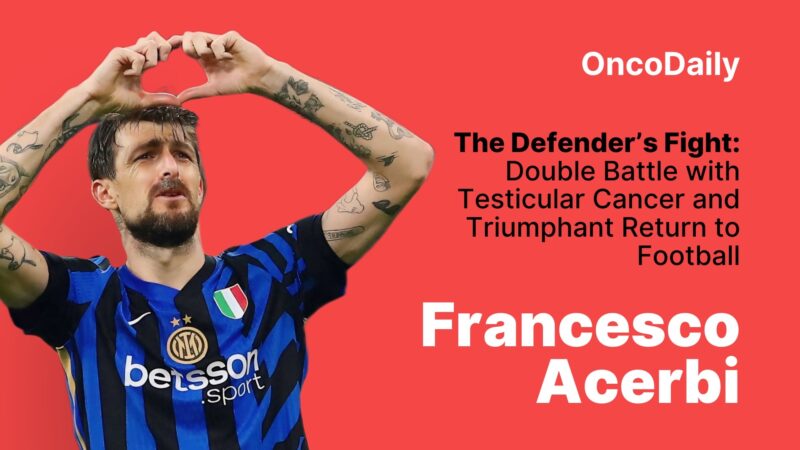
You Can Also Read Francesco Acerbi and Testicular Cancer: The Defender’s Fight and Triumphant Return to Football by OncoDaily
Written by Aharon Tsaturyan, MD, Editor at OncoDaily Intelligence Unit
FAQ
How can the FIFA World Cup promote cancer awareness?
The FIFA World Cup can promote cancer awareness by using stadium screens, fan zones, player ambassadors, survivor stories, and global broadcasts to share messages about prevention, symptoms, screening, and early detection. Because the World Cup reaches billions of viewers, even a short health message can create global visibility.
What is the connection between FIFA and public health campaigns?
FIFA has worked with the World Health Organization on several public-health campaigns, including mental health, domestic violence prevention, vaccine access, tobacco control, healthy lifestyles, and safe stadium initiatives. These campaigns show how football can be used as a platform for health education beyond the pitch.
How can football help improve cancer early detection?
Football can improve cancer early detection by making screening messages easier to see, understand, and act on. Stadiums, clubs, and fan festivals can promote symptom awareness, provide screening information, connect fans to local clinics, and encourage people to seek care earlier.
Has FIFA worked with WHO on health campaigns?
Yes. FIFA and the World Health Organization signed a health-focused partnership in 2019 and extended it in 2023. Their collaboration has supported campaigns on mental health, domestic violence, vaccine access, COVID-19 prevention, healthy lifestyles, and health promotion at major football tournaments.
What cancer awareness campaigns have football clubs supported?
Football clubs have supported cancer awareness through charity donations, awareness matchdays, special jerseys, armbands, survivor recognition, and fundraising campaigns. Examples include Chelsea’s donations to cancer-related organizations, Spanish clubs supporting World Cancer Day campaigns, CD Leganés promoting testicular cancer awareness, and Levittown Soccer Club raising funds for breast cancer research.
How can stadiums and fan zones support cancer screening awareness?
Stadiums and fan zones can support cancer screening awareness by hosting health booths, QR-code referral stations, mobile screening units, symptom-education displays, and survivor-led awareness events. These spaces can turn matchday attention into practical health action.
Why is early detection important in cancer care?
Early detection is important because cancers found earlier are often more treatable and may require less intensive therapy. Earlier diagnosis can improve survival, expand treatment options, reduce complications, and lower the burden on patients, families, and health systems.
How can football players help raise cancer awareness?
Football players can raise cancer awareness by sharing campaign messages, wearing awareness symbols, participating in charity events, supporting screening education, and amplifying survivor stories. Their visibility helps make health messages more relatable and easier for fans to remember.
What role can the FIFA World Cup 2026 play in health education?
The FIFA World Cup 2026 can play a major role in health education by using fan festivals, host cities, digital platforms, and broadcast moments to promote lifesaving messages. Current fan-zone health activations, such as CPR education, show how World Cup spaces can also support broader prevention and screening campaigns.
How can sports campaigns support cancer prevention and screening?
Sports campaigns can support cancer prevention and screening by combining public attention with clear health actions. The strongest campaigns do not only raise awareness; they guide people toward screening appointments, trusted health information, local clinics, vaccination programs, and follow-up care.