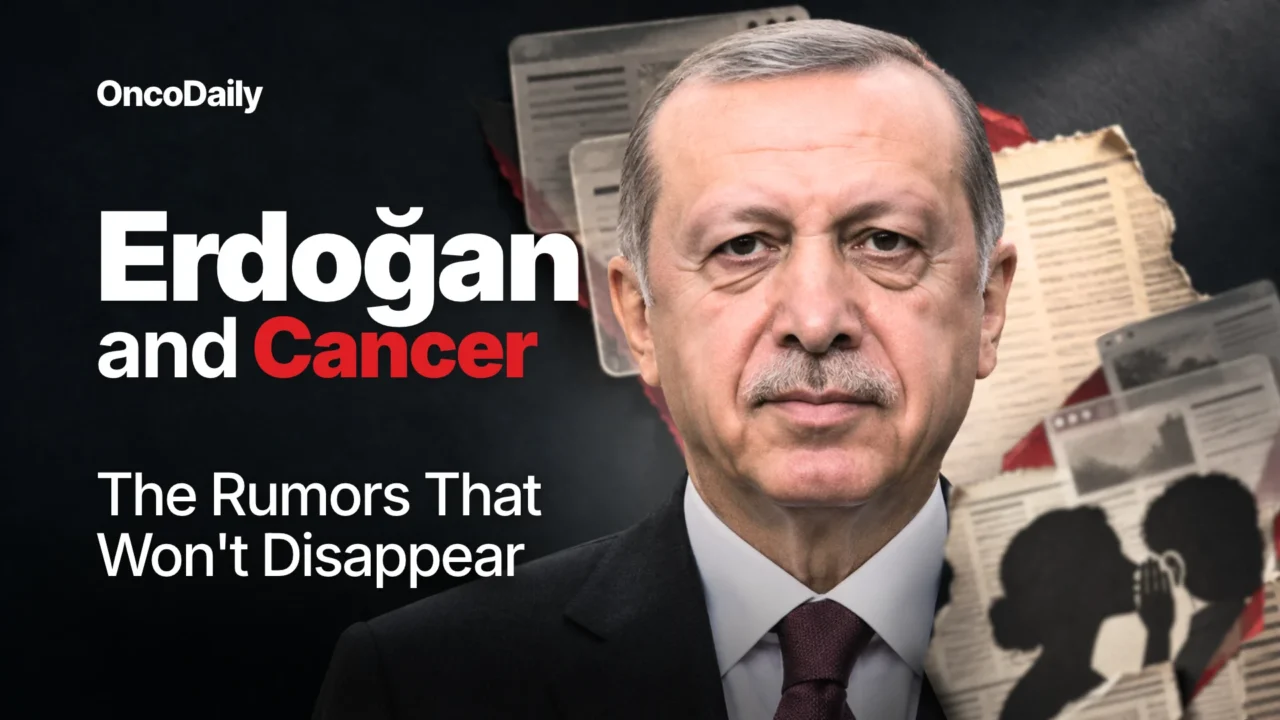
Does Turkish President Recep Tayyip Erdoğan have cancer? The question of Erdoğan and cancer has remained a subject of public speculation for more than a decade, yet no credible publicly verified medical evidence establishes that he has been diagnosed with the disease. The documented record includes intestinal surgery in 2011, a follow-up procedure in 2012, public denials of cancer allegations, and official rejections of later health-related claims.
The speculation surrounding Erdoğan and cancer has resurfaced during elections, political controversies, and periods of intense public scrutiny. Some allegations originated in leaked intelligence-related correspondence, while others spread through social media, online videos, and political commentary. In March 2012, a leaked email attributed to the American private intelligence company Stratfor alleged that Erdoğan had colon cancer and approximately two years to live. The allegation gained international attention despite being rejected by his representatives and lacking independently verified clinical evidence (Reuters, 2012).
The controversy illustrates a broader problem in health journalism: how a documented medical procedure can become the foundation for years of speculation when complete clinical information is not publicly available. For OncoDaily, examining the claims about Erdoğan and cancer means looking beyond the headlines and asking whether reliable medical evidence supports the diagnosis being discussed.
Does Recep Tayyip Erdoğan Have Cancer?
The publicly available information does not establish a confirmed cancer diagnosis for Recep Tayyip Erdoğan. Reports concerning his health first attracted significant attention following gastrointestinal surgery in November 2011. The speculation intensified after the publication of leaked Stratfor correspondence in March 2012.
According to a Reuters report published on March 6, 2012, the email alleged that Erdoğan had terminal cancer and a limited life expectancy. His representatives rejected the claim, and doctors quoted in contemporary Turkish reporting disputed the alleged diagnosis. Additional health-related allegations circulated in 2021, 2023, and 2025, prompting official responses from Turkish authorities.
The documented events establish that Erdoğan underwent gastrointestinal procedures and that allegations concerning his health were repeatedly made and publicly rejected. However, the available reporting does not provide a complete independently verified medical history. The absence of a public cancer diagnosis does not prove that Erdoğan is free of every illness. It means only that the public evidence does not establish a cancer diagnosis.
What Is Known About Erdoğan’s Medical History?
The most significant documented medical event underlying the speculation occurred on November 26, 2011, when Erdoğan was serving as Türkiye’s prime minister. He underwent surgery involving his lower intestine. Contemporary reporting described the procedure as keyhole, or laparoscopic, surgery. According to Reuters reporting published in February 2012, Erdoğan subsequently underwent a planned follow-up procedure on February 10, 2012. His office described the second procedure as the final phase of the earlier operation and stated that he was in good health.
Reports also referred to the removal of intestinal polyps. However, these publicly reported details do not constitute a complete clinical record. The operative findings, histological classification of the reported polyps, and full pathology documentation have not been independently disclosed. The distinction is medically important because gastrointestinal surgery can be performed for benign, inflammatory, structural, or malignant conditions.
What Happened During Erdoğan’s 2011 Surgery?
The November 2011 operation involved Erdoğan’s lower gastrointestinal tract and was followed by a period of recovery. The procedure generated considerable attention because of his position as prime minister and the public interest in his health. On February 10, 2012, Erdoğan underwent a second reported gastrointestinal procedure. A Reuters report published in February described it as a planned second and final phase of the November operation. The same reporting indicated that a doctor present during the November surgery had described the removed polyps as harmless.
In March 2012, Reuters also reported that the newspaper Taraf had quoted Erdoğan’s chief surgeon rejecting the cancer allegation, while another doctor who observed the operation reportedly stated that no cancer or tumor had been found. These were statements attributed to medical professionals in contemporary reporting, rather than independently reviewed pathology findings (Reuters, February 2012; Reuters, March 2012). The available information therefore supports a documented history of gastrointestinal procedures and reported medical denials of malignancy.
Did Erdoğan Have Intestinal Polyps?
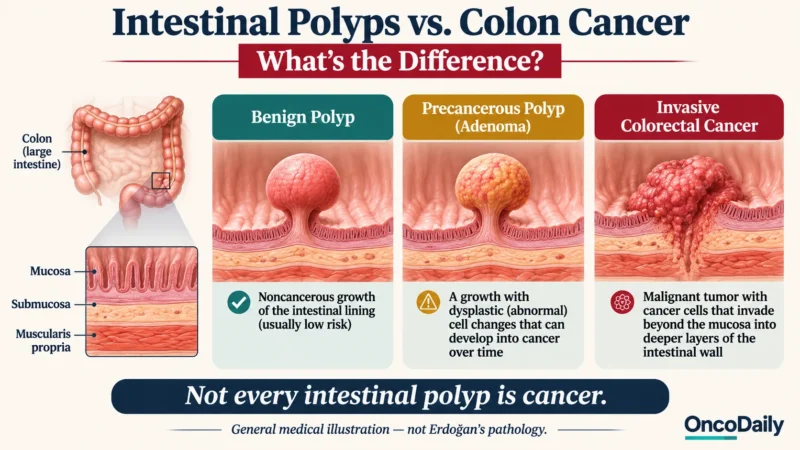
Contemporary reporting described the removal of intestinal polyps during Erdoğan’s gastrointestinal treatment. A polyp is an abnormal growth of tissue arising from a mucosal surface, such as the lining of the colon or rectum.m Many intestinal polyps are benign. However, some colorectal polyps, particularly certain adenomatous and serrated lesions, can develop precancerous changes and may progress to colorectal cancer over time. The clinical significance of a polyp depends on its histological type, size, location, number, and microscopic characteristics.
According to the American Cancer Society, certain types of colorectal polyps are associated with increased cancer risk, while their significance depends on pathological findings (American Cancer Society, 2023). In Erdoğan’s case, contemporaneous reports attributed reassuring findings to doctors involved in his care. However, complete independently reviewed pathology documentation has not been made publicly available. A reported history of intestinal polyps should not be interpreted as evidence of invasive colorectal cancer.
Where Did the Erdoğan Cancer Rumors Begin?
The allegations gained international attention in March 2012. The Turkish newspaper Taraf reported on a leaked email attributed to Stratfor, an American private intelligence and geopolitical analysis company. The correspondence alleged that Erdoğan had colon cancer and suggested that he had approximately two years to live. The email had become publicly available through WikiLeaks as part of a larger release of Stratfor correspondence.
However, Taraf did not independently establish a cancer diagnosis by publishing the alleged correspondence. The email was not an authenticated medical report, and its claims were not accompanied by independently verified pathology or clinical documentation. On March 6, 2012, Reuters reported the allegations and the response from Erdoğan’s representatives. An aide dismissed the leaked email as:
“Speculation and gossip.”
The aide also stated that the prime minister was in good health. The March 2012 controversy established a pattern that would recur in subsequent years: a medical allegation would circulate, attract public attention, and prompt official responses without producing a complete independently verified clinical disclosure (Reuters, March 6, 2012).
What Was the Stratfor Email?
Stratfor was a private intelligence and geopolitical analysis company whose internal correspondence was published through WikiLeaks. The leaked material included discussions about political developments, international relationships, and prominent public figures. Among the communications was an email dated December 10, 2011, containing allegations about Erdoğan’s health.
According to Reuters, the reported information was attributed to an intermediary who claimed to have received details through a personal connection to a surgeon involved in Erdoğan’s treatment. The chain of attribution was therefore indirect. Reuters also reported that the source identified in the correspondence, Faruk Demir, subsequently rejected the account and said that the report was false. The email’s appearance in intelligence-related correspondence gave the allegations considerable public visibility.
However, an intelligence report or internal communication is not equivalent to medical documentation. A leaked message can demonstrate that an allegation was made. It does not independently establish the accuracy of the information contained in it. This distinction became particularly important because the correspondence included not only an alleged diagnosis but also a prediction concerning Erdoğan’s survival (Reuters, March 6, 2012).
Did a Leaked Stratfor Email Claim Erdoğan Had Two Years to Live?
A leaked email attributed to Stratfor contained an unverified allegation that Erdoğan had approximately two years to live. It was not an authenticated medical prognosis. The email reportedly claimed that Erdoğan had colon cancer and that a surgeon had estimated a limited life expectancy.
Reuters documented the claim in March 2012, alongside denials from Erdoğan’s representatives and doctors quoted in Turkish reporting. From an oncology perspective, an individualized survival prediction requires information about a confirmed diagnosis, disease stage, tumor biology, available treatment options, general health, and response to therapy. Even with complete clinical information, survival estimates remain probabilistic rather than certain. A prognosis attributed to an indirect source without authenticated medical documentation cannot be considered scientifically reliable. The Stratfor controversy illustrates the distinction between a reported prediction and an evidence-based medical prognosis.
How Did Erdoğan Respond to the Cancer Allegations?
Erdoğan publicly rejected the speculation about his health and life expectancy. During a meeting of his ruling Justice and Development Party in Ankara on March 7, 2012, he challenged the prediction contained in the leaked correspondence.
According to Reuters, Erdoğan stated:
“It is Allah and only Allah who will decide how long I will live.”
The remarks directly addressed the suggestion that his remaining life expectancy could be predicted with certainty. Reuters reported his response on March 7, 2012, following the publication of the leaked correspondence. The BBC subsequently reported in November 2021 that Erdoğan had repeatedly denied cancer allegations since his gastrointestinal surgery. These denials are part of the documented public record. They establish Erdoğan’s response to the allegations without providing access to all aspects of his private medical history (Reuters, March 2012; BBC, November 2021).
Why Did Rumors About Erdoğan’s Health Resurface in 2021?
In November 2021, speculation intensified following the circulation of videos and social media commentary about Erdoğan’s public appearances. Some online discussions focused on footage in which he appeared to walk cautiously. Other posts circulated claims that he had died. The controversy prompted an official response from Turkish authorities. According to BBC reporting published on November 4, 2021, police opened an investigation involving 30 individuals accused of spreading misleading information about Erdoğan’s health.
The controversy involved the Turkish-language hashtag #ölmüş, associated with claims that the president had died. Erdoğan’s lawyers also pursued legal action concerning the circulating posts. The incident demonstrated how health speculation can rapidly become a political and legal controversy when it concerns a head of state (BBC, November 4, 2021; The Guardian, November 4, 2021).
Did Videos Show That Erdoğan Was Seriously Ill?
Videos circulated online showing Erdoğan during public appearances, including footage from international meetings. Some commentators interpreted his movements as evidence of serious illness. However, brief video recordings cannot reliably establish a specific medical diagnosis. A person’s posture, walking pattern, facial expression, or apparent fatigue may have many possible explanations. Without a clinical evaluation and relevant medical information, such observations cannot establish cancer or another particular disease. The appropriate distinction is between what the footage visibly documents and the medical interpretations that social media users may attach to it. The videos showed public appearances. They were not diagnostic examinations.
How Did Turkish Officials Respond?
Erdoğan’s representatives sought to counter the rumors by sharing photographs and videos of his public activities. His communications director, Fahrettin Altun, published footage showing the president walking after leaving an official vehicle. The communication was intended to counter the circulating claims. Contemporary reporting also described legal action involving social media users accused of spreading misinformation about Erdoğan’s health (BBC, November 4, 2021; The Guardian, November 4, 2021).
Such public responses can establish that officials disputed an allegation. However, images of public appearances do not provide a complete medical assessment. The 2021 controversy therefore illustrates how both speculation and attempts to counter it can become part of a broader political narrative.
What Happened to Erdoğan During the 2023 Presidential Election?
Health-related speculation returned during Türkiye’s presidential election campaign in April 2023. On April 25, 2023, Erdoğan’s live television interview was interrupted after he appeared unwell. The broadcast subsequently resumed. Erdoğan apologized to viewers and attributed the interruption to a stomach illness following an intensive campaign schedule. The incident occurred shortly before the May 2023 presidential election and attracted considerable media attention.
He subsequently canceled or adjusted some scheduled appearances. According to an Associated Press report published on April 26, 2023, Erdoğan said he had experienced stomach flu. The episode prompted online speculation, but the interruption itself did not establish a specific medical diagnosis (Associated Press, April 26, 2023).
What Did Turkish Officials Say in April 2023?
On April 26, 2023, Presidential Communications Director Fahrettin Altun publicly rejected claims concerning Erdoğan’s health.The Republic of Türkiye Directorate of Communications published his response that day.
Altun stated:
“We categorically reject such baseless claims regarding President Recep Tayyip Erdoğan’s health.”
He also announced that Erdoğan would participate in the opening of the Akkuyu Nuclear Power Plant the following day through videoconference. The Directorate framed the circulating allegations as disinformation during the election campaign. The statement established the official response to the claims but did not include a detailed clinical assessment (Republic of Türkiye Directorate of Communications, April 26, 2023).
Did Erdoğan Have a Heart Attack in 2023?
Claims that Erdoğan had experienced a heart attack and had been hospitalized circulated following the interruption of his April 25 television interview. However, Türkiye’s Center for Countering Disinformation publicly rejected these specific allegations. An Anadolu Agency report published on April 27, 2023, documented the denial and attributed it to the government center. The distinction is important because an interrupted interview and a public report of stomach illness are not evidence of a confirmed cardiac event. The alleged heart attack should therefore be described as a claim that circulated and was officially denied, rather than as an established diagnosis (Anadolu Agency, April 27, 2023).
Did Erdoğan Undergo Another Surgery in June 2023?
Another controversy emerged in June 2023. Online claims suggested that Erdoğan was scheduled to undergo an additional operation. On June 9, Türkiye’s Center for Countering Disinformation rejected the allegation. The response was documented by Anadolu Agency and other Turkish news organizations. The government center disputed the claim that an operation was planned.
International reporting subsequently discussed the denial, including coverage published on June 11, 2023. This controversy was separate from Erdoğan’s documented gastrointestinal procedures in 2011 and 2012. A previous history of surgery does not independently substantiate claims about a later procedure (Anadolu Agency, June 9, 2023).
Why Did Erdoğan’s Health Rumors Return in 2025?
Health-related allegations resurfaced in June 2025. The controversy followed claims made through a Turkish YouTube channel. Türkiye’s Center for Countering Disinformation, operating under the Presidential Communications Directorate, issued a response rejecting the allegations. According to reporting published by Türkiye Today on June 10, 2025, the government center stated that Erdoğan’s health condition was satisfactory and that he continued to fulfill his constitutional duties as president.
The statement also characterized the circulating claims as unfounded. The 2025 controversy involved broad allegations about Erdoğan’s health, not a newly confirmed cancer diagnosis or a cancer-specific medical disclosure. The response documented the government’s rejection of the claims rather than providing an independently reviewed clinical assessment (Türkiye Today, June 10, 2025).
What Can Official Statements Prove About Erdoğan’s Health?
Official statements are important sources when reporting allegations concerning a public figure’s health. They can establish what the individual, their representatives, or government institutions have publicly said. In Erdoğan’s case, the documented statements show that officials rejected claims concerning his health at different points in time. They also establish that the allegations attracted sufficient public attention to prompt official responses.
However, an official statement is not necessarily equivalent to a complete medical record. Without supporting clinical documentation, it cannot independently establish all findings from private medical examinations. Nor can public appearances or statements provide a comprehensive assessment of someone’s health. This distinction does not make unsupported allegations credible. Rather, it defines what the available sources can establish.
What Would Make a Cancer Claim Credible?
A credible public claim about an individual’s cancer diagnosis would ordinarily require an authorized disclosure from the individual or treating medical team, authenticated medical documentation released with appropriate authorization, or independent reporting based on verified primary sources. In medical practice, cancer diagnoses are generally established through appropriate clinical evaluation and, for most solid tumors, pathological examination. Depending on the condition, imaging and other diagnostic investigations may also contribute.
Anonymous posts, leaked emails without verified medical sourcing, brief videos, and political accusations do not establish a diagnosis. A claim should be evaluated according to the quality of its evidence rather than how frequently it has been repeated.
What Does the Absence of a Public Diagnosis Not Prove?
The absence of a public cancer diagnosis does not establish that Erdoğan is free of every illness. It also does not justify assuming that a particular diagnosis has been concealed. Private medical information may remain undisclosed for many reasons. For journalists, the appropriate standard is to report what is supported by the available sources while clearly identifying unanswered questions.
Can Intestinal Polyps Turn Into Cancer?
Some colorectal polyps can develop into cancer over time, but many are benign and never become malignant. This medical distinction is particularly relevant because Erdoğan’s reported history of intestinal polyps became associated with speculation about colon cancer. Polyps are abnormal growths arising from mucosal surfaces. Their biological significance depends on their histological characteristics and location.
Certain adenomas and serrated lesions are recognized precursors in colorectal carcinogenesis. However, the presence of a polyp does not automatically mean that invasive cancer has developed. In clinical practice, tissue obtained during colonoscopy or surgery is examined by a pathologist to determine the nature of the lesion. The findings may identify a benign lesion, dysplasia, or invasive carcinoma.
According to the American Cancer Society, the type and pathological characteristics of colorectal polyps help determine their clinical significance and the need for follow-up (American Cancer Society, 2023).
What Makes an Intestinal Polyp Cancerous?
A definitive diagnosis of invasive colorectal cancer depends on identifying malignant epithelial cells that have invaded beyond the muscularis mucosae into the submucosa or deeper tissues. This distinction separates invasive carcinoma from dysplasia confined to the mucosa. Pathologists evaluate cellular architecture, nuclear abnormalities, growth patterns, and evidence of tissue invasion. High-grade dysplasia indicates advanced abnormal cellular changes but does not automatically establish invasive colorectal carcinoma. Other factors, including polyp size, histological subtype, and completeness of removal, influence subsequent management.
These medical principles explain why the term polyp should not be interpreted as synonymous with cancer. They do not establish the histological nature of the lesions reportedly removed during Erdoğan’s procedures.
Does Intestinal Surgery Mean Someone Has Colon Cancer?
No. Intestinal surgery alone does not establish a diagnosis of colon cancer. Gastrointestinal operations may be performed for a broad range of conditions, including benign growths, obstruction, bleeding, inflammation, structural abnormalities, and malignant tumors. Some patients undergo surgery to remove lesions that are not cancerous. Others may require surgery for precancerous lesions that cannot be removed adequately through endoscopy.
When malignancy is suspected or identified, tissue examination plays a central role in diagnosis and staging. A history of surgery cannot substitute for those findings. This principle applies equally to ordinary patients and prominent public figures.
Why Do Cancer Rumors About Political Leaders Persist?
Health-related speculation involving political leaders often extends beyond medical curiosity. The health of a head of state may be perceived as relevant to leadership continuity, constitutional succession, political stability, and elections. This creates substantial public interest, particularly when a leader has held national office for many years. Recep Tayyip Erdoğan served as Türkiye’s prime minister from 2003 to 2014 and has served as president since 2014. His long period in national leadership has made questions concerning his health a recurring subject of public discussion.
During elections or periods of political uncertainty, health allegations may circulate more widely. Some originate from identifiable reporting. Others emerge through anonymous social media accounts, recycled videos, or unattributed claims. Limited publicly available medical information can also create uncertainty. However, uncertainty should not be mistaken for confirmation of a particular medical condition.
How Does Social Media Amplify Medical Misinformation?
Social media enables medical claims to spread rapidly, often without independent evaluation of their original sources. A brief video may be interpreted as evidence of an illness. An old article may circulate without its publication date. A leaked email may be described as a confirmed medical document. As the same allegation appears repeatedly, readers may begin to perceive it as independently corroborated. However, multiple posts may trace back to a single unverified source. This is particularly relevant to Erdoğan’s case, where the 2012 allegations have periodically resurfaced in different forms. Responsible reporting requires identifying the original source, checking the date and context, and distinguishing repetition from independent confirmation.
Were Erdoğan’s Cancer Rumors Part of a Political Conspiracy?
The history of the allegations has prompted questions about political motivations and possible coordinated campaigns. The 2012 claims emerged through leaked correspondence and were amplified by subsequent media reporting. Later allegations circulated through social media and political commentary. Turkish authorities have described some health-related claims as disinformation. Following the April 2023 election-period controversy, Presidential Communications Director Fahrettin Altun publicly rejected allegations concerning Erdoğan’s health. His statement was part of an official response to claims circulating online (Directorate of Communications, April 26, 2023).
However, establishing that a coordinated conspiracy existed would require evidence concerning the individuals or organizations involved, their communications, and their intentions. The existence of unsupported allegations does not, by itself, prove organized coordination. Likewise, the political context surrounding a rumor does not establish the accuracy of its medical content.
Did Erdoğan Withhold Medical Details From the Public?
Detailed independently verified information about Erdoğan’s gastrointestinal procedures and subsequent medical evaluations has remained limited. This has contributed to questions about the extent of public medical disclosure. However, limited access to private medical information is not proof that a particular illness exists. Accusing someone of concealing cancer requires evidence beyond speculation about medical privacy. Public figures may disclose some medical information while keeping other details private.
Journalists can accurately describe the information that has been released and identify gaps in the public record. They should not interpret those gaps as evidence of a specific undisclosed diagnosis. The distinction between limited disclosure and proven concealment is essential for responsible medical reporting.
How Should Journalists Fact-Check Cancer Claims About Public Figures?
Reporting a cancer diagnosis requires reliable evidence. A cancer diagnosis is a specific clinical conclusion, not an impression derived from someone’s appearance, behavior, or political circumstances. The strongest public evidence may include an authorized statement from the individual or treating physicians, authenticated clinical documentation, or credible independent reporting supported by verified primary sources. Journalists should also examine the original publication date of each allegation.
Older reports may be republished or circulated without context. Separate medical events may also be combined into a misleading narrative. In Erdoğan’s case, the 2011 surgery, February 2012 procedure, March 2012 Stratfor allegation, 2021 social media controversy, 2023 official denials, and 2025 government statement are distinct events. Their chronology is important, but chronology alone does not establish a causal or medical connection.
What Is Not Reliable Evidence of Cancer?
Anonymous social media posts do not establish a cancer diagnosis. Neither do brief videos showing changes in a public figure’s movement, posture, facial expression, or apparent energy level. A leaked email lacking independent medical verification is insufficient. Likewise, a previous operation does not establish malignancy without appropriate diagnostic findings. Political accusations and predictions concerning an individual’s life expectancy should not be presented as medical evidence without reliable supporting documentation. The evidentiary standard should remain consistent regardless of the individual’s political position.
What Is the Verified Timeline of Erdoğan’s Cancer Rumors?
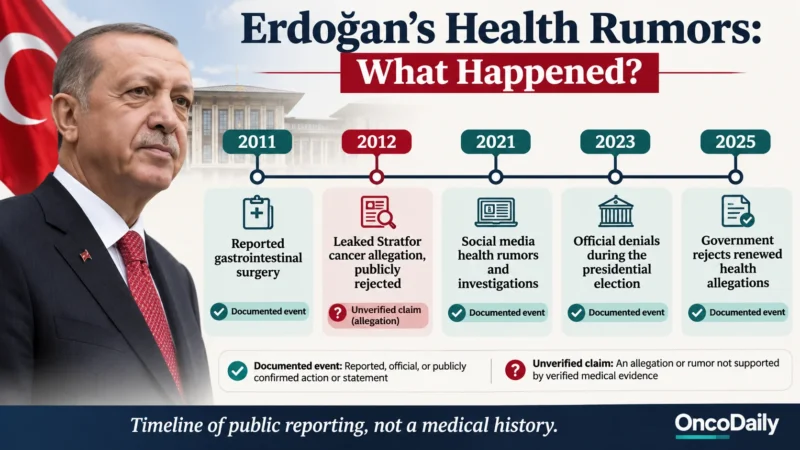
The history of Erdoğan’s health-related allegations spans more than a decade. The following chronology distinguishes documented medical events, unverified allegations, and official statements.
- November 26, 2011 – Gastrointestinal surgery. Erdoğan underwent a reported operation involving his lower intestine while serving as Türkiye’s prime minister. Contemporary accounts described a laparoscopic procedure. The surgery is a documented medical event, but its existence alone cannot establish malignancy (Reuters, 2012).
- February 10, 2012 – Follow-up procedure. Erdoğan underwent a planned second gastrointestinal procedure, described by his office as the final phase of the earlier operation. Contemporary reports also attributed reassuring findings to doctors involved in his treatment (Reuters, February 2012).
- March 6, 2012 – Stratfor allegation. Reuters reported that a leaked email attributed to Stratfor alleged colon cancer and approximately two years of remaining life expectancy. Erdoğan’s representatives rejected the allegation as speculation and gossip (Reuters, March 6, 2012).
- March 7, 2012 – Erdoğan’s public response. Erdoğan challenged the alleged prognosis and stated that only God determines how long an individual will live. His remarks represented a public rejection of the prediction, not a comprehensive medical disclosure (Reuters, March 7, 2012).
- November 2021 – Social media controversy. Turkish authorities investigated 30 individuals accused of spreading misleading information about Erdoğan’s health. The controversy included unsubstantiated claims concerning his death (BBC, November 4, 2021).
- April 25–26, 2023 – Television interview and official denial. Erdoğan’s live interview was interrupted after he appeared unwell. He attributed the interruption to stomach flu, while Turkish officials subsequently rejected more serious medical allegations circulating online (Associated Press, April 26, 2023; Directorate of Communications, April 26, 2023).
- June 9, 2023 – Surgery allegations rejected. Türkiye’s Center for Countering Disinformation denied online claims that Erdoğan was scheduled to undergo another operation (Anadolu Agency, June 9, 2023).
- June 2025 – Renewed health speculation. Turkish authorities rejected claims about Erdoğan’s health and stated that he continued to perform his constitutional duties as president (Türkiye Today, June 10, 2025).
Taken together, these episodes illustrate the recurrence of medical allegations and official responses across different periods. They should be understood as a chronology of public reporting, not as a clinical history of a confirmed disease.
What Does the Publicly Documented Record Show?
The publicly documented record supports several conclusions. Erdoğan underwent gastrointestinal surgery in November 2011 and a reported follow-up procedure in February 2012. Contemporary reporting attributed the removal of harmless polyps and denials of cancer to doctors associated with his treatment.
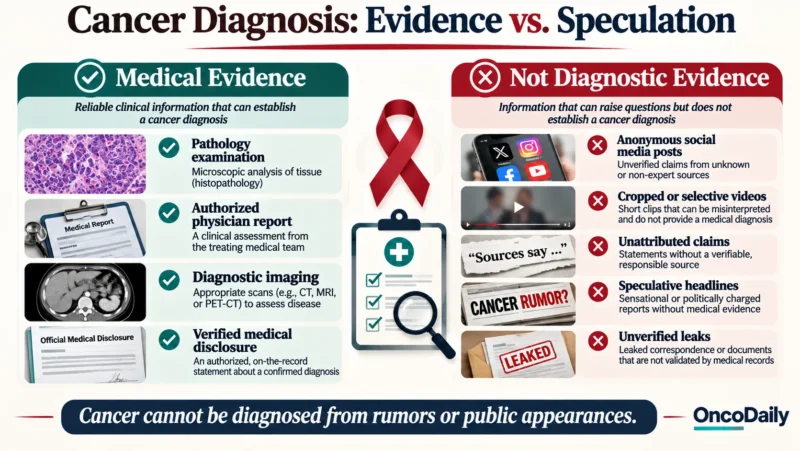
In March 2012, leaked correspondence alleged that he had colon cancer and a limited life expectancy, but the allegations were rejected and lacked independently verified clinical documentation. Later health-related claims prompted official responses in 2021, 2023, and 2025. The available record therefore consists of reported medical procedures, attributed statements, public denials, and subsequent controversies. It should not be described as a complete independently verified clinical record. The key journalistic distinction is between the existence of a medical allegation and the evidence required to establish the diagnosis.
Conclusion: Does Recep Tayyip Erdoğan Have Cancer?
Recep Tayyip Erdoğan’s health has been the subject of recurring speculation for more than a decade. The allegations became prominent following his 2011 intestinal surgery and the publication of leaked Stratfor correspondence in March 2012. Further controversies emerged in 2021, 2023, and 2025, each prompting renewed public discussion and official responses. The documented record includes gastrointestinal procedures, reported medical statements, unverified allegations, and repeated public denials.
No credible publicly verified medical evidence establishes that Erdoğan has been diagnosed with cancer. The absence of a public diagnosis does not amount to a complete assessment of his private health, but it also provides no basis for treating an unverified allegation as fact. For oncology journalism, this distinction is essential. Cancer is a medical diagnosis established through appropriate clinical evidence, not political interpretation, social media speculation, or the repetition of unverified reports. The same scientific and editorial standards should apply whether the subject is an ordinary patient, a celebrity, or a head of state.
Editorial note: This article examines publicly documented reporting and official statements available through November 2026. It does not independently assess President Erdoğan’s health. Allegations are identified as allegations, and official denials are attributed to their respective sources.
You Can Also Read Former Brazilian President Jair Bolsonaro Diagnosed with Skin Cancer by OncoDaily
Written by Aharon Tsaturyan, MD, Editor at OncoDaily Intelligence Unit
FAQ
Does Recep Tayyip Erdoğan have cancer?
There is no credible publicly verified medical evidence establishing that Recep Tayyip Erdoğan has cancer. Cancer allegations have circulated for more than a decade, but Erdoğan and his representatives have repeatedly denied them. His complete private medical history is not publicly available.
Did Erdoğan have colon cancer in 2012?
A leaked email attributed to the private intelligence company Stratfor alleged in 2012 that Erdoğan had colon cancer. However, the claim was rejected by his representatives and was not supported by independently verified medical documentation.
Why did Erdoğan undergo intestinal surgery?
Erdoğan underwent gastrointestinal surgery in November 2011, followed by another reported procedure in February 2012. Contemporary reporting discussed the removal of intestinal growths or polyps. However, the publicly available evidence does not establish a malignant diagnosis.
Did Erdoğan have cancerous intestinal polyps?
There is no publicly verified pathology evidence establishing that Erdoğan's reported intestinal polyps were cancerous. Many intestinal polyps are benign, although some types may carry a risk of malignant transformation.
Did WikiLeaks reveal that Erdoğan had terminal cancer?
WikiLeaks published leaked Stratfor correspondence containing an allegation about Erdoğan's health and life expectancy. The existence of that correspondence does not establish the accuracy of the alleged cancer diagnosis or prognosis.
Did Stratfor predict that Erdoğan had two years to live?
Yes. A leaked email attributed to Stratfor contained a prediction that Erdoğan had approximately two years to live. The claim was not independently medically verified and should not be regarded as a reliable prognosis.
Did Erdoğan have a heart attack in 2023?
Claims about a heart attack circulated after Erdoğan became unwell during a televised interview in April 2023. Turkish authorities denied those allegations, and the publicly verified record does not establish the claimed cardiac diagnosis.
Was Erdoğan secretly treated for cancer?
There is no credible verified evidence establishing that Erdoğan secretly received cancer treatment. Limited public medical disclosure does not demonstrate that an undisclosed malignancy exists.
Is there a conspiracy surrounding Erdoğan's health?
Several unverified theories have circulated about Erdoğan's health, including allegations of concealed illness. However, there is no independently verified evidence establishing a coordinated conspiracy or confirming the underlying cancer allegations.
Why do Erdoğan's cancer rumors keep returning?
The rumors have resurfaced during elections, political controversies, and periods of public scrutiny. Earlier allegations, limited publicly available medical information, and repeated social media circulation have contributed to their persistence.
Can intestinal polyps become colon cancer?
Some colorectal polyps, particularly certain adenomas and serrated lesions, can develop into cancer over time. However, many polyps are benign. Histopathological evaluation is important for determining whether a lesion contains precancerous changes or invasive cancer.
What is known about Erdoğan's health in 2026?
The verified public record includes gastrointestinal surgery in 2011 and 2012, historical cancer allegations, and repeated official denials of health-related rumors. It does not establish a publicly verified cancer diagnosis or provide a complete independent assessment of his current medical condition.