
Earlier this year, Dwayne Johnson experienced a health scare that turned a routine moment into 24 hours of uncertainty. While showering during a promotional tour for Jumanji: Open World, Johnson discovered a “really painful” lump in one of his testicles. He recognized immediately that something was wrong and sought medical attention.
At the appointment, his doctor explained that the lump was most likely epididymitis, an inflammation of the epididymis, the tube behind the testicle that stores and carries sperm. However, cancer could not be ruled out without further imaging. An ultrasound was scheduled for the following morning. That meant Johnson had to continue his public commitments while privately carrying the possibility of a cancer diagnosis.
“I had to live with that for those twenty-four hours, not knowing and I had to be on all day, joking around, making speeches,”
he recounted in an exclusive interview with Esquire’s June 2026 summer issue. The next morning, the ultrasound confirmed that the lump was not cancerous. “The Rock” was diagnosed with epididymitis and later reassured the public: “I’m fine.”
A Sudden Discovery
Johnson’s story began with a painful lump noticed in the shower. For many people, that kind of finding can be alarming, especially because testicular cancer is often associated with a lump or swelling in the testicle. While testicular cancer is usually painless at presentation, discomfort or pain can still occur, which is why any new testicular change deserves prompt medical attention.
In Johnson’s case, the pain was significant enough to make him seek care right away. That decision was important. Testicular and scrotal lumps can have several causes, including inflammation, infection, fluid collections, hernia, trauma, torsion, or cancer. A clinical examination and ultrasound can help distinguish between benign and potentially serious causes.
The Doctor’s First Impression
During the medical evaluation, his doctor considered epididymitis the most likely diagnosis. Epididymitis is inflammation of the epididymis, a coiled tube located at the back of the testicle. It can cause pain, swelling, tenderness, and sometimes urinary symptoms or fever, depending on the cause. Epididymitis is not cancer. It is often infectious or inflammatory, and treatment depends on the underlying cause. Still, symptoms can overlap with other conditions, and a painful lump cannot be safely dismissed without proper assessment.
That is why Johnson’s doctor ordered an ultrasound. In clinical practice, scrotal ultrasound is one of the key imaging tools used to evaluate testicular lumps, swelling, and pain. It can help determine whether a mass is inside or outside the testicle and can assess blood flow when urgent conditions such as torsion are a concern.
24 Hours of Not Knowing
The most human part of Johnson’s story was not only the medical concern, but the waiting period. For 24 hours, he had to live with uncertainty. He had public appearances to complete, speeches to give, and a promotional schedule to follow, all while privately wondering whether the lump could be cancer. He also chose not to tell his wife, Lauren Hashian, before he had more information, explaining that he did not want to worry her unnecessarily.
This part of the story reflects an experience familiar to many patients: the anxiety of waiting for test results. Even when a doctor believes a condition is probably benign, the words “we need to rule out cancer” can change everything. The time between suspicion and confirmation can feel long, emotionally heavy, and isolating. For patients and families, diagnostic uncertainty is often one of the most difficult parts of the medical journey. The scan may take only minutes, but the waiting can dominate every thought.
What Is Testicular Cancer?
Testicular cancer is a malignancy that begins in the testicle. It is most common in younger and middle-aged men, particularly between the ages of 15 and 45, but it can occur at any age. The typical presentation is a lump, swelling, or change in the size or feel of one testicle. Many cases are painless at first, which is why awareness matters. Some people may experience heaviness in the scrotum, dull ache in the lower abdomen or groin, discomfort, or pain.
Important risk factors include a history of an undescended testicle, a personal or family history of testicular cancer, and certain developmental or genetic conditions. However, many people diagnosed with testicular cancer do not have an obvious risk factor. The encouraging message is that testicular cancer is one of the most treatable solid tumors, especially when diagnosed early. Prompt evaluation can make a major difference.
What Is Epididymitis?
Epididymitis is inflammation of the epididymis, the coiled tube behind the testicle that stores and carries sperm. Unlike testicular cancer, epididymitis is not malignant, but it can closely mimic more serious conditions because it may cause pain, swelling, tenderness, and a lump-like feeling in the scrotum.
In many cases, epididymitis is linked to infection. In younger sexually active men, common causes include sexually transmitted infections such as Chlamydia trachomatis and Neisseria gonorrhoeae. In older men, urinary tract-related infections and prostate or bladder conditions may be more common triggers. Non-infectious inflammation can also occur.
According to the World Health Organization, more than 1 million curable sexually transmitted infections are acquired every day worldwide among people aged 15–49. In 2020, WHO estimated 374 million new infections with one of four curable STIs: chlamydia, gonorrhoea, syphilis, and trichomoniasis. Chlamydia alone accounted for about 128.5–129 million new infections globally, while gonorrhoea accounted for about 82 million new infections. These figures matter because untreated chlamydia can cause epididymitis or epididymo-orchitis in men, and in rare cases may contribute to infertility.
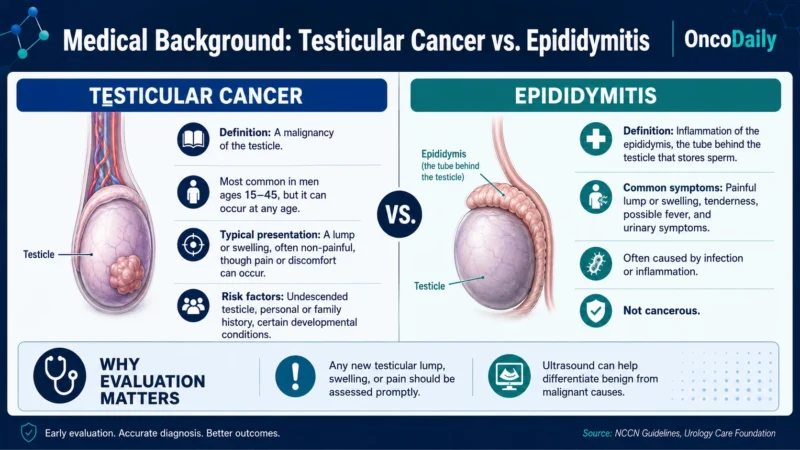
Typical symptoms of epididymitis include scrotal pain, swelling, tenderness, pain during urination, fever, and discomfort that may feel like a painful lump. WHO notes that chlamydia is often asymptomatic, but when symptoms occur in men they may include burning during urination, penile discharge, and testicular pain. This overlap is one reason why clinical evaluation is important.
Because testicular pain and swelling can also occur in urgent conditions such as testicular torsion, or in malignancy, patients should not self-diagnose. A physical examination, urine testing, STI testing when appropriate, and scrotal ultrasound can help distinguish epididymitis from testicular cancer and other emergencies. In Johnson’s case, the ultrasound confirmed epididymitis rather than cancer, allowing him to move from diagnostic uncertainty to reassurance.
Why This Case Matters
His story carries a clear public health message: pay attention to changes in your body and seek medical care promptly. Testicular self-awareness does not mean panic. It means knowing what feels normal and acting when something changes. A new lump, swelling, pain, heaviness, or change in testicular size should not be ignored. Even when the cause is benign, as it was for Johnson, a medical evaluation is the safest way to know.
His case also highlights that painful lumps are not automatically “less concerning.” While testicular cancer is often painless, pain does not exclude cancer. Likewise, a painful lump may turn out to be inflammatory, infectious, or another benign condition. The key is not to guess, but to be examined. At 54, Johnson is older than the typical age range for testicular cancer, but his doctor still treated cancer as something that needed to be ruled out. That is an important point. Age can guide risk, but it should not replace proper diagnosis.
The Role of Ultrasound
The ultrasound was the turning point in Johnson’s story. Within a short period, imaging helped clarify the nature of the lump and confirmed that it was not cancer. For patients, this is a reassuring reminder that not every testicular lump is malignant. But it is also a reminder that reassurance should come from proper evaluation, not from waiting and hoping the problem goes away.
A fast medical visit, physical examination, and ultrasound can rapidly separate many benign causes from conditions that require urgent treatment.
Beyond The Rock: Dwayne Johnson’s Message on Body Awareness
Johnson’s experience matters because public figures can make difficult health conversations easier to start. Testicular symptoms are often under-discussed because of embarrassment, fear, or the assumption that pain will pass. His decision to speak about the scare publicly may encourage others to take similar symptoms seriously.
The lesson is simple and clinically important: do not ignore a new testicular lump or pain. Do not wait because it feels uncomfortable to talk about. Do not assume that being healthy, active, or strong makes serious disease impossible.
For Dwayne Johnson, the final diagnosis was epididymitis, and he is now fine. But for 24 hours, cancer remained a real possibility. That uncertainty is exactly why early evaluation matters.
You Can Also Read Francesco Acerbi and Testicular Cancer: The Defender’s Fight and Triumphant Return to Football by OncoDaily
Written by Aharon Tsaturyan, MD, Editor at OncoDaily Intelligence Unit
FAQ
Did Dwayne Johnson have testicular cancer?
No. Dwayne Johnson said the lump was later confirmed by ultrasound to be epididymitis, not cancer.
What happened “The Rock” ?
He found a painful lump in one testicle, was told cancer could not be ruled out immediately, and waited about 24 hours before ultrasound confirmed it was not cancer.
What is epididymitis?
Epididymitis is inflammation of the epididymis, the coiled tube at the back of the testicle that stores and carries sperm.
Can epididymitis feel like a lump?
Yes. Epididymitis can cause swelling, tenderness, pain, or a lump-like feeling in the scrotum.
Can epididymitis be mistaken for testicular cancer?
Symptoms can overlap because both may involve swelling, discomfort, or a testicular/scrotal lump. That is why medical examination and ultrasound are important.
Is a painful testicular lump always cancer?
No. Painful testicular lumps can be caused by epididymitis, infection, hydrocele, torsion, trauma, or other conditions, but cancer still needs to be ruled out by a clinician.
What are the symptoms of testicular cancer?
A common first sign of testicular cancer is a new lump, swelling, or change in the size or shape of one testicle. The lump is often painless, but some people may feel discomfort, heaviness in the scrotum, a dull ache in the lower abdomen or groin, or pain in the testicle. Any new testicular change should be checked by a doctor, because early evaluation can help distinguish cancer from other causes such as epididymitis, infection, cysts, or injury.
What are the symptoms of epididymitis?
Symptoms of epididymitis may include one-sided testicular pain and tenderness, swelling of the scrotum, warmth or redness in the affected area, and a painful lump-like feeling behind or around the testicle. Some people may also experience pain or burning during urination, frequent or urgent urination, pelvic or lower abdominal discomfort, penile discharge, or fever. Because these symptoms can overlap with other conditions, including testicular torsion or testicular cancer, new testicular pain or swelling should be evaluated by a doctor.
When should men see a doctor for testicular pain or swelling?
Medical evaluation is needed for any new testicular lump, swelling, or pain, especially if symptoms come on quickly.