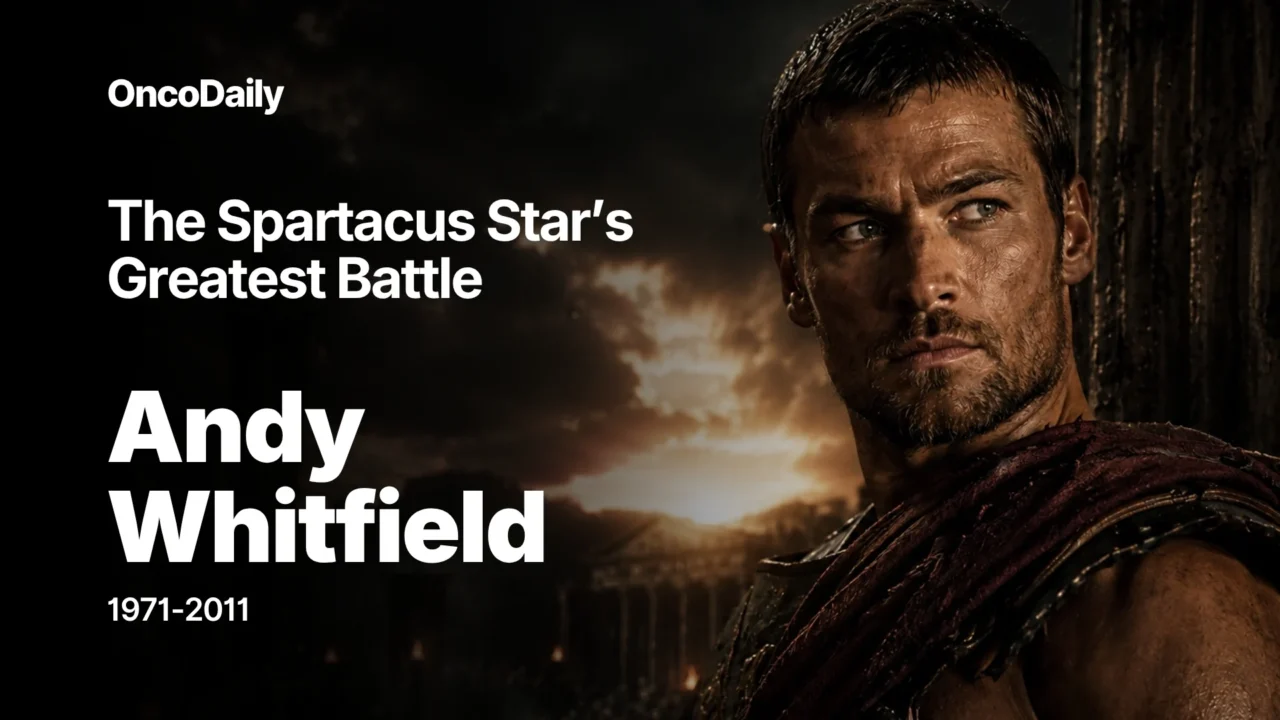
Andy Whitfield became known to millions as the face of Spartacus: Blood and Sand, the Starz series that turned him into an international television star almost overnight. Strong, intense, and charismatic on screen, Whitfield appeared to be standing at the beginning of a major Hollywood career.
Then, in March 2010, his life changed dramatically. At the age of 38, shortly after completing the first season of Spartacus, Whitfield was diagnosed with stage IV non-Hodgkin lymphoma. What began as a sudden interruption to a rising career became an 18-month cancer battle that would ultimately take his life on September 11, 2011, in Sydney, Australia. He was 39.
His story was later documented in Be Here Now: The Andy Whitfield Story, a film that followed Whitfield, his wife Vashti, and their family through treatment, relapse, hope, fear, and the effort to remain present during the most difficult period of their lives.
From Wales to Spartacus
Andy Whitfield was born in Wales and later moved to Australia, where he initially worked outside the entertainment industry before entering acting. Before Spartacus, he appeared in several Australian television productions and films, gradually building a screen career.
His breakthrough came when he was cast as Spartacus in Spartacus: Blood and Sand, which premiered in 2010. The role demanded physical strength, emotional intensity, and a commanding screen presence. Whitfield delivered all three. For many viewers, he became inseparable from the character: a warrior defined by endurance, loss, and resistance. The success of the show placed Whitfield on a fast track to international recognition. But just as that career-defining opportunity was beginning, a diagnosis interrupted everything.
A Diagnosis That Changed Everything
In March 2010, Whitfield was diagnosed with stage IV non-Hodgkin lymphoma and began treatment in New Zealand. The diagnosis delayed production of the second season of Spartacus, as the team waited for his treatment and expected recovery. The early response to therapy appeared hopeful. Whitfield was reported to be cancer-free in June 2010, and there was optimism that he could return to the role. During this period, Starz developed Spartacus: Gods of the Arena, a prequel series created while Whitfield was recovering.
For fans, colleagues, and producers, the expectation was that the interruption would be temporary.
Remission, Then Relapse
The optimism did not last. In September 2010, a routine medical check revealed that the lymphoma had returned. The relapse changed the course of Whitfield’s treatment, career, and future.
Following the recurrence, Whitfield stepped away from Spartacus to focus fully on his health. Starz later recast the role, with Australian actor Liam McIntyre taking over as Spartacus in the following seasons. The decision was not only a production change; it was a visible sign that Whitfield’s illness had become more serious than initially hoped. His treatment continued through an intensive and difficult period. The documentary Be Here Now later captured the emotional and physical burden of this journey, showing not only the medical process but also the impact on family life, identity, and hope.
The Final Months
Andy Whitfield died on September 11, 2011, in Sydney, 18 months after his initial diagnosis. He was 39 years old. He was survived by his wife, Vashti, and their two children, Jesse and Indigo. Vashti Whitfield described him as a “beautiful young warrior,” a phrase that reflected both the public image many fans associated with him and the private strength he showed during illness.
His death deeply affected the Spartacus cast, crew, and viewers. The series continued, but Whitfield’s presence remained central to its legacy. For many fans, his performance in the first season became even more powerful in retrospect, shaped by the knowledge of what he was facing off screen.
Be Here Now: The Andy Whitfield Story
Be Here Now: The Andy Whitfield Story became one of the most important parts of Whitfield’s legacy. The documentary followed Andy and Vashti through his cancer journey, presenting the experience not as a distant celebrity story but as a deeply human portrait of illness, family, love, and uncertainty.
The film premiered at the Los Angeles Film Festival in 2015 and was later released more widely, including on Netflix in some regions. It gave audiences a closer look at what cancer treatment can mean beyond hospital rooms and clinical language: the waiting, the decisions, the exhaustion, the fragile hope, and the effort to stay present. For oncology-focused readers, the documentary remains meaningful because it shows the human side of aggressive lymphoma. It reminds us that behind every diagnosis is a person trying to preserve identity, relationships, and dignity.
Medical Context: What Is Non-Hodgkin Lymphoma?
Non-Hodgkin lymphoma is not a single disease, but a heterogeneous group of lymphoid malignancies that arise from B cells, T cells, or natural killer cells. The clinical course can vary widely, from indolent lymphomas that may progress slowly over years to aggressive lymphomas that require urgent treatment. In the United States, non-Hodgkin lymphoma accounts for about 4% of all cancers. The American Cancer Society estimates that in 2026, about 79,320 people will be diagnosed with non-Hodgkin lymphoma, including 43,770 males and 35,550 females. About 19,970 deaths are expected from the disease in 2026.
Survival depends strongly on lymphoma subtype, stage, age, performance status, biologic risk, and response to therapy. Across all non-Hodgkin lymphoma subtypes, the overall 5-year relative survival rate is approximately 74%, but this number can vary substantially by disease type and stage. Stage IV disease means the lymphoma has spread widely, often involving multiple lymph node regions, bone marrow, liver, lung, or other extranodal organs. In lymphoma, stage IV does not always carry the same meaning as stage IV solid tumors, because some advanced lymphomas remain treatable and, in selected cases, potentially curable depending on subtype and treatment response.
Diffuse large B-cell lymphoma, the most common aggressive non-Hodgkin lymphoma subtype, illustrates how stage influences outcomes. SEER data show that about 40% of DLBCL cases are diagnosed at stage IV, with a 5-year relative survival of 56.3% for stage IV disease. Earlier-stage outcomes are higher, with 5-year relative survival of 79.9% for stage I, 76.0% for stage II, and 67.5% for stage III DLBCL. Treatment is guided by histologic subtype, immunophenotype, stage, symptoms, tumor burden, and patient fitness. In NCCN-style clinical practice, accurate classification of lymphoma subtype is central before choosing therapy, because treatment differs substantially between diffuse large B-cell lymphoma, follicular lymphoma, mantle cell lymphoma, Burkitt lymphoma, peripheral T-cell lymphoma, and other entities.
For many aggressive B-cell lymphomas, first-line treatment has historically included rituximab-based chemoimmunotherapy, such as R-CHOP, depending on the exact subtype and risk profile. In relapsed or refractory disease, treatment may involve salvage chemotherapy, autologous stem cell transplant in eligible patients, antibody-drug conjugates, bispecific antibodies, CAR T-cell therapy, targeted agents, radiotherapy, or clinical trial participation.
Because Whitfield’s publicly available reports describe stage IV non-Hodgkin lymphoma but do not consistently specify the exact subtype, it is important not to overstate the expected prognosis or treatment pathway. His case should be understood as an aggressive clinical course marked by initial remission, relapse, intensive treatment, and death 18 months after diagnosis.
Why Relapse Matters in Lymphoma
Relapse after initial remission is one of the most difficult turning points in lymphoma care. It means the disease has returned after treatment, often requiring a new and more intensive strategy.
For patients and families, relapse can be emotionally devastating because it changes the meaning of earlier progress. A period of remission may bring hope, return to normal life, and future planning. When cancer returns, the clinical discussion often shifts toward second-line treatment, transplant eligibility, clinical trials, or newer therapies, depending on the lymphoma subtype and patient condition. In Whitfield’s case, relapse in 2010 shifted his story from expected recovery to a more uncertain and difficult course. It also changed the future of Spartacus, forcing a recast and reshaping the series around the absence of its original lead.
A Legacy Beyond the Screen
Andy Whitfield’s legacy is not limited to his performance as Spartacus. His story continues to resonate because it brings together art, illness, family, and public awareness. He became a reminder that cancer can interrupt life at its most promising moments, even in someone young, strong, and seemingly unstoppable. His journey also contributed to broader cancer awareness. Starz and the Spartacus community publicly honored him, and his story helped draw attention to lymphoma and the importance of supporting patients through treatment and relapse. For many fans, Whitfield remains the original Spartacus not only because of the role he played, but because of the courage associated with his final years.
Remembering Andy Whitfield
Andy Whitfield’s cancer battle lasted 18 months, but his impact has lasted far longer. His story remains a powerful reminder that behind every diagnosis is a life in motion: a career, a family, a future, and a person trying to hold on to hope. His performance gave audiences a warrior on screen. His real life showed another kind of strength one shaped by vulnerability, love, and the determination to be present. Andy Whitfield’s legacy continues through Spartacus, through Be Here Now, and through the people who still remember him not only as an actor, but as a husband, father, and fighter.
You Can Also Read A Man From the Roman Empire Diagnosed With Metastatic Cancer 1,700 Years After His Death by OncoDaily
Written by Aharon Tsaturyan, MD, Editor at OncoDaily Intelligence Unit
FAQ
What type of cancer did Andy Whitfield have?
Andy Whitfield was diagnosed with stage IV non-Hodgkin lymphoma in March 2010. Non-Hodgkin lymphoma is a group of blood cancers that begin in lymphocytes, a type of white blood cell involved in the immune system.
How old was Andy Whitfield when he was diagnosed with cancer?
Andy Whitfield was 38 years old when he was diagnosed with stage IV non-Hodgkin lymphoma in 2010.
When did Andy Whitfield die?
Andy Whitfield died on September 11, 2011, in Sydney, Australia, 18 months after his diagnosis. He was 39 years old.
Was Andy Whitfield cancer-free before his relapse?
Yes. After initial chemotherapy, Whitfield was reported to be in remission in 2010. However, the lymphoma later returned, and he stepped away from Spartacus to continue treatment.
Why did Andy Whitfield leave Spartacus?
Andy Whitfield left Spartacus after his non-Hodgkin lymphoma relapsed in September 2010. He chose to focus on treatment and recovery, and the role was later recast with Liam McIntyre.
Who replaced Andy Whitfield in Spartacus?
Australian actor Liam McIntyre replaced Andy Whitfield as Spartacus after Whitfield’s cancer relapse prevented him from returning to the series.
What is non-Hodgkin lymphoma?
Non-Hodgkin lymphoma is a cancer of the lymphatic system. It can develop from B cells, T cells, or natural killer cells and may behave slowly or aggressively depending on the subtype.
What does stage IV non-Hodgkin lymphoma mean?
Stage IV non-Hodgkin lymphoma means the disease has spread widely, often involving multiple lymph node regions or organs outside the lymphatic system. In lymphoma, stage IV can still be treatable, but prognosis depends on the subtype, response to therapy, and overall health.
Is non-Hodgkin lymphoma curable?
Some types of non-Hodgkin lymphoma are potentially curable, especially certain aggressive B-cell lymphomas when they respond well to treatment. Other types may be managed as chronic diseases. Outcomes depend strongly on the exact lymphoma subtype and whether the disease relapses.
What is Be Here Now: The Andy Whitfield Story?
Be Here Now: The Andy Whitfield Story is a documentary about Andy Whitfield’s cancer journey, his treatment, family life, and effort to remain present while facing non-Hodgkin lymphoma.