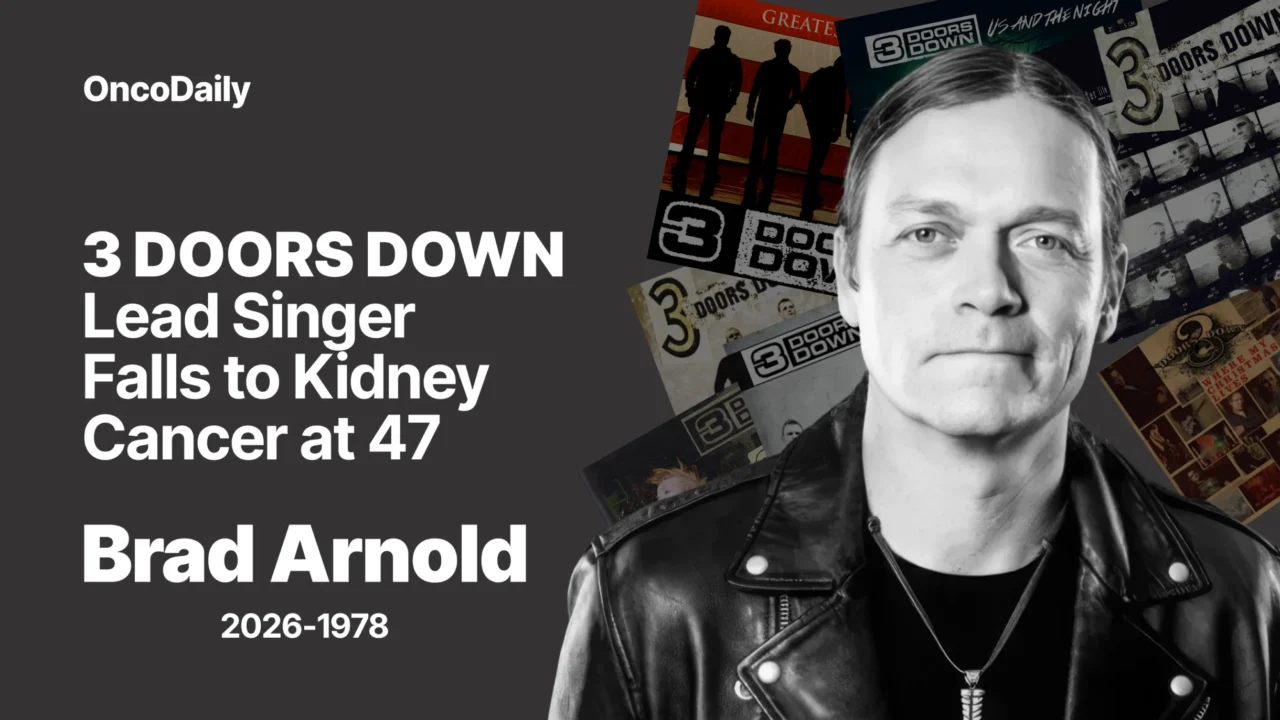
Brad Arnold, lead singer of 3 Doors Down, captivated millions with hits like “Kryptonite” and symbolized rock resilience. On May 6, 2025, he shared a shocking Instagram video from his hospital bed, announcing his stage 4 clear cell renal cell carcinoma diagnosis.
His illness began early 2025 with fatigue and pain, leading to hospitalization in late April. Tests revealed kidney tumors metastasized to his lungs, prompting tour cancellation days later. Undeterred, Arnold stated, “I have no fear… We serve an almighty God,” inspiring fans worldwide. He passed away peacefully on February 7, 2026, at age 47 after a nine-month battle.
Brad Arnold and the Rise of 3 Doors Down
Brad Arnold was born on September 27, 1978, in Escatawpa, Mississippi, where he grew up immersed in Southern rock influences and the raw energy of small-town life. In 1996, at age 18, he co-founded 3 Doors Down with schoolmates in nearby Moss Point, naming the band after a sign on a rundown club door. What started as weekend jams in garages exploded with their 2000 debut album The Better Life, featuring “Kryptonite” a brooding anthem about personal weakness that Arnold scribbled during math class and now boasts over 1 billion Spotify streams.
Hits like “When I’m Gone” and “Here Without You” followed, propelling 3 Doors Down to Grammy-nominated stardom with 20 million albums sold worldwide. Arnold’s songwriting often channeled inner turmoil—relationships, loss, redemption—mirroring the resilience that later defined his cancer fight. From post-grunge radio dominance to sold-out arenas, his voice became a soundtrack for struggle and survival, laying the groundwork for a real-life battle that echoed his lyrics’ defiant spirit.
Brad Arnold’s Battle with Stage IV Clear Cell Renal Cell Carcinoma
Clear cell renal cell carcinoma (ccRCC) accounts for 70-80% of all kidney cancers, originating in the kidney’s proximal convoluted tubule lining cells. It often remains asymptomatic in early stages, detected incidentally via imaging for unrelated issues, but advances stealthily—by stage 4, it has metastasized, typically to lungs (as in Brad Arnold’s case), bones, or liver. Robert J Motzer J Natl Compr Canc Netw . 2022 Jan
Common risk factors include smoking (doubles risk), obesity, hypertension, and chronic kidney disease; males are affected twice as often as females, with peak incidence around age 60-70. Arnold, 46 at diagnosis, reported no early red flags but progressive unwellness in early 2025: fatigue, lower back pain, and general malaise leading to late-April hospitalization. Scans and biopsy confirmed stage 4 ccRCC with lung metastases, a grim finding where tumors spread hematogenously from the kidney’s rich venous network.
For stage 4 metastatic ccRCC, five-year survival hovers at 10-12% overall, improved from <10% pre-2005 thanks to targeted therapies and immunotherapy; median overall survival now reaches 30-50+ months in favorable-risk cases per IMDC criteria (performance status, time from diagnosis, labs like hemoglobin/neutrophils). Prognosis challenges persist: high tumor burden, poor-risk features (e.g., ≥3 IMDC factors), and resistance to traditional chemotherapy, which shows minimal efficacy in ccRCC.
Arnold’s treatment likely followed NCCN guidelines for relapsed/stage IV ccRCC: systemic therapy as cornerstone, since surgery (nephrectomy) offers palliation but not cure in metastatic disease. Preferred first-line regimens include immunotherapy combos like nivolumab + ipilimumab (CheckMate 214 trial: 55% ORR in intermediate/poor risk) or pembrolizumab + lenvatinib/axitinib; tyrosine kinase inhibitors (TKIs) such as cabozantinib (Cabometyx) or pazopanib target VEGF pathways fueling angiogenesis. He shared optimistic updates in July 2025 (“feeling better every day”), suggesting response to such IO-TKI doublets, though ultimate progression led to his February 2026 passing. These advances underscore personalized risk stratification’s role in extending life amid ccRCC’s vascular, immune-evasive biology.
The Battle and Public Response
Brad Arnold’s cancer fight blended raw vulnerability with defiant optimism, chronicled through social media amid unwavering fan support. After his May 2025 diagnosis and tour cancellation which halted 3 Doors Down’s 25th anniversary run, a blow to the post-grunge faithful—he rallied with faith-fueled updates. In a poignant July 10 video, he shared, “I’m feeling better every day,” crediting prayer and treatment progress while urging fans to blast the band’s 2008 anthem “It’s Not My Time”—lyrics like “It’s not my time / I’m not going” mirroring his resolve.
The rock community mobilized swiftly. Creed’s Scott Stapp commented on Arnold’s post: “If anyone possesses the FAITH and STRENGTH to confront this battle, it’s YOU brother… we are lifting you up in prayer,” dedicating “Never Die” during tours. Support poured from Three Days Grace, Shinedown, Sevendust, Bret Michaels, Chris Daughtry, and Jason Aldean, turning hashtags like #PrayForBrad into global vigils. Arnold leaned on spirituality as his anchor, often quoting scripture and calling fans “prayer warriors,” transforming isolation into communal strength. A Christmas 2025 post reinforced gratitude: “I can’t tell ya how thankful I am to be here!” despite advancing disease. This openness sustained him through nine grueling months, embodying the resilience fans cherished in his music.
Legacy and Awareness Impact
Arnold’s candor amplified kidney cancer visibility, an under-discussed disease striking ~81,000 Americans yearly with 14,000 deaths, often due to late diagnosis like his ccRCC. By sharing symptoms (fatigue, pain) and imploring early checkups”Get tested if something feels off” he sparked conversations, boosting searches and donations to groups like Kidney Cancer Association.
His faith-driven advocacy mobilized “prayer warriors,” blending spirituality with science to inspire patients facing grim odds. Posthumously, after his peaceful passing on February 7, 2026, tributes flooded: 3 Doors Down hailed his “emotionally direct songwriting” as a “cultural touchstone”; Stapp mourned, “Brad is where he longed to be, fully restored, face-to-face with Jesus,” vowing enduring memories. Rockers like Daughtry and Michaels echoed the void, while fans reminisced his stage energy.
For oncology patients, Arnold’s lessons endure: Faith as coping bolsters mental resilience amid 10-12% stage 4 survival; vulnerability fosters community; and voices like his drive progress toward better therapies. His story urges vigilance, proving one battle can illuminate paths for many.
You Can Also Read George Harrison Cancer Battle: A Beatles Legend’s Struggle with Throat and Lung Cancer by OncoDaily

Written by Aharon Tsaturyan, MD, Editor at OncoDaily Intelligence Unit
FAQ
What type of cancer did Brad Arnold have?
Brad Arnold was diagnosed with stage 4 clear cell renal cell carcinoma (ccRCC), the most common kidney cancer that had metastasized to his lungs.
When did Brad Arnold announce his cancer diagnosis?
He shared the news in an Instagram video on May 6-7, 2025, from his hospital bed, explaining symptoms like fatigue and pain led to tests in late April.
Why did 3 Doors Down cancel their tour?
The band canceled their Summer of '99 tour, including dates with Creed, due to Arnold's stage 4 diagnosis and need for treatment.
Did Brad Arnold survive his cancer?
No, Arnold passed away on February 7, 2026, at age 47 after battling the disease for nine months.
What was Brad Arnold's attitude during his cancer battle?
Arnold expressed fearless faith, stating "I have no fear... We serve an almighty God," and shared positive updates like "feeling better every day" in July 2025 while calling fans "prayer warriors."