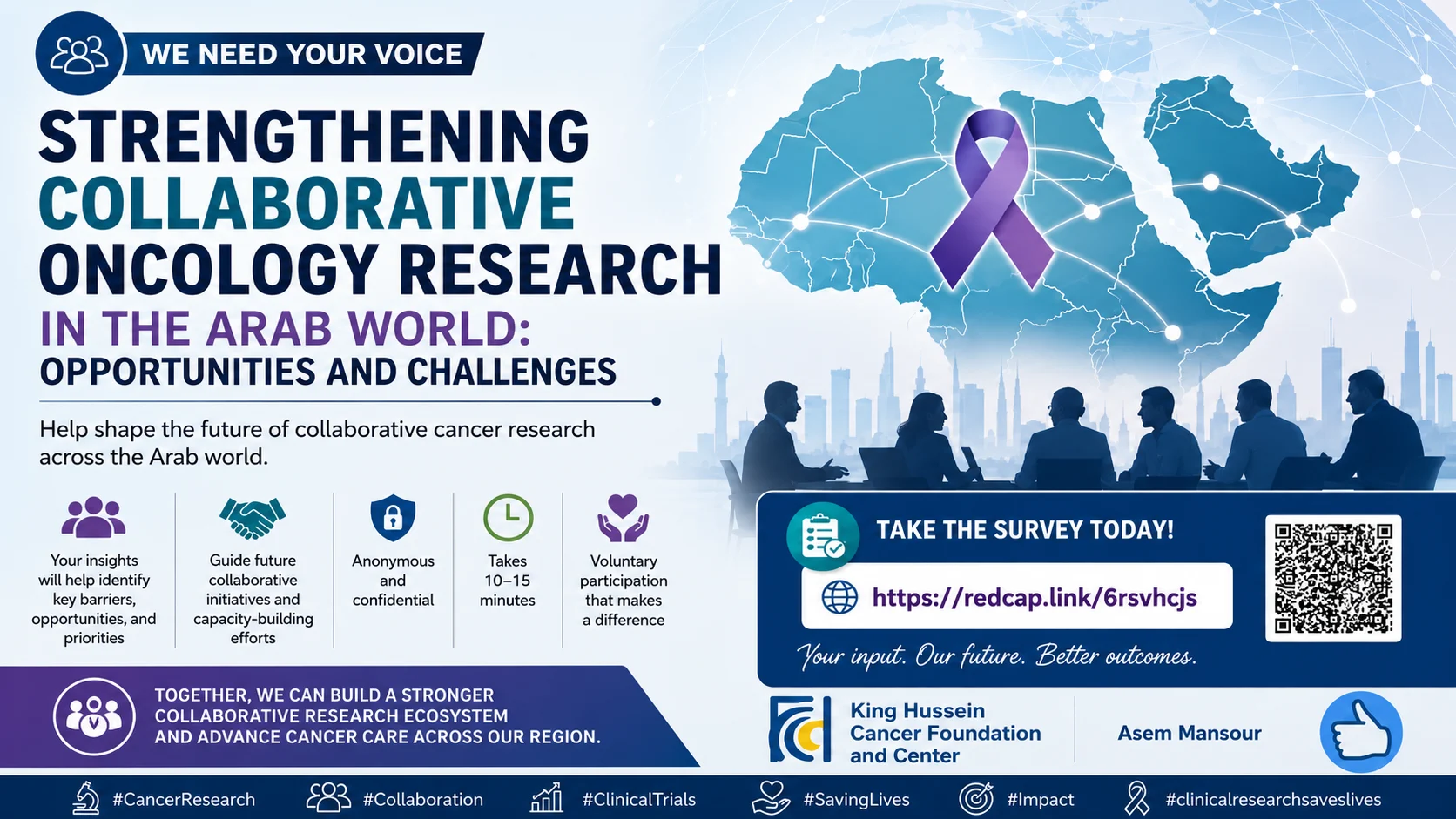
The King Hussein Cancer Foundation and Center is inviting oncology and research professionals across the Arab world to contribute to a new study examining how regional collaboration in cancer research can be strengthened.
The study, titled “Strengthening Collaborative Oncology Research in the Arab World: Opportunities and Challenges,” is led by Asem Mansour, MD, CEO and Director General of the King Hussein Cancer Center (KHCC). It aims to identify the barriers, opportunities, and priorities that could shape future collaborative oncology research initiatives and networks across the region.
Mapping the Barriers to Oncology Research
The anonymous survey seeks perspectives from professionals working in or collaborating with the Arab MENA region, including clinicians, researchers, clinical trial professionals, regulatory and ethics specialists, data managers, biostatisticians, research support staff, and health policymakers.
Participants are asked to assess their institutions’ current research capacity, including access to research infrastructure, clinical trial units, biostatistics and data-management support, research training, protected research time, and funding.
The study also examines potential barriers to cancer research, including difficulties obtaining funding, competing clinical responsibilities, gaps in trial-design training, limited data infrastructure, regulatory and ethics processes, challenges in international data and material transfer, weaknesses in cancer registries, workforce shortages, and limited institutional or governmental prioritization of research.
Building a Regional Oncology Research Network
A major component of the study focuses on the potential development of a regional oncology research network.
Participants are being asked how important regional collaboration is for advancing oncology research and how feasible such a network would be. They can also identify which functions would provide the greatest value, including multicenter clinical trials, shared research protocols, training and mentorship, regional registries, funding facilitation, and regulatory harmonization.
The survey also explores what may be preventing stronger collaboration today, including fragmented research infrastructure, insufficient sustainable funding, lack of a common regional governance model, challenges with data sharing, limited human resources, and the absence of shared research priorities.
International collaboration is another focus, with participants invited to assess the importance of equitable partnerships, harmonized research standards, sustainable funding, dedicated infrastructure, capacity building, and a shared scientific mission.
From Regional Registries to Multinational Clinical Trials
The study goes beyond identifying current challenges by asking participants to rank priorities for action and consider what could realistically be achieved over the next one to five years.
Potential initiatives include establishing common standard operating procedures for protocol development, ethics, authorship and data sharing; creating a regional investigator and institutional capability directory; identifying priority research questions; launching multicenter observational studies or prospective registries; and strengthening research infrastructure.
Longer-term measures of success proposed in the survey include conducting multinational investigator-initiated clinical trials, maintaining regional prospective registries and real-world evidence platforms, harmonizing research standards across countries, developing shared platforms such as biobanks and molecular databases, and generating evidence that could directly inform cancer care guidelines for Arab populations.
Participants are also asked whether they would support the creation of a formal Middle East oncology research consortium and whether their institutions would be interested in participating in regional multicenter studies and international collaborative clinical trials.
Who Can Participate?
The survey takes approximately 10–15 minutes, is voluntary, and is designed for professionals involved in oncology and related research fields within or in collaboration with the MENA region.
Responses are anonymous, with results planned to be reported only in aggregate. According to the study information, data will be securely stored at KHCC and accessible only to the research team. The study has received approval from the King Hussein Cancer Center Institutional Review Board, under study number 26 KHCC 261.
The findings are expected to help inform recommendations for future regional collaborative research initiatives, capacity-building programs, policy development, and the possible establishment of a regional oncology research consortium.
Proceed with the survey.
Read other news from King Hussein Cancer Foundation and Center on OncoDaily.