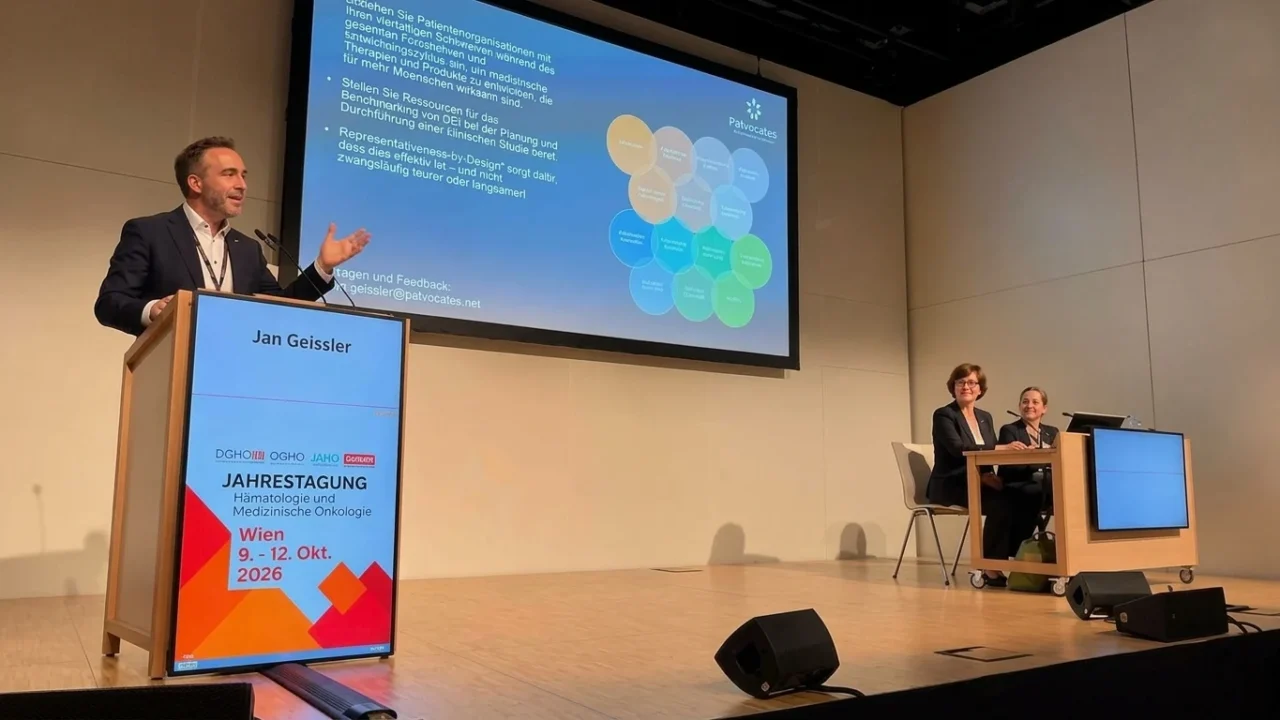
Jan Geissler, Founder and CEO of Patvocates, shared on LinkedIn:
“A clinical trial cannot be truly patient-centric if it is only designed for a privileged subset of patients.
Yesterday at the DGHO2026 congress of the German, Austrian and Swiss societies of hematology and oncology in Vienna, I had the opportunity to bring the patient perspective into a great interdisciplinary session on diversity-sensitive and inclusive clinical trials, alongside clinical, industry and regulatory perspectives.
I am very aware of the limits of my own experience. As a white, heterosexual man with a university education, living in a major European city with some of the world’s best cancer centres nearby, many of the barriers I talked about yesterday are barriers I have never personally had to overcome.
That is exactly why diverse patient involvement matters. In my patient advocacy roles, during my time with EUPATI and with the Patvocates team, we have been working on improving diversity, inclusion and representativeness in clinical research for years, building also on our patient involvement roadmap for medicines R&D, which I co-authored back in 2017.
Since then, I had the privilege to strengthen various patient communities that struggle with exactly those issues.
One lesson has become very clear: Diversity cannot be fixed at recruitment. By then, many barriers have already been designed into the trial.
Who helped set the research priorities? Who can realistically meet the eligibility criteria, travel to the study centre, take time off work, understand the information, afford the additional costs, or ‘se the required technology?
We need to move from diversity targets to ‘representativeness by design’, involving diverse communities from research priority setting and protocol design all the way through trial conduct, reporting, regulatory processes and access.
And perhaps we should stop asking ‘Why don’t these patients participate or trust research?’ and ask instead: What are we doing that makes participation difficult, limits the applicability of trial results to real-world patients, or fails to earn the trust of diverse communities?
At a time when diversity and inclusion in research have become politically contested in parts of the world, Europe has an opportunity and a responsibility to demonstrate that representative clinical research is not about political agendas, but about scientific quality and clinical relevance in real world. Medicines need to work for more patients regardless of who they are, where they come from, or where they live.
Many thanks to Anne Letsch and Eva Maria von Lilienfeld for chairing this important session, and to Birgit Grünberger, Axel Glasmacher and Harald Enzmann for contributing the clinical, industry and regulatory perspectives. Great to have all these very complementary perspectives in one session!”
You can also read:
Inside Setidegrasib’s Phase 3 Development: Targeting KRAS G12D Through Protein Degradation