Iranian Association of Cardio-Oncology Bulletin shared on LinkedIn:
“Iranian Association of Cardio-Oncology Bulletin – Issue 9
A monthly evidence update at the intersection of cardiology and oncology.
Featured Study: Wilcox et al. (JACC: Advances, 2026)
Can the timing of a biomarker response reveal what a single measurement misses?
GDF-15 is a stress-responsive cytokine linked to mitochondrial dysfunction and DNA damage – processes implicated in anthracycline cardiotoxicity. Yet a rising biomarker does not automatically become a useful clinical test.
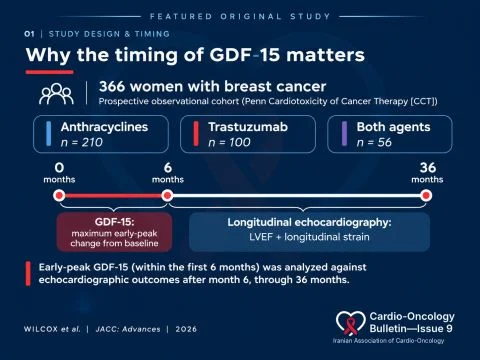
In the prospective Penn Cardiotoxicity of Cancer Therapy cohort, Wilcox et al. evaluated 366 women receiving anthracyclines, trastuzumab, or both, with serial GDF-15 sampling and echocardiographic follow-up to 36 months.
- An Early Signal, Defined Differently
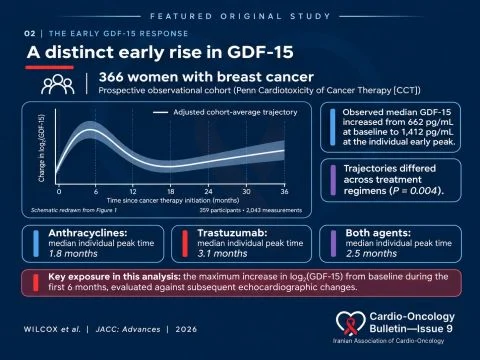
Median GDF-15 increased from 662 pg/mL before treatment to an individual early peak of 1,412 pg/mL. Trajectories differed by regimen (P = 0.004). Rather than relying on pretreatment levels alone, investigators examined the maximum log₂ change during the first six months in relation to later echocardiographic findings.
- A Systolic Association, Not a Prediction Model
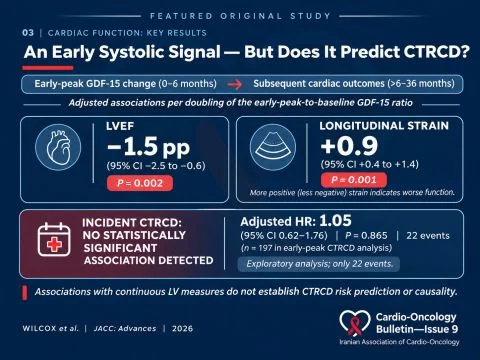
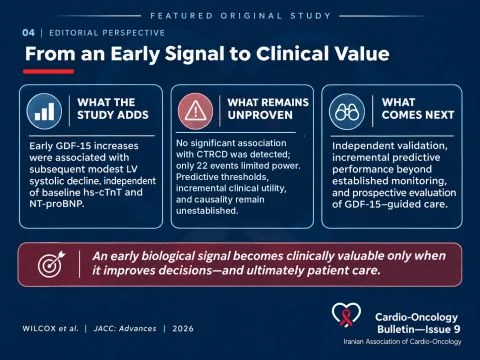
Each doubling of the early-peak-to-baseline GDF-15 ratio was associated with a 1.5-percentage-point lower subsequent LVEF (95% CI: −2.5 to −0.6; P = 0.002) and a 0.9-unit worsening in longitudinal strain (95% CI: 0.4–1.4; P = 0.001). Associations persisted after adjustment for baseline hs-cTnT and NT-proBNP – but this does not establish added predictive performance.
- The Essential Caution
Early GDF-15 change was not significantly associated with incident CTRCD (HR 1.05; 95% CI: 0.62–1.76), with only 22 events among 197 participants in this analysis. In a sensitivity analysis of 241 participants, the LVEF association was directionally similar but no longer statistically significant. No adjustment for multiple comparisons was made; the findings remain hypothesis-generating.
- Our Editorial Perspective
An earlier analysis of a subset of the same cohort found no significant GDF-15 association with LVEF change. The contribution here is therefore not the discovery of GDF-15, but a potentially more informative way of capturing when and how much it rises.
That distinction matters. A biomarker may reflect a biological response without identifying who will develop clinically defined dysfunction. And because circulating GDF-15 is not cardiac-specific, association cannot establish the signal’s cellular source or causal role.
The next step is independent replication, then testing whether GDF-15 adds predictive value beyond current biomarkers and imaging – and whether acting on it improves monitoring and patient outcomes.
A biologically informative signal deserves attention. A clinically actionable one must earn it.”
You can also read: