Talha Badar, Hematology/Oncology Specialist at Mayo Clinic, shared on X:
“A new era in Ph+ ALL?
Weekend review Ph+ ALL The newly published phase III GIMEMA ALL2820 trial may be a turning point: Ponatinib + blinatumomab > imatinib + chemotherapy.
But the story is more nuanced. How did we get here, what have we gained, and what concerns remain?
D-ALBA: proof of concept.
D-ALBA treated 63 adults with: Dasatinib + steroids → blinatumomab + dasatinib.
No conventional systemic chemotherapy. At 53-month follow-up:
- OS 80.7%
- DFS 75.8%
- EFS 74.6%
It established that durable disease control was possible without conventional chemotherapy.
D-ALBA also changed the transplant conversation.
Blinatumomab substantially deepened molecular responses after dasatinib induction.
Patients achieving early molecular response did exceptionally well, while allo-HCT was concentrated among those with persistent MRD.
A new concept emerged: MRD/biology, rather than Ph+ status alone, could determine who needs transplant.
Why wait to introduce blinatumomab? MD Anderson colleagues Jabbour et al combined ponatinib + blinatumomab upfront.
Updated frontline cohort (n=60):
- CMR by PCR: 83%
- NGS MRD negative: 98%
- 3-year OS: 91%
- Only 2 underwent HSCT
Deep molecular responses without chemotherapy or routine CR1 transplant.
D-ALBA exposed an important vulnerability: ABL1 mutations, particularly T315I, emerged in relapsing patients. Ponatinib offers more potent BCR: ABL1 inhibition and activity against T315I.
The evolution was therefore logical: Dasatinib → blinatumomab became Ponatinib + blinatumomab upfront But we still lacked randomized evidence.
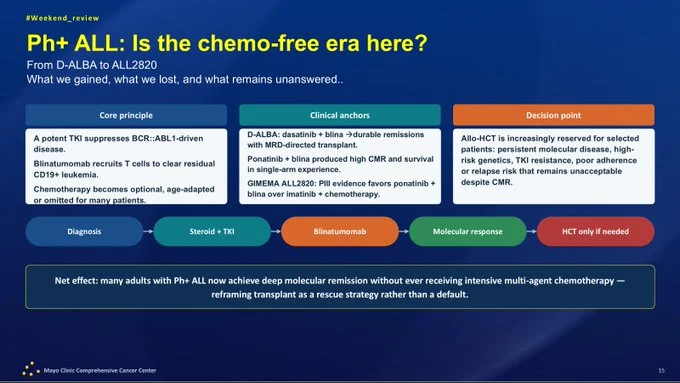
ALL2820 provides that evidence.
236 adults randomized 2:1:
- Ponatinib + blinatumomab
- Imatinib + chemotherapy
At ~24 months:
- EFS: 86% vs 67%
- CR: 94% vs 79%
- Molecular response: 71% vs 49%
- Relapse: 5% vs 13%
- OS: 90% vs 85%
For the first time, a randomized trial shows the chemo-free strategy is not just feasible, but superior for EFS.
The remarkable contraction of BMT.
Historically: TKI + chemotherapy → allo-HCT in CR1
Now:
- D-ALBA → transplant increasingly MRD-directed
- MD Anderson → only 2/60 transplanted
- ALL2820 → only 19% underwent HSCT in CR1
BMT is not disappearing.
But its role is shifting from routine consolidation → selective therapy for higher-risk disease.
Chemo-free ≠ toxicity-free.
Blinatumomab has its own limitations:
- Continuous infusion/logistical burden
- CRS
- Neurotoxicity
- Need for multiple cycles
- CD19-dependent activity/possible antigen escape
Ponatinib adds vascular toxicity. So we are not eliminating toxicity.
We are exchanging broad chemotherapy toxicity for a different, increasingly targeted toxicity profile.
Is the CNS the Achilles heel?
An intriguing pattern across chemo-free studies:
- D-ALBA: 4 CNS relapses
- SWOG S1318: 2 CNS relapses
- MD Anderson: 4 of 7 relapses were isolated CNS
As systemic disease control becomes remarkably effective, sanctuary-site failure may become more visible.
This does not prove chemo-free therapy causes CNS relapse.
But:
Chemo-free cannot mean CNS-therapy-free.
Optimizing CNS prophylaxis may be the next major challenge.
Where are we now?
ALL2820 changes the central question in Ph+ ALL.
OLD:
‘How much chemotherapy should we add to a TKI?’
NEW: ‘How do we optimize TKI + immunotherapy while minimizing chemotherapy and transplant?’
Questions remain:
- Best TKI for whom?
- How much blinatumomab?
- Optimal CNS prophylaxis?
- Which MRD assay should guide decisions?
- Who still needs allo-HCT?
But the direction is increasingly clear: Less chemotherapy. Deeper molecular monitoring. More targeted therapy + immunotherapy. More selective transplantation.
A remarkable evolution for a disease once defined by poor outcomes.”
You can also read:
Optimizing Asparaginase and Blinatumomab in Frontline Acute Lymphoblastic Leukemia – Resonance